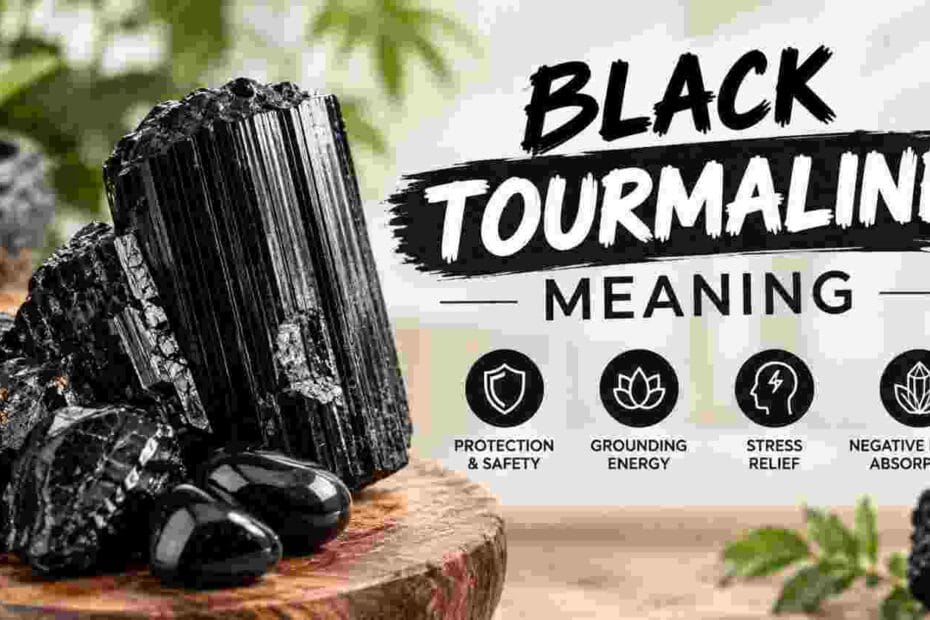
Black tourmaline is sold as a shield against bad energy, stress, and even electromagnetic fields. The problem is that spiritual claims, mineral facts, and marketing promises often get mixed together. That can leave you unsure what to believe or buy. This guide separates tradition from tested fact, explains black tourmaline meaning in plain language, and shows you how to choose, use, clean, and assess the stone responsibly.
What Is the Meaning of Black Tourmaline?
The most widely accepted black tourmaline meaning is protection. In modern crystal traditions, the dark stone represents a boundary between its owner and unwanted emotional influence. It also stands for grounding: returning attention to the body, the present moment, and practical choices.
These meanings are cultural and personal rather than measurable mineral properties. A stone can still carry sincere symbolic value without producing a medical effect. Many people use a ring, pocket stone, or desk specimen as a prompt to pause, breathe, or state a boundary.
What Is Black Tourmaline Made Of?
Most material sold as black tourmaline is schorl, the most common member of the tourmaline mineral group. Schorl is an iron-rich borosilicate. Its iron content contributes to its dark brown-to-black appearance.
“Tourmaline” names a mineral group, not one single chemical substance. Members differ in composition and color. A black crystal may also belong to another dark tourmaline species, so color alone cannot prove that a specimen is schorl. Precise species identification may require chemical analysis.
Black tourmaline profile
| Feature | Practical detail |
|---|---|
| Common trade name | Black tourmaline |
| Most likely mineral species | Schorl |
| Mineral group | Tourmaline |
| Mineral class | Borosilicate |
| Typical color | Black; sometimes very dark brown in strong light |
| Crystal system | Trigonal |
| Common form | Long prismatic crystals with vertical grooves |
| Mohs hardness | About 7 to 7.5 for tourmaline [1] |
| Luster | Commonly vitreous to resinous |
| Transparency | Usually opaque; thin edges may transmit light |
| Common settings | Granitic pegmatites and some metamorphic rocks |
| Common uses | Mineral specimens, beads, carvings, cabochons, jewelry, symbolic objects |
| Main care concern | Chipping, fractures, sudden temperature change, and high heat |
Is Black Tourmaline Meaning Spiritual, Cultural, or Scientific?
It is mainly symbolic and spiritual. The black tourmaline meaning used in crystal practice comes from shared beliefs, contemporary wellness culture, personal experience, and repeated associations with its color and form. Science can test the mineral’s composition and physical behavior, but it cannot confirm a symbolic association such as courage or protection.
This distinction respects belief while preventing a symbolic object from being promoted as medical care.
Why Is Black Tourmaline Linked With Protection?
Its near-black color, weighty appearance, and strongly grooved crystals create a visual sense of firmness. Across many modern spiritual systems, black objects symbolize shielding, absorption, or the end of a cycle. Sellers and practitioners have reinforced that association through jewelry, meditation, and home-placement customs.
The black tourmaline meaning of protection can work as a behavioral cue. Touching a bracelet before a hard conversation may remind you to speak clearly. Placing a specimen by a journal may mark a routine for processing stress. The useful action comes from the habit and intention, not a proven protective field.
What Are Black Tourmaline’s Alleged Advantages?
Crystal practitioners often connect the stone with calm, confidence, focus, emotional protection, and relief from “negative energy.” These are claims from spiritual tradition, not established clinical benefits.
A 2025 randomized controlled study compared rose quartz with a visually matched placebo during a 14-day protocol. Anxiety improved only among participants who already believed in crystal efficacy, with no meaningful difference between the crystal and placebo groups [3]. That study examined rose quartz rather than black tourmaline, so it does not test this mineral directly. It does, however, show why expectation must be considered when people report healing effects.
A responsible way to interpret benefits
| Common claim | Evidence-aware interpretation |
|---|---|
| “It absorbs negativity” | A spiritual belief; “negative energy” has no agreed scientific measure in this context. |
| “It makes me feel grounded” | A stone may serve as a tactile reminder for breathing, reflection, or attention. |
| “It reduces anxiety” | It is not a proven anxiety treatment. Do not replace professional care with a crystal. |
| “It protects my home” | This is a symbolic placement practice, not a tested security measure. |
| “It blocks EMF” | No good evidence shows that a loose stone protects a person from device emissions. |
Does Black Tourmaline Block EMF?
No reliable evidence shows that a piece of black tourmaline beside a phone, router, or bed reduces harmful electromagnetic-field exposure. Tourmaline can show piezoelectric and pyroelectric behavior: charge can develop under mechanical pressure or a temperature change. That real physical property does not turn an unengineered stone into an EMF shield.
Do not confuse “electrically responsive” with “radiation blocking.” Effective shielding depends on the radiation type, frequency, material, thickness, coverage, and tested design. If you want to reduce everyday radiofrequency exposure, increase distance from a device, follow its safety instructions, and use approved equipment rather than a crystal.
This science-first distinction adds essential context to black tourmaline meaning without dismissing its role as a personal symbol.
How Do You Use Black Tourmaline in Daily Life?
Use it in ways that are safe, simple, and connected to a clear action. The stone does not need an elaborate ceremony.
For a habit that lasts, connect the black tourmaline meaning to one observable behavior. “This stone reminds me to silence notifications for 20 minutes” is more useful than expecting the mineral to remove stress on its own.
Where Should You Place Black Tourmaline?
Choose a place where the stone supports the routine you want. Put it on a stable surface and keep heavy specimens away from shelf edges, pets, and small children.
| Location | Symbolic purpose | Useful paired action |
|---|---|---|
| Entryway | Leave outside pressure at the door | Take three slow breaths before entering |
| Desk | Focus and mental boundaries | Start one timed work block |
| Living room | A calmer shared space | Put phones away during conversation |
| Meditation area | Grounding and attention | Follow a short breathing practice |
| Bedside table | Release the day | Write tomorrow’s first task, then stop planning |
A bedroom crystal cannot treat insomnia or protect against device emissions. If sleep problems continue, speak with a qualified health professional and improve proven sleep factors such as timing, light, noise, caffeine use, and room comfort.
Which Chakra Is Associated With Black Tourmaline?
Modern chakra practice usually connects black tourmaline with the root chakra, often called Muladhara. This energy center is symbolically associated with safety, physical needs, belonging, and stability.
The chakra connection is part of a spiritual framework, not anatomy. Someone who values that framework might sit comfortably, hold the stone near the lap or place it on the floor, and reflect on practical questions: Do I feel safe? Which boundary needs attention? What task would make today more stable?
Within this practice, black tourmaline meaning becomes a prompt for self-inquiry rather than a promise of cure.
How Can You Tell If Black Tourmaline Is Real?
Start with observable traits, then consider professional testing for an expensive or important piece. Natural rough crystals often show lengthwise grooves, an uneven termination, a glassy-to-resinous luster, and small chips or matrix material. Tumbled pieces lose many of those clues.
A scratch test at home can damage the stone and still fail to identify it. Glass, dyed minerals, black spinel, obsidian, and other materials can confuse a visual check. The safest buying decision combines seller transparency, close inspection, and expert testing when the price justifies it.
Black Tourmaline vs. Obsidian, Onyx, and Shungite
Several black materials share similar spiritual marketing, yet they are different geological entities. Their origin, structure, hardness, and appearance vary.
| Material | What it is | Typical visual clue | Common symbolic association |
|---|---|---|---|
| Black tourmaline | Crystalline borosilicate; usually schorl | Prismatic form with lengthwise grooves | Protection and grounding |
| Obsidian | Natural volcanic glass | Smooth glassy surface; conchoidal fracture | Release and self-reflection |
| Onyx | Banded chalcedony; much retail “black onyx” is treated | Even polish, sometimes subtle banding | Discipline and strength |
| Shungite | Carbon-rich rock from Karelia | Dull to metallic black, often lightweight-looking | Purification and EMF claims |
Choose by intended use, appearance, verified identity, and care needs—not by dramatic claims. The symbolism overlaps, but the minerals and rocks are not interchangeable.
Can Black Tourmaline Be Worn Every Day?
Yes, tourmaline’s Mohs hardness of about 7 to 7.5 makes it suitable for many jewelry uses Hardness gages resistance to scratches rather than impacts. Tourmaline can still chip or fracture, especially at exposed edges.
Pendants and earrings usually face fewer knocks than rings or bracelets. Remove the jewelry before sports, heavy cleaning, gardening, bathing, swimming, and work with tools. Check prongs and drill holes often, particularly on bead bracelets.
Daily wear can deepen the personal black tourmaline meaning because repetition strengthens the reminder attached to it. The stone still needs ordinary jewelry care.
Where Does Black Tourmaline Come From?
Schorl occurs in many places and geological settings. It commonly forms in granitic pegmatites and can also occur in metamorphic rocks. Documented localities span Africa, Asia, Europe, and the Americas; Pakistan’s Gilgit-Baltistan region is among the areas recorded for schorl-bearing specimens [2].
A country name does not prove ethical sourcing, quality, or authenticity. Supply chains may pass through miners, local traders, exporters, cutters, wholesalers, and retailers. Ask a seller how far back they can trace the stone and whether workers received fair, safe treatment.
A Brief History of Black Tourmaline
Black tourmaline has no “childhood-to-current-life biography” because it is a mineral, not a person. A timeline gives the accurate equivalent: the story of its name, study, and modern use.
| Period | Development | Why it matters |
|---|---|---|
| Before modern mineral classification | Communities encountered and used dark minerals as tools, ornaments, trade goods, or symbolic objects; exact identifications are often uncertain | Modern names should not be projected onto every ancient black stone |
| Before 1400 | Forms of the name “schorl” were associated with the mining village now called Zschorlau in Saxony | The term has deep European mining roots [2] |
| 1505 | Schorl appeared in an early written mineral reference connected with mining | Written use helped fix the name in mineral history [2] |
| 1700s | European natural philosophers studied tourmaline’s ability to attract particles after heating | Pyroelectric behavior became part of its scientific story |
| 1800s–1900s | Mineral classification and chemical analysis separated tourmaline-group species more clearly | “Black tourmaline” became understandable as a trade term, often referring to schorl |
| Late 1900s | Crystal-wellness movements expanded protection, grounding, and chakra associations | Much of today’s spiritual language took its current form |
| 2000s–today | Online retail spread both mineral education and unsupported health or EMF claims | Buyers now need a clear line between symbolism, mineral science, and clinical evidence |
This history supports an accurate reading of black tourmaline meaning: an old mineral name, a real physical substance, and a changing body of cultural interpretation.
Make the Symbol Useful
The lasting value of black tourmaline meaning does not depend on exaggerated promises. Learn the mineral facts, respect spiritual use as spiritual use, buy from a transparent seller, and attach the stone to a helpful action you can control. Choose one value the stone will represent today—then take the real-world step that gives that value weight.