You’ve seen “Buon Natale” on a Christmas card, in an Italian movie, or maybe in a text from a friend traveling through Rome in December. And now you’re stuck wondering what this phrase truly means and whether you’re using it correctly.
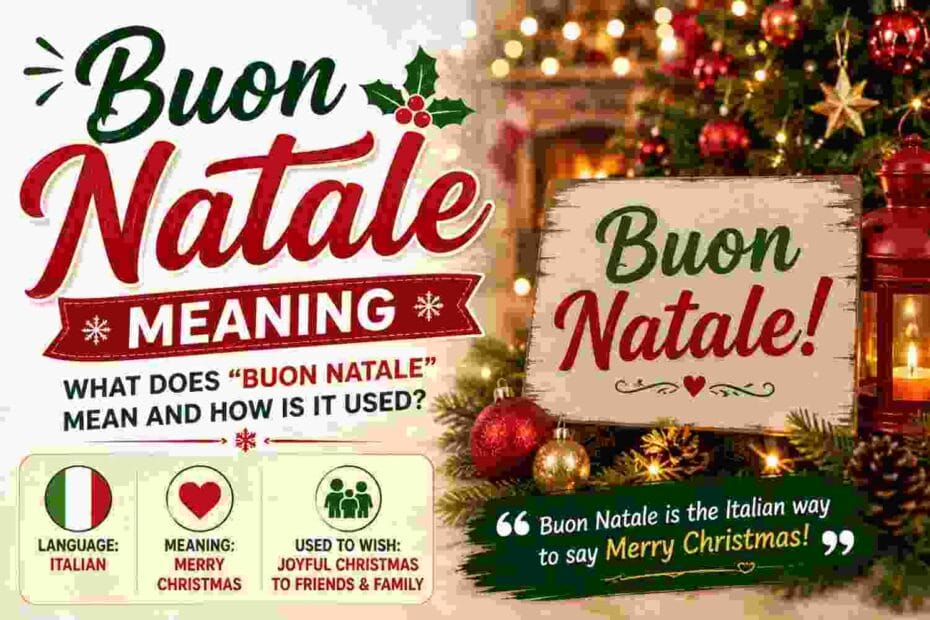
Here’s the quick answer: the Buon Natale meaning translates directly to “Merry Christmas” in Italian. But that simple definition misses the cultural depth, pronunciation tricks, and etiquette rules hiding behind these two small words.
By the time you finish this guide, you’ll understand the full Buon Natale meaning, how native Italians actually use it, and the small mistakes that make non-native speakers sound awkward during the holidays.
What Is the Buon Natale Meaning in English?
The Buon Natale meaning breaks down into two simple Italian words that carry a warm, festive weight. Once you understand the roots, the phrase becomes impossible to forget.
“Buon” translates to “good” in English, while “Natale” refers specifically to Christmas or the Nativity. Put together, the Buon Natale meaning literally becomes “Good Christmas,” though English speakers naturally translate it as “Merry Christmas.”
Breaking Down Each Word
Understanding word origins makes the Buon Natale meaning stick in your memory far better than rote memorization ever could.
- Buon — Derived from the Latin “bonus,” meaning good or well
- Natale — Comes from the Latin “natalis,” referring to birth, tied to the birth of Christ
- Combined phrase — A festive greeting wishing someone a joyful, blessed Christmas season
This Latin connection explains why similar phrases exist across Romance languages, including Spanish “Feliz Navidad” and French “Joyeux Noël.”
Why Italians Say Buon Natale Instead of Just “Ciao”
Italy takes holiday greetings seriously, and casual “ciao” simply doesn’t carry enough warmth for Christmas. The Buon Natale meaning represents genuine emotional connection, not just a formal courtesy.
Italians grow up hearing this phrase from grandparents, priests, shopkeepers, and neighbors throughout December. It becomes woven into family traditions rather than staying a throwaway greeting.
How to Pronounce Buon Natale Correctly
Getting the Buon Natale meaning right matters, but mispronouncing it in front of Italian friends can feel embarrassing. Let’s fix that immediately.
Phonetic Breakdown
Say it slowly first, then speed up as it becomes natural on your tongue.
- Buon — Pronounced “bwohn,” rhyming loosely with “own”
- Natale — Pronounced “nah-TAH-leh,” with stress on the middle syllable
- Full phrase — “Bwohn nah-TAH-leh,” said with a warm, upbeat tone
Practicing this a few times out loud helps the Buon Natale meaning feel less like a textbook phrase and more like something you’d naturally say.
Common Pronunciation Mistakes
Non-native speakers often stumble on the same few sounds every single year.
- Pronouncing “Buon” like the English word “boon” instead of “bwohn”
- Stressing the wrong syllable in “Natale,” saying “NAH-ta-leh” instead of “nah-TAH-leh”
- Rushing the phrase instead of giving it warmth and rhythm
When and How Italians Use Buon Natale
Timing matters just as much as pronunciation when using this greeting correctly. Italians follow subtle but important social rules around when this phrase appears.
The Correct Timeline
Italians typically start using this greeting from early December through January 6th, which marks Epiphany. Understanding the Buon Natale meaning includes knowing this extended holiday window.
| Time Period | Common Greeting Used |
|---|---|
| Early December | “Buone Feste” (Happy Holidays) |
| December 24–25 | “Buon Natale” |
| December 26–31 | “Buon Natale” still acceptable |
| January 1 | “Buon Anno” (Happy New Year) |
| January 6 | “Buona Epifania” (Happy Epiphany) |
Quick human analysis: This table shows something most guides skip entirely — Italians don’t just say Buon Natale on Christmas Day itself. The greeting stretches across nearly two weeks, reflecting how Italian Christmas celebrations extend far beyond a single day, unlike the more compressed American holiday timeline.
Written vs Spoken Usage
The Buon Natale meaning stays identical whether written or spoken, but tone shifts depending on context.
- Christmas cards — Often written as “Buon Natale e Felice Anno Nuovo” (Merry Christmas and Happy New Year)
- Text messages — Frequently shortened with emojis like
- Formal settings — Said slowly and clearly, sometimes paired with a handshake or cheek kiss
- Family gatherings — Said loudly, enthusiastically, often shouted across a dinner table
Regional Variations Across Italy
Italy’s regional dialects add fascinating layers to the standard Buon Natale meaning, and locals sometimes swap in dialect versions depending on where you’re visiting.
Popular Dialect Alternatives
Travelers rarely learn these, which makes using one instantly impressive to locals.
- Neapolitan — “Bon Natale” (slightly softened pronunciation)
- Sicilian — “Bon Natali,” reflecting the island’s unique vowel shifts
- Venetian — “Bon Nadal,” closer to old Venetian dialect roots
These variations don’t change the core Buon Natale meaning, but they reveal how deeply regional identity shapes even simple holiday greetings across Italy.
Common Mistakes English Speakers Make
Learning the Buon Natale meaning is easy, but applying it naturally takes a bit more cultural awareness.
Mistake #1: Using It Too Early
Saying this phrase in mid-November confuses Italians, since the proper greeting during that period is usually “Buone Feste” instead.
Error #2: Confusing Informal and Formal Tone
While the phrase itself stays the same for everyone, pairing it with overly casual slang can feel jarring in formal Italian settings like church services or business emails.
Mistake #3: Forgetting the Follow-Up Phrase
Italians often extend the greeting into a fuller sentence, and stopping short can feel abrupt.
- Full version: “Buon Natale e Felice Anno Nuovo!”
- Meaning: “Merry Christmas and Happy New Year!”
Frequently Asked Questions
What is the literal Buon Natale meaning in English?
The literal Buon Natale meaning translates to “Good Christmas,” though it’s commonly understood in English as “Merry Christmas.”
Is Buon Natale formal or informal?
It works in both formal and informal settings, making it one of the most versatile Italian holiday greetings for strangers, coworkers, and close family alike.
How do you respond when someone says Buon Natale to you?
You simply repeat it back, saying “Buon Natale a te” (Merry Christmas to you too), or “Anche a te” (same to you).
Can you say Buon Natale after December 25th?
Yes, Italians commonly continue using it through December 31st, since the Christmas season traditionally extends until Epiphany on January 6th.
Does Buon Natale have any religious meaning?
Yes, since “Natale” derives from the Latin word for birth, directly referencing the Nativity and the birth of Christ within Catholic tradition.
What’s the difference between Buon Natale and Buone Feste?
Buon Natale specifically means “Merry Christmas,” while Buone Feste is broader, translating to “Happy Holidays,” and gets used earlier in December.
Do all Italian regions say Buon Natale the same way?
Standard Italian uses this exact phrase everywhere, though some regions use dialect variations like “Bon Natali” in Sicily or “Bon Nadal” in Venice.
Final Verdict on Buon Natale
Understanding the Buon Natale meaning goes far beyond a quick translation you’d find in a phrasebook. It connects to centuries of Latin roots, regional Italian pride, and genuine warmth shared between family and friends every December.
Next time you write a card or greet an Italian friend, use this phrase with confidence, correct pronunciation, and proper timing. That small effort turns a simple two-word greeting into a moment of real cultural connection.