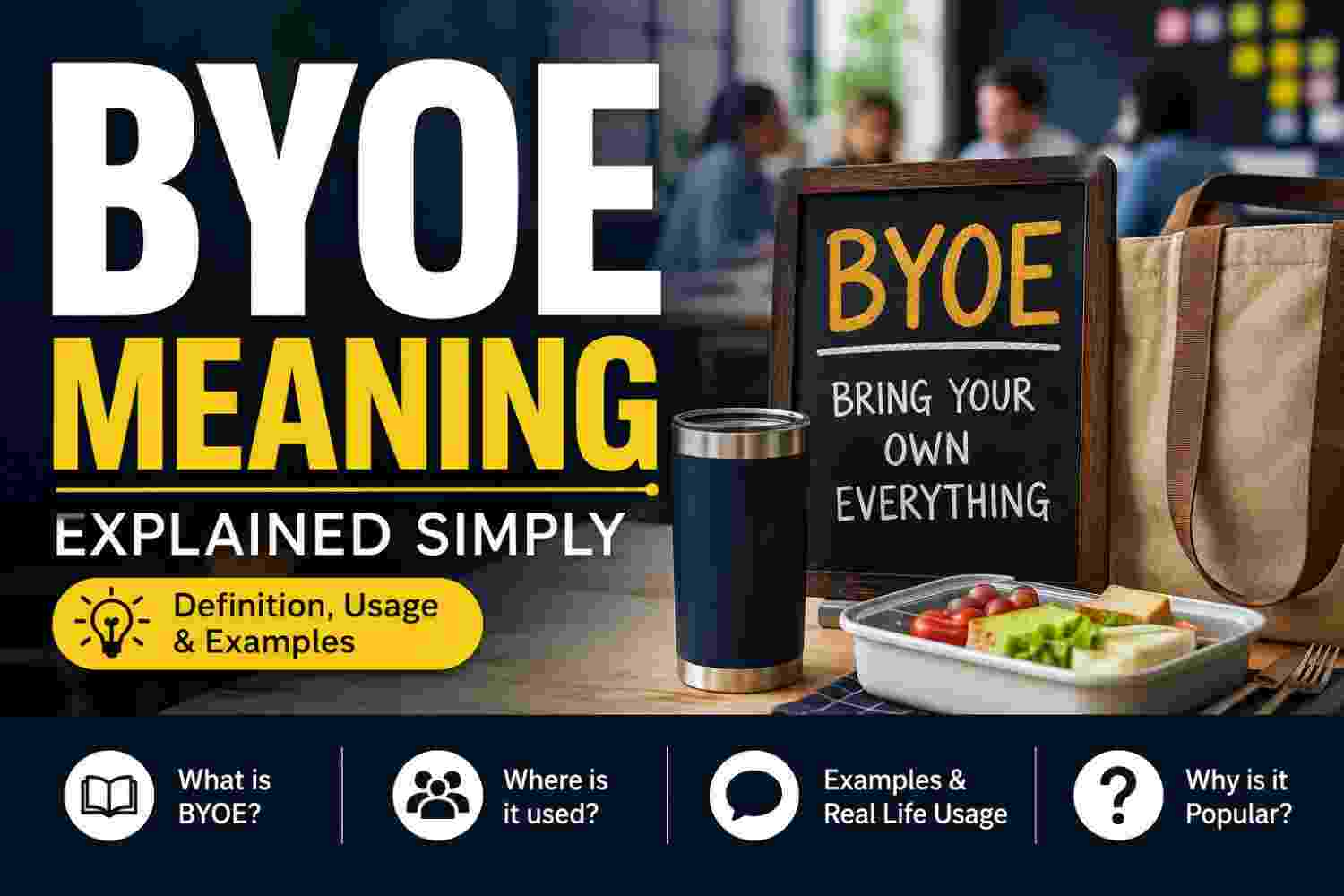
You got a text that just says “party’s BYOE tonight” and now you’re standing in your kitchen wondering if you’re supposed to bring a whole grocery run. Or maybe your IT department dropped the term in a security meeting and everyone nodded like they understood it. Either way, you’re not alone, and the real answer depends entirely on where you heard it.
BYOE is one of those acronyms that quietly split into two completely different lives. One version lives on party flyers and group chats. The other lives in cybersecurity meetings and cloud contracts. Get the wrong one and you’ll either show up to a party empty-handed or misread a serious data protection clause.
This guide breaks down both meanings in plain English, shows you exactly when each one applies, and gives you the practical moves to make so you never get caught guessing again.
What Does BYOE Actually Stand For?
BYOE most commonly means Bring Your Own Everything. It started as an evolution of the more familiar BYOB (Bring Your Own Bottle) and quietly took over group chats, party invites, and casual event flyers over the past several years.
There’s a second, entirely separate meaning too. In business and tech circles, BYOE stands for Bring Your Own Encryption, a cloud security setup that has nothing to do with parties at all.
Here’s the quick breakdown:
| Meaning | Where You’ll See It | Who Uses It |
|---|---|---|
| Bring Your Own Everything | Party invites, texts, social flyers | Friends, college students, event hosts |
| Bring Your Own Encryption | Cloud contracts, IT meetings, security docs | IT teams, businesses, cybersecurity vendors |
| Bring Your Own Enthusiasm/Energy | Sarcastic party slang variant | Gen Z and millennial hosts |
A quick glance at that table tells you almost everything you need to know before reading further. The context clues around the acronym usually settle the confusion in about two seconds flat.
BYOE Meaning at a Party: The Social Definition
Where BYOE Came From
BYOB has been around for decades, telling guests to bring their own drinks so the host doesn’t foot the whole bill. BYOE stretched that idea further, and it stuck because renting a venue, buying snacks, and covering music costs adds up fast for anyone hosting.
College students picked it up first, mostly because dorm budgets are tight and nobody wants to be the one person supplying an entire party. Group chats turned it into shorthand almost overnight, and now it shows up on flyers, Snapchat stories, and text threads everywhere.
What “Everything” Actually Means
The word “everything” is doing a lot of heavy lifting here, and it genuinely changes meaning depending on the host. Some interpretations are wildly different from each other.
- Drinks and snacks — the most literal and common reading
- Chairs or seating — common for backyard or rooftop gatherings
- Speakers or music — frequent at low-budget house parties
- Cups, plates, ice — smaller details hosts skip buying
- Your own entertainment — the sarcastic Gen Z twist, meaning the party itself might be boring
The final one is more important than most people realize. A growing number of hosts use BYOE as a joke, warning guests upfront that the vibe might be flat and they should manage their own expectations.
How to Handle a BYOE Invite Without Overthinking It
Nobody wants to show up either overloaded with snacks nobody asked for or completely empty-handed at an actual potluck-style event. A short text to the host clears this up in seconds.
- Ask directly: “Hey, what’s everyone bringing?”
- Check the group chat for hints from other guests
- Default to a drink and a snack if you get no response
- Bring a folding chair if the party is outdoors and space-limited
- Never assume the host is joking — some genuinely mean it
Texting first genuinely saves you from an awkward doorway moment. Most hosts appreciate the question rather than finding it annoying.
BYOE Meaning in Tech: Bring Your Own Encryption
The Business Side Nobody Talks About Enough
Away from parties entirely, BYOE describes a cloud security model where a company keeps control of its own encryption instead of relying fully on a cloud provider’s built-in protection. This matters a lot more than it sounds like on paper.
Cloud providers like AWS, Azure, and Google Cloud typically encrypt customer data using their own systems by default. BYOE flips that setup, letting the customer bring a separate encryption layer and manage their own keys through something called a Hardware Security Module, or HSM.
Why Companies Actually Care About This
Handing full control of encryption to a third-party cloud provider makes some businesses nervous, especially in finance, healthcare, and government sectors. Regulatory requirements in these industries often demand stricter proof of who can access sensitive data.
- Reduces dependency on a single cloud vendor’s security promises
- Gives compliance teams a cleaner audit trail
- Lets a business swap cloud providers without losing encryption control
- Adds a layer of protection if the provider itself gets breached
- Meets stricter regulatory standards in healthcare and banking
A company using BYOE essentially says, “we don’t fully trust any single vendor with our most sensitive data, so we’re keeping the keys ourselves.” That mindset has only grown stronger as data breaches keep making headlines.
BYOE vs BYOK: Are They the Same Thing?
Close, but not identical, and mixing them up in a meeting can make you look unprepared. BYOK, or Bring Your Own Key, is technically considered a subset of the broader BYOE approach.
| Term | Full Meaning | What It Controls |
|---|---|---|
| BYOE | Bring Your Own Encryption | The entire encryption software and process |
| BYOK | Bring Your Own Key | Just the encryption keys, not the full software |
BYOE gives a company control over the whole encryption pipeline, while BYOK narrows that control down to just the keys themselves. Most enterprise conversations use these terms almost interchangeably, even though a security specialist would tell you they’re not perfectly identical.
Other Places You Might Spot BYOE
The acronym has quietly spread into a few other corners too, and it helps to recognize them so you’re never caught off guard.
- Education tech — some universities use “bring your own everything” to describe students carrying laptops, tablets, and phones onto campus networks simultaneously
- Workplace culture — HR teams occasionally borrow the phrase for casual office potlucks or team events
- Gaming communities — LAN party organizers sometimes use it for hardware, snacks, and seating combined
- Fitness classes — some studios use BYOE for mats, towels, and water bottles
Universities specifically started tracking this trend years ago because students bringing multiple personal devices onto campus WiFi created real infrastructure strain. It’s a less common usage, but it does show up in IT reports occasionally.
Quick Reference: Decoding BYOE in Any Context
Reading the room, or the group chat, is honestly the fastest way to nail this down every single time.
- If it’s a text from a friend about a party — it’s Bring Your Own Everything
- If it’s in a business or IT document — it’s Bring Your Own Encryption
- If a friend says it sarcastically with an eye-roll emoji — it might mean bring your own entertainment
- If it’s from a university IT department — it likely means personal devices on campus
Frequently Asked Questions
What does BYOE mean in a text message?
In a casual text or group chat, BYOE almost always means Bring Your Own Everything. It signals that the host isn’t supplying food, drinks, or supplies, so guests need to show up prepared with their own items.
Is BYOE the same as BYOB?
Not exactly. BYOB only asks guests to bring their own drinks, while BYOE expands that request to cover snacks, seating, music, and sometimes even entertainment. BYOE is essentially a broader, more demanding version of the older BYOB tradition.
What does BYOE mean in cybersecurity?
BYOE stands for Bring Your Own Encryption, a setup where a business manages its own encryption software and keys instead of relying entirely on a cloud provider’s built-in security. It gives companies more direct control over how their sensitive data stays protected.
Why do people use BYOE sarcastically?
Some hosts use it as a joke to lower expectations, hinting the party itself might not be very exciting. In that context, BYOE quietly means “bring your own entertainment” because the host isn’t promising much of a good time.
Should I bring food to a BYOE party?
Bringing a snack or drink is a safe default unless the host specifies otherwise. It’s always worth sending a quick text to confirm, since some hosts genuinely expect guests to cover everything from cups to music.
Is BYOE the same as BYOK in business settings?
They’re closely related but not identical. BYOE covers the entire encryption process, while BYOK specifically refers to just the encryption keys. Most companies use the terms loosely, though technically BYOK sits inside the larger BYOE category.
Where did the term BYOE originally come from?
It grew out of BYOB culture, mostly among college students and casual event hosts looking to split hosting costs more evenly. Over time it expanded from just drinks to covering nearly everything a guest might need at a gathering.
The Bottom Line on BYOE
Context is really the only decoder ring you need here. A party invite and a cybersecurity contract will never use this acronym to mean the same thing, so read the room before you respond either way.
If a friend texts you about a BYOE party, grab a drink and a snack, and maybe a folding chair if it’s outdoors. If your company’s IT team mentions BYOE, they’re talking about who controls the encryption keys protecting your organization’s data, and that conversation deserves your full attention.