Struggling to understand why some chemical reactions finish in a flash while others drag on for ages? Without a clear grasp of catalyst meaning, you miss the hidden accelerators driving nature, industry, and even personal growth. This guide delivers that clarity. You will learn exactly what a catalyst is, how it works, and where it shows up in your daily world.
What Does Catalyst Meaning Truly Entail?
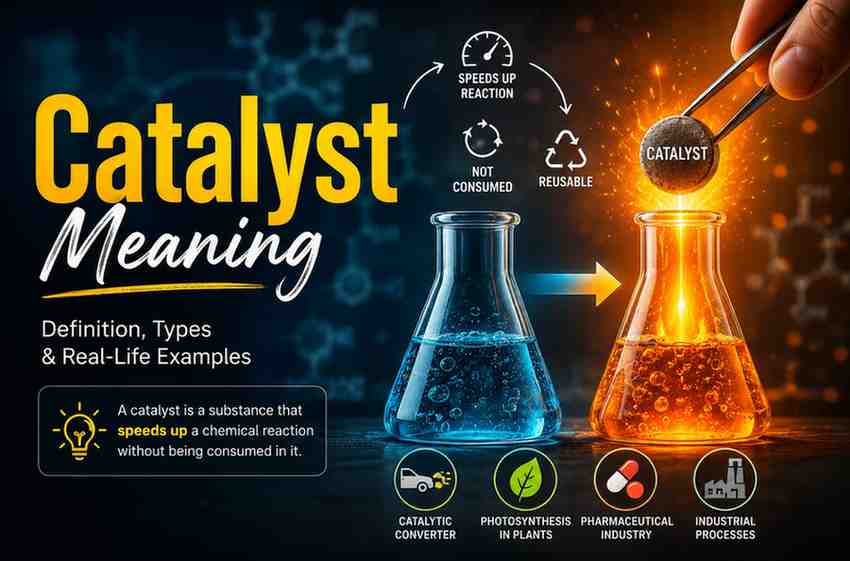
The core catalyst meaning points to a substance that increases the rate of a chemical reaction without undergoing any permanent change itself. Imagine a matchmaker who brings two people together, helps them connect faster, and then steps away unchanged. That is what a catalyst is all about.It participates in the process, lowers the energy barrier, and emerges intact at the end. The true catalyst meaning rests on this elegant ability to accelerate change while remaining unaltered.
The Science Behind Catalysis
Catalysis describes the action a catalyst performs. During a reaction, reactant molecules must collide with enough energy to rearrange their atoms. A catalyst offers an alternative pathway that requires less energy. This alternative route turns sluggish transformations into rapid events. The catalyst meaning becomes tangible when you see how a tiny amount of catalyst can convert massive quantities of starting material into product without being consumed.
How a Catalyst Lowers Activation Energy
Every chemical reaction faces an energy hill called activation energy. Reactants must climb this hill before they can roll down into products. A catalyst carves a tunnel through the hill, reducing the height the reactants must overcome. Lowering the activation energy means more molecules possess the necessary energy at a given temperature. So the reaction speeds up dramatically. Understanding this mechanism unlocks the full catalyst meaning for students and professionals alike.
Types of Catalysts: Homogeneous vs. Heterogeneous
Based on their phase in relation to the reactants, catalysts can be divided into two main groups.
- Homogeneous catalysts exist in the same phase as the reactants, often dissolved in a liquid. They mix uniformly and offer excellent contact with the reactants.
- Heterogeneous catalysts occupy a different phase, typically solid catalysts in contact with liquid or gas reactants. They provide easy separation and reusability.
The catalyst meaning does not change across these types; the difference lies in how the catalyst interacts with the reaction mixture.
| Catalyst Type | Phase Match with Reactants | Example | Key Benefit |
| Homogeneous | Same phase (liquid) | Sulfuric acid in esterification | Uniform mixing, high selectivity |
| Heterogeneous | Different phase (solid-gas) | Iron in ammonia synthesis (Haber process) | Easy recovery, long catalyst life |
Enzymes: Nature’s Biological Catalysts
Nature’s finest expression of catalyst meaning appears in enzymes. These protein molecules drive virtually every biochemical reaction inside living organisms. Enzymes bind specific substrates at their active sites, stabilize the transition state, and release products rapidly. Without enzymes, digestion, energy production, and DNA replication would grind to a halt. Their remarkable specificity and efficiency show how catalyst meaning extends far beyond test tubes and industrial reactors.
Catalyst Meaning in Everyday Chemical Reactions
You encounter catalysts more often than you realize. Hydrogen peroxide sits quietly in your medicine cabinet, but add a tiny speck of manganese dioxide, and it decomposes into water and oxygen almost instantly. That decomposition illustrates the core catalyst meaning in a visible, bubbling demonstration. Baking powder contains acids that catalyze the release of carbon dioxide, fluffing up your pancakes. Even the rusting of iron accelerates in the presence of salts, which act as catalysts for corrosion.
Industrial Catalysts That Power the World
Modern society leans heavily on catalysts. The Haber-Bosch process uses an iron catalyst to synthesize ammonia from nitrogen and hydrogen, sustaining global fertilizer production. Petroleum refining relies on zeolite catalysts to crack large hydrocarbon molecules into gasoline and valuable chemicals. Polymer manufacturing uses metallocene catalysts to produce plastics with precise properties. Each of these massive operations depends on a deep understanding of catalyst meaning to optimize yield, save energy, and reduce waste.
The Role of Catalysts in Environmental Protection
Catalysts defend the environment in multiple ways. Catalytic converters in automobiles contain platinum, palladium, and rhodium. These metals transform toxic carbon monoxide, unburned hydrocarbons, and nitrogen oxides into harmless carbon dioxide, water, and nitrogen. Power plants use selective catalytic reduction to cut nitrogen oxide emissions. The catalyst meaning here translates into cleaner air and a healthier planet, proving that chemical knowledge carries powerful societal benefits.
Catalyst as a Metaphor: Sparking Change in Life and Business
Beyond the lab, catalyst meaning stretches into everyday language. A catalyst in business might be a visionary leader who ignites innovation without micromanaging every step. In personal development, a mentor acts as a catalyst by providing guidance that accelerates your growth while remaining steadfast themselves.
This metaphorical use captures the same principle: an agent that speeds transformation and remains unchanged after the change takes hold.
Key Characteristics of Effective Catalysts
An effective catalyst displays several telltale traits:
- It remains chemically unchanged at the end of the reaction.
- A small quantity influences a large amount of reactant.
- It does not alter the equilibrium position; it only shortens the time to reach equilibrium.
- It can be highly selective, steering a reaction toward a specific product.
These characteristics bring the catalyst meaning into sharp focus, distinguishing true catalysts from mere reactants.
Historical Milestones in Catalyst Discovery
Early observations of catalysis date to the 19th century. Jöns Jakob Berzelius coined the term “catalysis” in 1835 to describe reactions that sped up in the presence of certain substances. The discovery of sulfuric acid as a catalyst for esterification and the later development of the Haber-Bosch process marked pivotal moments. Each milestone deepened the scientific understanding of catalyst meaning and sparked industrial revolutions that shaped the modern world.
How to Identify a Catalyst in a Reaction
Laboratory identification follows a straightforward logic. Monitor the reaction rate with and without the suspected catalyst. If the rate increases significantly and the substance can be recovered unchanged after the reaction, you have identified a catalyst.
Spectroscopic techniques like infrared or X-ray photoelectron spectroscopy can confirm that the catalyst’s structure remains intact. This practical detective work reinforces the catalyst meaning by linking experimental evidence with the theoretical definition.
Common Misconceptions About Catalyst Meaning
Several myths cloud the catalyst meaning:
- “Catalysts make impossible reactions possible.” False. Catalysts only speed up reactions that are already thermodynamically allowed.
- “Catalysts get used up over time.” Not if they are true catalysts. Deactivation can happen due to poisoning or fouling, but the ideal catalyst endures unchanged.
- “Catalysts lower the energy of products.” They do not. Catalysts lower the activation energy, not the overall energy of products or reactants.
Clearing these misconceptions makes the true catalyst meaning stand out.
Future of Catalysis: Green Chemistry Innovations
Research pushes toward catalysts that work under mild conditions, use abundant metals, and produce zero hazardous waste. Photocatalysts harness sunlight to split water into hydrogen fuel. Biocatalysts engineered through directed evolution create pharmaceuticals with exquisite precision.
Electrocatalysts drive carbon dioxide conversion into useful chemicals. The evolving catalyst meaning now embraces sustainability and circular economy principles, promising breakthroughs that blend chemistry with ecological responsibility.
Frequently Asked Questions
Can a catalyst be consumed in a reaction?
No, by definition a true catalyst remains chemically unchanged. If a substance gets used up, it acts as a reactant, not a catalyst. The fundamental catalyst meaning requires that the catalyst emerges from the reaction cycle intact.
What is the difference between a catalyst and an inhibitor?
A catalyst speeds up a reaction; an inhibitor slows it down. While the catalyst meaning centers on lowering activation energy, an inhibitor either increases the activation barrier or blocks active sites. Both influence rate without being consumed.
Why are enzymes called biological catalysts?
Enzymes perfectly embody the catalyst meaning because they dramatically accelerate biochemical reactions without being permanently altered. They show high substrate specificity and work under mild physiological conditions, making them nature’s premier catalysts.
How does a catalytic converter work?
A catalytic converter uses a solid heterogeneous catalyst coated with platinum-group metals. It adsorbs harmful exhaust gases, lowers the activation energy for their conversion, and releases cleaner emissions. This application of catalyst meaning slashes vehicle pollution.
Is a catalyst always a solid?
No. Catalysts can be solids, liquids, or gases. Sulfuric acid serves as a liquid homogeneous catalyst, while enzymes function as soluble biological catalysts. The catalyst meaning depends on function, not physical state.
What makes a good catalyst?
High activity, selectivity, stability, and reusability define a good catalyst. It must accelerate the desired reaction efficiently, avoid side products, and endure many reaction cycles. The catalyst meaning applied in industry values all these attributes equally.