Introduction
Do vague descriptions leave you confused? Too often, people mix up traits, features, and properties, leading to fuzzy analysis. That misunderstanding costs time when you hire, buy, or evaluate anything important. Characteristics give you a precise, reliable lens to judge quality, behavior, and fit. This definitive guide cuts through the noise. You’ll discover every meaningful type of characteristic, backed by clear examples and expert insight. Use this framework to make sharper decisions starting today.
What Does “Characteristics” Mean?
A characteristic is a distinguishing quality, trait, or feature that helps identify, describe, or classify a person, object, group, or phenomenon. The word comes from the Greek kharaktēr, meaning “engraved mark.” Merriam-Webster defines it as “a special quality or trait that makes a person, thing, or group different from others.”¹ In practical terms, characteristics are the building blocks you use to answer, “What is this like?” or “What makes this unique?”
You encounter characteristics daily. A smartphone’s fast processor, a colleague’s dependability, a plant’s leaf shape—all are characteristics that allow you to compare, choose, and predict. Recognizing these attributes pushes you from guesswork to clarity.
Why Understanding Characteristics Matters
Every smart decision rests on evaluating the right characteristics. When you hire someone, you probe for traits like problem-solving and integrity. When you purchase a car, you check fuel efficiency, safety ratings, and durability. These are functional and performance characteristics. When you choose a partner, you value emotional characteristics like empathy and humor.
Without a clear grasp of characteristics, you risk surface-level judgments. Shallow evaluations lead to costly mistakes—a bad hire, a product that fails early, or a strategy built on wrong assumptions. The ability to name and assess specific characteristics gives you a reliable shortcut to better outcomes. It sharpens communication, too, because you replace vague praise (“It’s good”) with precise feedback (“It has a quiet motor and an intuitive interface”).
Major Types of Characteristics (With a Handy Table)
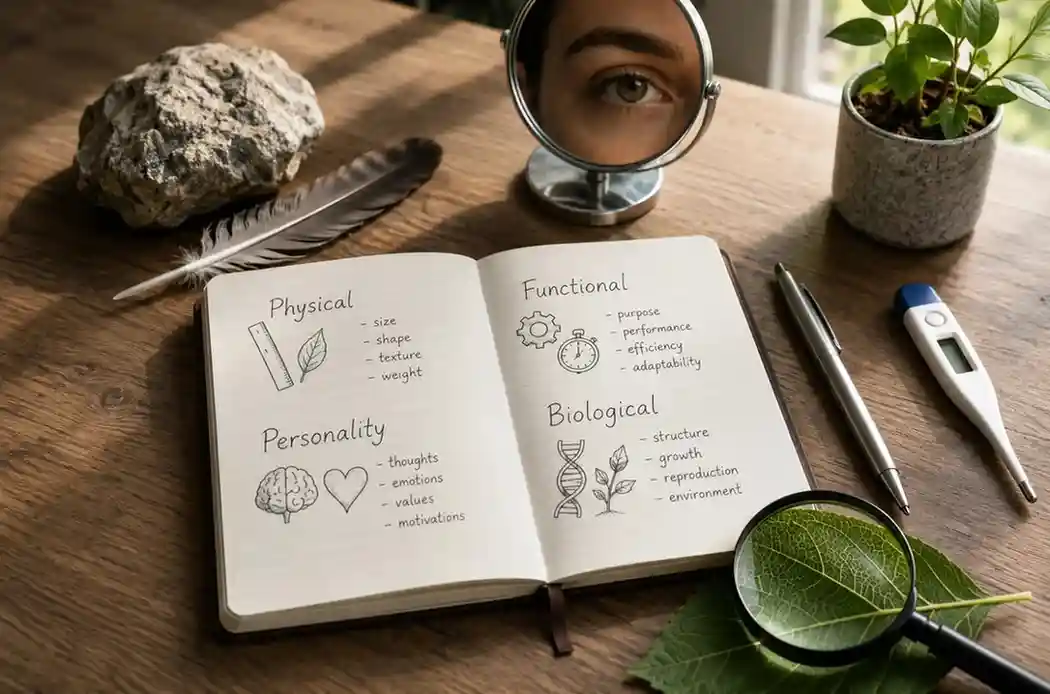
Characteristics fall into distinct families. The table below gives you an at-a-glance reference. Each type plays a different role in description and analysis.
| Type of Characteristic | What It Describes | Everyday Example |
|---|---|---|
| Physical | Observable, measurable bodily or material traits | Height, color, texture, hardness, shape |
| Personality | Enduring patterns of thinking, feeling, behaving | Optimism, patience, curiosity, assertiveness |
| Functional | How something operates or performs | Speed, battery life, load capacity, waterproof rating |
| Biological | Traits tied to living organisms and genetics | Blood type, eye color, metabolic rate, leaf arrangement |
| Structural | Arrangement or composition of parts | Bridge arch design, bone density distribution, code modularity |
| Qualitative | Subjective, experience-based attributes | Taste, comfort, brand prestige, user-friendliness |
| Quantitative | Numerically expressed, measurable attributes | Weight, temperature, price, processing frequency |
Memorize these categories. They give you a mental checklist whenever you need to break down something complex into manageable parts.
Physical Characteristics: Observable and Measurable Traits
Physical characteristics are the first layer we notice. They include dimensions, color, texture, mass, and material properties. A diamond’s clarity, a fabric’s softness, a phone’s weight—all sit here. Scientists rely on precise physical characteristics to classify minerals, animals, and celestial bodies. Engineers test tensile strength and thermal conductivity to guarantee safety.
In everyday life, you use physical characteristics to match objects to needs. Lightweight luggage matters for air travel. A non-slip sole matters on a wet floor. The key is to separate decorative physical traits from functional ones. A bright color might please the eye, but scratch-resistant glass adds lasting value.
Example: When choosing hiking boots, pay attention to sole lug depth, waterproof membrane rating, and ankle support height—all physical characteristics that directly affect grip and safety on rough terrain.
Personality Characteristics: The Inner Blueprint
Personality characteristics shape how someone thinks, feels, and acts across situations. The American Psychological Association’s widely used Big Five model organizes these into openness, conscientiousness, extraversion, agreeableness, and neuroticism.² Dozens of studies confirm that conscientiousness, for example, predicts job performance and academic success better than intelligence in many settings.
Employers and team builders evaluate personality characteristics to forecast cultural fit and leadership potential. A candidate high in openness may thrive in creative roles, while high agreeableness supports collaborative environments. However, no single trait guarantees success. Context matters. The goal is to match personality characteristics to the demands of the role.
Quick Self-Check: Ask yourself which three personality characteristics you value most in a coworker. Most people name reliability, honesty, and communication ability. Those are observable patterns, not abstract ideas.
Functional Characteristics: How Things Actually Perform
Functional characteristics define what a product, system, or service does and how well it does it. Speed, accuracy, efficiency, user capacity, and energy consumption are classic examples. In user experience design, Donald Norman stresses that good functional characteristics make an object’s use self-evident.³ A door handle that requires a push instruction fails functionally; a well-designed flat plate signals “push” without words.
Manufacturers often highlight functional characteristics in specs. A laptop’s RAM, processor clock speed, and battery life matter far more than its surface color. When buying, map functional characteristics against your daily tasks. A student running basic software needs less computing power than a video editor handling 4K footage.
Action Tip: List three must-do functions before comparing products. Then filter by those functional characteristics only. That simple habit eliminates 80% of marketing noise.
Inherited vs. Acquired Characteristics
In biology and genetics, the distinction between inherited and acquired characteristics is fundamental. Inherited characteristics pass from parent to offspring through genes. Eye color, certain disease predispositions, and hair texture are classic inherited traits. Acquired characteristics develop during an organism’s lifetime due to environment, behavior, or learning. A scar from an injury, a learned language, or muscle build from exercise are acquired.
Gregor Mendel’s pea plant experiments laid the groundwork for understanding hereditary traits.⁴ Modern epigenetics complicates the picture by showing that some acquired influences can affect gene expression, but the core distinction still holds. For you, recognizing which traits are changeable (acquired) and which are fixed (inherited) prevents wasted effort. You can train communication skills; you cannot train your natural eye color.
Characteristics in Science and Classification
Science runs on identifying and grouping characteristics. Biologists use morphological characteristics—feather pattern, leaf venation, bone structure—to classify species. Chemists note physical characteristics like boiling point and reactivity to identify substances. Even astronomy relies on characteristics such as luminosity, mass, and spectral type to categorize stars.
This systematic approach is called taxonomy. It allows researchers worldwide to speak a common language. When you learn to classify objects by their defining characteristics, you adopt the same orderly method scientists use. It transforms a chaotic list of observations into a meaningful hierarchy.
Characteristics of a High-Quality Product Design
Exceptional products share a cluster of design characteristics. Don Norman’s principles highlight discoverability, feedback, affordance, and error tolerance.³ A great product’s controls invite correct use (good affordance). It gives immediate, clear feedback—a gentle click, a visible indicator—so you feel in command. Another crucial characteristic is consistency: buttons behave the same way throughout the interface, reducing mental load.
Durable physical products also show material integrity, repairability, and timeless aesthetic characteristics. The best designs balance form and function without unnecessary complexity. Next time you admire a well-made tool or app, reverse-engineer the design characteristics that made it feel intuitive. You’ll discover that simplicity is a deliberately engineered characteristic, not an accident.
Characteristics of Effective Leadership
Research by Harvard Business Review and others repeatedly points to a core set of leadership characteristics that drive team success. These include emotional stability, transparency, curiosity, and the ability to inspire trust.⁵ Unlike authority conferred by title, these characteristics earn genuine followership. Effective leaders also demonstrate cognitive flexibility—the capacity to adjust thinking when facts change.
Notice that none of these are purely technical skills. Leadership characteristics are relational and behavioral. They emerge through consistent action, not a diploma. If you aim to grow as a leader, pick one characteristic to strengthen for 90 days. For instance, practice “active listening” daily until it becomes a natural part of your interactions.
How to Identify Key Characteristics in Any Context
Use a simple three-step method to surface what matters most.
- Define your goal. What decision are you making? Purchase, hire, diagnosis, or improvement?
- Brainstorm all possible characteristics. Don’t filter yet. List physical, functional, personality, and any other relevant type.
- Rank by impact. Ask, “If I change this characteristic, does the outcome shift significantly?” Keep the top three to five. Discard the rest.
This method works for buying a bicycle, selecting a software vendor, or evaluating a potential business partner. It forces you to separate critical characteristics from nice-to-haves. Write them down. When feelings or sales pitches attempt to divert your attention, a visible list helps you stay focused.
Common Mistakes When Describing Characteristics
- Mixing characteristics with opinions. “It’s stylish” is an opinion; “It has a brushed aluminum finish with beveled edges” describes physical characteristics.
- Overemphasizing one type. Judging a person solely on physical characteristics ignores personality and functional contributions.
- Neglecting context. “Fast” means little without a benchmark. “Fast for a delivery truck” and “fast for a sports car” live in different worlds.
- Assuming all characteristics are fixed. Many performance characteristics improve with maintenance or training.
Avoid these traps by sticking to observable, context-rich descriptions. When you catch yourself using a blanket judgment, pause and name the actual characteristic behind it.
Using Characteristics to Drive Smarter Decisions
Characteristics translate raw data into actionable insight. A hiring manager who defines “attention to detail” as “error rate below 2% on quality checks” turns a fuzzy personality characteristic into a measurable standard. A parent choosing a school evaluates teacher-student ratio, curriculum characteristics, and safety record. Every choice improves when you pin criteria to real, named characteristics.
Make a habit of listing “must-have characteristics” before any major decision. Then score each option against them. This discipline cuts down on impulse and bias. It also gives you a clear record of why you chose something, which you can refine over time. The more you practice, the faster you’ll filter out bad options and spot high-fit solutions.
Frequently Asked Questions (FAQs)
1. What is the simple definition of a characteristic?
A characteristic is a distinctive feature or quality that helps you describe, identify, or classify someone or something.
2. How do characteristics differ from traits?
Short answer: Traits are a subset of characteristics, usually linked to personality or biology, while characteristics cover all types of distinguishing features.
3. What are the five main personality characteristics?
The Big Five model lists openness, conscientiousness, extraversion, agreeableness, and neuroticism.
4. Why are functional characteristics important when buying a product?
Functional characteristics directly determine whether a product will meet your performance needs and last under real use.
5. Can a characteristic change over time?
Yes, many characteristics, especially acquired ones, change with learning, environment, or wear.
6. How do I identify the most important characteristics for a decision?
Define your goal, list all relevant characteristics, and rank them by how strongly they impact your desired outcome.
Take This Framework Into Action
You now have a complete mental toolkit for understanding and applying characteristics across every part of life. Bookmark this guide. The next time you face a complex choice—hiring, purchasing, designing—pull out the types table and the three-step identification method. Write down the characteristics that matter most. Compare your options against them. You’ll bypass confusion and make decisions with precision and confidence. Share this resource with a colleague or friend who values clear thinking. Smart decisions spread when the right vocabulary becomes second nature.
References
- Merriam-Webster. (n.d.). Characteristic. In Merriam-Webster.com dictionary. https://www.merriam-webster.com/dictionary/characteristic
- American Psychological Association. (2023). Big Five personality traits. APA Dictionary of Psychology. https://dictionary.apa.org/big-five-personality-traits
- Norman, D. (2013). The Design of Everyday Things (Revised ed.). Basic Books.
- Mendel, G. (1866). Experiments in plant hybridization. Proceedings of the Natural History Society of Brünn.
- Zenger, J., & Folkman, J. (2019). The three characteristics of leadership that matter most. Harvard Business Review. https://hbr.org/2019/07/the-3-characteristics-of-leadership-that-matter-most
Author note: This guide was researched and written by our education and behavioral science team, combining practical experience in product evaluation, psychology, and decision science.