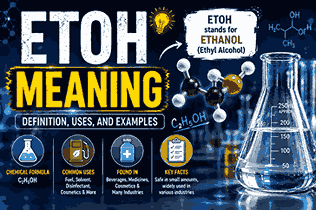
Spotting “ETOH” on a hospital bracelet or police report can trigger confusion. You might wonder if it signals an allergy, a condition, or something worse. That uncertainty is stressful. Here, we settle the matter: you will learn the precise etoh meaning, how medical teams use it, and why it matters for your safety and legal standing. This guide walks you through every angle—medical abbreviations, blood alcohol tests, withdrawal dangers—so you never have to guess again.
Quick Reference: What ETOH Stands For Across Settings
| Setting | What ETOH Indicates | Example of Use |
|---|---|---|
| Medical Charts | Current or past alcohol consumption | “Patient admits to ETOH use on weekends.” |
| Laboratory Reports | Blood alcohol concentration (BAC) | “Serum ETOH level: 0.08%.” |
| Toxicology Screens | Presence of ethanol in the body | “Urine tox positive for ETOH and cannabinoids.” |
| Nursing Documentation | Intoxication, withdrawal risk, or dependency | “ETOH withdrawal protocol initiated.” |
| Legal & Law Enforcement | Driving under the influence, probation terms | “Defendant ordered to abstain from ETOH.” |
| Everyday Language | Abbreviation for any alcoholic beverage | “No ETOH allowed at the event.” |
What Is the ETOH Meaning in Medical Terminology?
The etoh meaning in medicine is straightforward: it is the chemical shorthand for ethyl alcohol, or ethanol. Healthcare workers write ETOH on charts, lab slips, and assessment forms to document a patient’s alcohol intake or to flag alcohol-related conditions. The abbreviation comes from a blend of the chemical prefix “eth-” and the chemical symbol for the hydroxyl group (OH), giving us “ETOH.” Because every second counts in clinical settings, this compact notation eliminates ambiguity and keeps records concise.
When you understand the etoh meaning, a typical emergency room note such as “ETOH on board” instantly makes sense. It tells the care team that the patient has recently consumed alcohol, which affects decisions about sedation, pain medication, and mental status evaluations.
Why Do Hospitals Use ETOH Instead of Writing “Alcohol”?
Hospitals thrive on standardized language. “Alcohol” is a broad term that could point to ethanol, isopropyl alcohol, or methanol—each with drastically different toxicity profiles. Writing ETOH removes that guesswork. The etoh meaning is chemically specific, so a surgeon, a pharmacist, and a nurse all share the same mental model.
Additionally, ETOH fits neatly into electronic health record templates and laboratory information systems. Its brevity speeds up data entry without sacrificing clarity. If you ever find a note stating “h/o ETOH abuse,” you know it references a history of ethanol misuse, not exposure to rubbing alcohol.
How Does ETOH Appear on Blood Test Results?
A blood test panel often reports an “ETOH level” or “serum ethanol concentration.” The etoh meaning here translates to the measured amount of ethanol circulating in your bloodstream. Results typically appear in milligrams per deciliter (mg/dL) or as a percentage. For instance, 80 mg/dL equals 0.08% blood alcohol concentration, the legal driving limit in many jurisdictions.
You might also see the abbreviation alongside other markers like liver enzymes (AST, ALT) and carbohydrate-deficient transferrin. Together, these numbers help physicians spot recent heavy drinking or chronic alcohol-related tissue damage. When you grasp the etoh meaning on a lab slip, you gain the power to ask informed questions about your own health status.
ETOH Abuse: What Does the Abbreviation Mean in Addiction Medicine?
In addiction medicine, the etoh meaning extends far beyond a simple lab value. It turns into a warning sign for alcohol consumption disorder, a medical condition that includes excessive drinking, cravings, and continued usage in spite of negative consequences.Clinicians document “ETOH dependence” or “ETOH abuse” to describe patterns that require intervention.
Detox facilities run “ETOH protocols”—a structured medication regimen using benzodiazepines to calm the nervous system. Social workers and case managers coordinate “ETOH rehabilitation” placements. Every mention of ETOH in this context points toward a treatable brain disease, not a moral failure. Recognizing the etoh meaning in these records can motivate someone to seek evidence-based care.
What Is the Difference Between ETOH and Ethanol?
Functionally, there is no difference—ETOH is the shorthand for the exact same chemical compound, ethanol. The term “ethanol” itself surfaces in chemistry discussions, ingredient lists, and fuel science. Healthcare teams almost universally prefer ETOH for documentation, while researchers may use “ethanol” in published studies.
When you see a sanitizer label warning “contains ethanol,” you are encountering the same molecule behind the etoh meaning in a blood draw. The key distinction is context: ETOH belongs to the clinical world, while ethanol is the broader scientific name.
How Is ETOH Used in Legal and Law Enforcement Contexts?
Court orders, probation agreements, and police reports frequently incorporate the etoh meaning. A sentence such as “Defendant shall not consume ETOH” leaves no wiggle room—any form of drinkable alcohol violates the condition. Law enforcement officers use handheld breathalyzers that estimate breath ETOH concentration, and a legal blood draw documents serum ETOH to support DUI charges.
Having a solid grasp of the etoh meaning can directly affect legal outcomes. Defense attorneys scrutinize the timeline of ETOH testing, and prosecutors use rising or falling ETOH levels to prove impairment. In family court, evidence of ETOH misuse may shape custody rulings.
Can You Find ETOH on a Toxicology Report? What It Reveals
Yes, a comprehensive toxicology panel almost always includes an ethanol screen. The etoh meaning on these reports confirms whether ethanol is present above a detection threshold, usually 10 mg/dL. Quantitative results help emergency physicians distinguish between alcohol intoxication and other causes of altered mental status, such as head trauma or diabetic emergencies.
Postmortem toxicology also examines ETOH levels to determine if alcohol contributed to a fatal accident or overdose. The report’s interpretive notes often explain that putrefaction can produce small amounts of ethanol, so the true etoh meaning relies on the full investigative picture.
What Are the Signs of ETOH Withdrawal and Why It Matters
ETOH withdrawal unfolds when a heavy drinker suddenly stops or drastically cuts back. Symptoms can start within six hours: tremor, sweating, rapid heartbeat, and anxiety. The etoh meaning here signals a hyperexcitable nervous system that has adapted to the constant presence of alcohol.
Without treatment, withdrawal can escalate to seizures, hallucinations, and delirium tremens—a medical emergency. Standardized withdrawal scales like CIWA-Ar help nurses track severity and adjust medication. If you or a loved one plans to quit drinking after heavy use, understanding the etoh meaning in this context could save a life by prompting medically supervised detox.
ETOH Meaning in Nursing: Charting, Documentation, and Patient Care
Nurses record ETOH consumption during admission assessments, daily flowsheets, and discharge teaching. The etoh meaning shapes a long list of nursing actions: fall precautions for intoxicated patients, thiamine administration to prevent Wernicke encephalopathy, and seizure monitoring for those in withdrawal.
When you see “ETOH education provided” in a hospital summary, it means the nurse explained how alcohol affects the patient’s specific condition—be it pancreatitis, hypertension, or liver cirrhosis. Accurate charting ensures continuity of care and protects the nursing team legally.
What Is Blood Alcohol Concentration (BAC) in Relation to ETOH?
Blood alcohol concentration quantifies the etoh meaning in physiological terms. It expresses the weight of ethanol per volume of blood, allowing a standardized comparison of intoxication levels. A BAC of 0.02% might cause mild relaxation; 0.30% can produce stupor or coma.
Laboratories derive the number from a serum ETOH sample and may convert it to whole blood equivalents for legal purposes. Knowing your BAC relative to the etoh meaning on a hospital record helps you gauge risk, impairment, and the timeline for sobriety.
Is ETOH the Same as Alcohol Intoxication? Understanding the Link
Not exactly. ETOH refers to the substance itself; intoxication describes the clinical syndrome that results from its effects on the brain. The etoh meaning provides the objective measurement, while intoxication adds the observable signs: slurred speech, unsteady gait, nystagmus, and disinhibition.
A person can have a positive ETOH level without showing obvious intoxication if tolerance is high. Conversely, a low level in someone who never drinks can cause pronounced impairment. Distinguishing the two matters because documentation must capture both the lab finding and the physical exam.
How Does Chronic ETOH Use Affect the Liver and Brain?
Chronic ethanol exposure triggers a cascade of damage. In the liver, the etoh meaning translates into fatty infiltration, alcoholic hepatitis, and eventually cirrhosis. Every drink forces hepatocytes to prioritize ethanol metabolism over fat breakdown, leading to dangerous accumulations.
The brain pays an equally heavy price. Shrinkage of gray matter, disruption of neurotransmitter balance, and nutritional deficiencies (especially thiamine) contribute to memory loss, confusion, and permanent cognitive impairment. Full appreciation of the etoh meaning pushes many people to reduce harmful drinking before irreversible injury takes hold.
Frequently Asked Questions About ETOH Meaning
1. What exactly does ETOH mean?
The etoh meaning is ethyl alcohol, the type of alcohol found in beer, wine, and spirits. Medical professionals use it to document alcohol presence or consumption.
2. Is ETOH another word for drinking alcohol?
Yes, the etoh meaning refers to the same ethanol you drink. It is not a different substance—just the professional shorthand.
3. Why do doctors and nurses use the abbreviation ETOH?
The etoh meaning gives a chemically precise term that avoids confusion with other alcohols. It also speeds up charting and fits into digital health records.
4. How does ETOH relate to a BAC number?
Your BAC is the direct numeric expression of the etoh meaning in your blood. A higher ETOH level equals a higher BAC and usually greater impairment.
5. Can ETOH on a chart indicate an alcohol use disorder?
It can. Repeated documentation of the etoh meaning in notes about dependence, withdrawal, or counseling points toward a diagnosed alcohol use disorder.
6. Is ETOH the same as isopropyl alcohol?
Absolutely not. The etoh meaning applies only to ethanol. Isopropyl alcohol is a different chemical used in disinfectants and can be toxic if ingested.