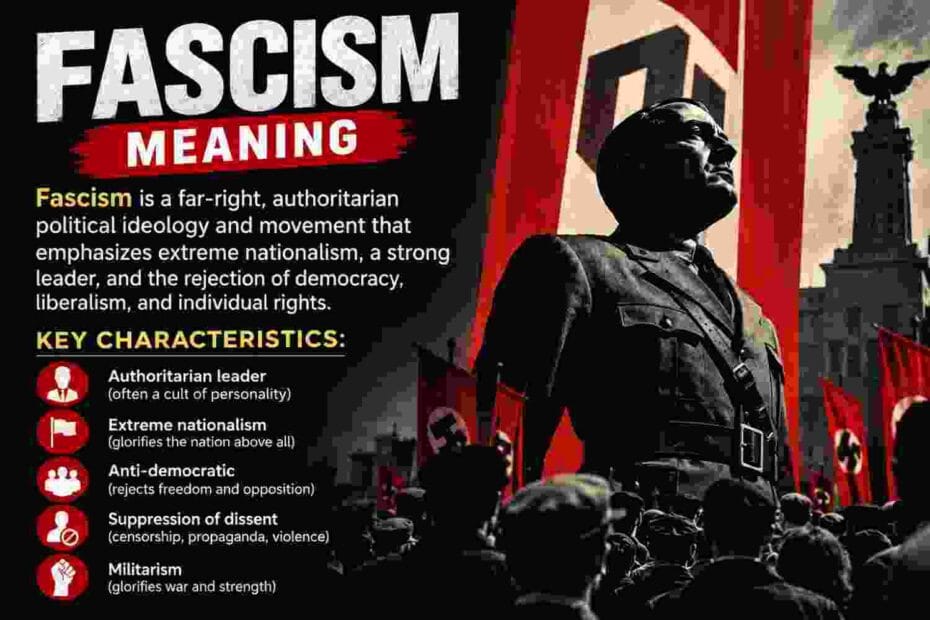
You’ve probably heard the word “fascism” thrown around in arguments, news headlines, and heated dinner table debates. But here’s the uncomfortable truth: most people using it couldn’t actually define it if you asked them directly.
This guide breaks down the real fascism meaning, its bloody origins, and the exact traits historians use to identify it. No political spin. Just facts you can actually use.
What Is Fascism? The Real Definition
Fascism is a far-right, authoritarian political ideology built on extreme nationalism and the total rejection of democracy. It emerged in early 20th-century Europe as a violent reaction against liberalism, socialism, and communism.
At its core, fascism demands total loyalty to the nation or race above the individual. Personal freedoms, elections, and dissenting opinions get crushed under the weight of a single unifying cause.
Where the Word Actually Comes From
The term traces back to the Italian word “fascio,” meaning a bundle of rods. Ancient Roman magistrates carried bundled rods called “fasces” as a symbol of unity and collective power.
Benito Mussolini adopted this imagery in 1919 when he formed his political movement in Italy. The bundle symbolized his core message: individual sticks break easily, but bundled together, they become unbreakable.
The Core Ingredients of a Fascist State
Political scientists generally agree on several defining features. These traits separate fascism from other authoritarian systems like military dictatorships or absolute monarchies.
- Extreme, almost religious nationalism
- A single all-powerful leader (the cult of personality)
- Suppression of political opposition and free press
- Glorification of violence and militarism
- Scapegoating of minority groups or “outsiders”
- Corporatist economic control blending state and business interests
- Rejection of democratic elections and checks on power
A Brief, Brutal History of Fascism
Understanding the fascism meaning requires looking at how it actually played out in the real world. Theory is one thing—the historical record is far darker.
Mussolini’s Italy: The First Fascist State
Mussolini seized power in Italy in 1922 through the “March on Rome,” pressuring the king into naming him Prime Minister. He then dismantled parliamentary democracy piece by piece over the following years.
His government controlled newspapers, banned rival parties, and used secret police to silence critics. Mussolini’s regime became the working blueprint that other fascist movements later copied.
Hitler and Nazi Germany
Adolf Hitler’s National Socialist party took fascist ideology to genocidal extremes in the 1930s and 1940s. His regime combined Mussolini’s authoritarian structure with a racial ideology that led to the Holocaust.
This is why the word “fascism” carries such heavy emotional weight today. It’s permanently linked to World War II, mass propaganda, and the murder of six million Jews along with millions of other victims.
Franco’s Spain and Beyond
Francisco Franco ruled Spain from 1939 to 1975 under a fascist-influenced dictatorship, though historians debate how purely fascist his regime actually was. Similar movements popped up across Europe, Latin America, and Asia during the same era.
Fascism vs. Other Political Systems: A Quick Comparison
People often confuse fascism with communism, socialism, or general authoritarianism. Here’s a table breaking down the real differences.
| System | Economic View | Role of the State | Individual vs. Group | Historical Example |
|---|---|---|---|---|
| Fascism | Private ownership, state-directed | All-powerful, nationalist | Nation/race above individual | Mussolini’s Italy |
| Communism | Collective/state ownership | Controls means of production | Class above individual | Soviet Union |
| Socialism | Mixed or public ownership | Regulates for equality | Balances individual & society | Nordic welfare states |
| Liberal Democracy | Market-based, mixed | Limited, elected government | Individual rights protected | Modern USA/UK |
The data shows fascism and communism are actually opposites in economic theory, even though both are authoritarian. This is a common mix-up people make when tossing the word around casually online.
Why the Word Gets Misused So Often Today
Calling something “fascist” has become a go-to insult in modern political arguments. It gets slapped onto policies, politicians, and even businesses that people simply dislike.
The Danger of Overusing the Term
Historians warn that overusing the label actually weakens its power. When every disagreeable policy gets called fascism, the word loses its ability to describe actual authoritarian threats when they appear.
- It shuts down real conversation and nuance
- It trivializes the genuine horrors of historical fascist regimes
- It makes people dismiss legitimate warnings as exaggeration
- It turns political debate into name-calling instead of analysis
How to Use the Term Responsibly
If you want to describe a political movement accurately, check it against the actual traits listed earlier in this guide. Genuine fascism involves systematic suppression of democracy, not just policies you personally oppose.
Journalists and academics typically reserve the term for movements that combine ultranationalism, authoritarian rule, and active hostility toward democratic institutions. Casual political disagreement doesn’t meet that bar.
Warning Signs Historians Watch For
Scholars like Umberto Eco and Robert Paxton have outlined checklists for spotting fascist tendencies in modern movements. These signs don’t require full dictatorship to matter.
- Constant appeals to a mythical “glorious past”
- Fear of difference and hostility toward minorities
- Obsession with a perceived national humiliation needing revenge
- Machismo culture and disdain for “weakness”
- Selective populism claiming to speak for “the people” alone
- Newspeak that simplifies language to limit critical thought
No single sign proves fascism on its own. Historians look for multiple traits appearing together, reinforced by real actions rather than just rhetoric.
Frequently Asked Questions
What is the simplest definition of fascism?
Fascism is an authoritarian political ideology that puts extreme nationalism above individual rights, crushes political opposition, and often relies on a powerful single leader.
Is fascism the same as being a dictator?
No. A dictator can rule without any specific ideology, while fascism is a distinct belief system built around nationalism, militarism, and anti-democratic control.
Was fascism only in Italy and Germany?
No. Movements with fascist characteristics appeared across Spain, Portugal, Romania, and parts of Latin America and Asia during the 20th century, though intensity varied.
Can fascism exist without a war?
Yes. Fascist movements can gain power through elections or political pressure without immediate war, though historical fascist states often pursued military expansion afterward.
What’s the difference between fascism and nationalism?
Nationalism is pride in one’s nation and can exist in healthy democratic forms. Fascism takes nationalism to an extreme, combining it with authoritarian control and suppression of opposition.
Why do people compare modern politicians to fascists?
Critics often draw comparisons when they see traits like nationalist rhetoric, attacks on the press, or hostility toward opposition groups, though scholars caution against loose comparisons without full context.
Is fascism left-wing or right-wing?
Fascism is widely classified as a far-right ideology due to its ultranationalism, opposition to communism and socialism, and support for traditional social hierarchies.
Final Verdict: Know the Word Before You Use It
The fascism meaning isn’t just a political insult—it’s a specific, documented ideology with a body count attached to its history. Understanding the real definition helps you spot genuine authoritarian threats instead of getting lost in social media noise.
Next time you see the word tossed around online, run it through the checklist in this guide. You’ll instantly know whether it’s an accurate warning or just angry rhetoric dressed up as analysis.