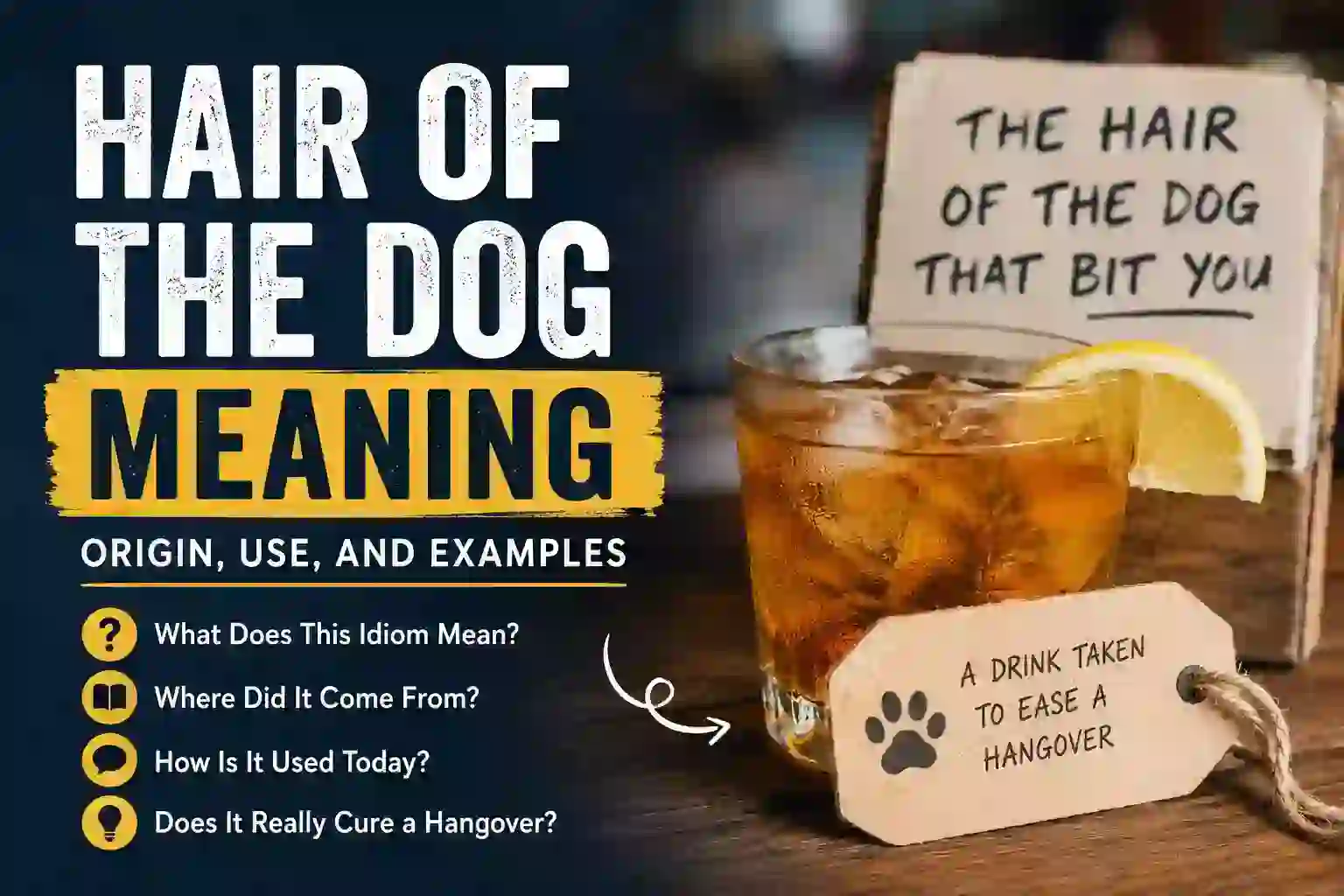
Have you heard someone ask for “the hair of the dog” after a long night and wondered whether a dog was involved? It sounds weird, and taking it literally adds to the uncertainty. The hair of the dog meaning is simple: it refers to drinking more alcohol to reduce a hangover. This guide explains the idiom, its origin, correct usage, examples, and the health facts behind it.
Quick Answer: What Does Hair of the Dog Mean?
The phrase “hair of the dog” means an alcoholic drink taken the morning after heavy drinking because the person hopes it will ease a hangover.
It is an informal English idiom and a shortened form of “the hair of the dog that bit you.” Merriam-Webster defines it as alcohol taken to feel better after drinking too much earlier.
The expression is often humorous. It may appear in casual conversations, films, books, bar culture, and social media. It should not be treated as medical advice.
Hair of the Dog Meaning at a Glance
| Detail | Clear Explanation |
|---|---|
| Basic meaning | Drinking more alcohol to try to reduce a hangover |
| Full expression | “The hair of the dog that bit you” |
| Type of phrase | Informal idiom |
| Literal meaning | Hair taken from the dog that caused a bite |
| Figurative meaning | Using a small amount of the cause as a supposed cure |
| Common setting | Casual talk after a night of drinking |
| Tone | Humorous, ironic, or informal |
| Example | “He ordered a small drink as the hair of the dog.” |
| Medical truth | More alcohol may delay or prolong symptoms rather than cure them |
| Best alternative | Time, rest, hydration, and avoiding more alcohol |
What Is the Exact Hair of the Dog Meaning?
The hair of the dog meaning refers to a morning-after alcoholic drink used as a supposed hangover remedy. The complete saying is “a hair of the dog that bit you.” In the saying, alcohol is the “dog,” and the hangover is the “bite.”
The expression follows a simple idea: use a little of what caused the problem to make the problem feel better. Collins English Dictionary describes it as an alcoholic drink taken as an antidote to a hangover, while also noting that the relief is only supposed.
People may also use the phrase more broadly. In a playful figurative sense, it can describe returning to the same activity that caused discomfort, fear, or failure.
Is Hair of the Dog a Literal or Figurative Phrase?
It is mainly a figurative phrase.
No dog hair is involved when people use the expression today. The words create a metaphor in which the original cause of pain also becomes the proposed treatment.
Here is the comparison:
- Dog: The alcohol consumed the night before
- Bite: The hangover the next morning
- Hair: Another small alcoholic drink
- Expected result: Temporary relief from the hangover
Understanding this structure makes the idiom easier to remember. The expression works because it turns an unpleasant morning into a vivid image.
Where Did the Phrase Hair of the Dog Come From?
The exact beginning of the expression is uncertain. The strongest early English evidence comes from John Heywood’s Proverbes, first printed in 1546.
It includes the line, “A haire of the dog that bit us last night,” showing that people were already using the dog-bite image for drinking-related recovery.
This does not prove that Heywood invented the phrase. Proverb collections often preserve sayings already used in speech. His wording gives us a clear, dated record of the drinking sense and the longer form of the idiom.
Why Is It Called “The Hair of the Dog That Bit You”?
The full expression compares a hangover to a dog bite. The “dog” represents alcohol because alcohol caused the pain. The “hair” represents a smaller dose of the same substance.
This explanation captures the hair of the dog meaning without requiring a long history lesson: the thing that harmed you is used as the supposed cure.
The full wording also explains why people sometimes say:
- “A little hair of the dog”
- “The hair of the dog”
- “Hair of the dog that bit me”
- “I need a morning-after drink”
All four versions point to the same basic idea.
How Is Hair of the Dog Used in Modern English?
People normally use the idiom in informal speech. It can describe an actual alcoholic drink, a joke about a hangover, or a playful attempt to recover after a party.
Common sentence patterns include:
- Have some hair of the dog.
- He ordered the hair of the dog.
- She said a Bloody Mary was her hair of the dog.
- They went back to the pub for a little hair of the dog.
The idiom keeps the same meaning in each example. Only the sentence structure changes.
Avoid the phrase in formal medical writing unless you are explaining the idiom. It may also be unsuitable in workplace, school, religious, recovery, or family settings where alcohol references could distract or offend.
Examples of Hair of the Dog in Sentences
These examples show natural use without making the phrase sound forced.
- “After the wedding, Mark joked that he needed the hair of the dog.”
- “She opted for water and breakfast instead of the dog’s hair.”
- “The bartender called the spicy cocktail a classic hair-of-the-dog drink.”
- “I know the hair of the dog meaning, but I would rather let the hangover pass.”
- “They met for brunch, and one friend ordered the hair of the dog.”
- “His idea of recovery was coffee, not the hair of the dog.”
- “The phrase sounded odd until the teacher explained its drinking-related origin.”
- “He did not use the phrase as serious health advise, but rather as a joke.”
Notice that “hair of the dog” usually takes the before it. When it modifies another noun, writers may hyphenate it, as in “a hair-of-the-dog cocktail.”
Can Hair of the Dog Have a Non-Alcohol Meaning?
Yes, but the alcohol meaning is far more common.
Writers sometimes extend the idiom to any situation where a person uses the cause of a problem as the proposed solution.
For example:
- A runner takes a short recovery jog after an exhausting race.
- A nervous speaker gives another speech soon after a poor performance.
- A traveler returns quickly to the road after a difficult trip.
- A person goes back to a game after losing badly.
In these cases, the speaker uses the hair of the dog meaning as a metaphor for facing the same source again. Context must make the figurative use clear. Without context, most readers will assume the phrase refers to alcohol.
Does Hair of the Dog Really Cure a Hangover?
No. It does not cure a hangover.
The National Institute on Alcohol Abuse and Alcoholism states that another alcoholic drink may briefly reduce certain symptoms, but it can also contribute to and prolong the hangover. The body still needs time to process alcohol, restore normal brain activity, rehydrate, and recover from irritation and inflammation.
This health fact matters because the everyday hair of the dog meaning describes a custom, not a proven treatment. A familiar phrase can sound harmless even when the action behind it carries risk.
A hangover can affect attention, decision-making, and muscle coordination. A person who feels hungover should not drive, operate machinery, or take responsibility for tasks that require sharp judgment.
Why Can Another Drink Seem to Help for a Short Time?
Another drink can make a person feel temporarily different because it raises the alcohol level again and may delay the uncomfortable stage that follows. That short change can create the impression of recovery.
However, delayed symptoms are not the same as cured symptoms. More alcohol gives the body additional alcohol to process.
The NIAAA notes that morning drinking can minimize symptoms for a short period while extending the overall discomfort.
The expression therefore contains a built-in irony. The “cure” may continue the cause.
What Causes a Hangover?
A hangover is not caused by one single process. It is possible for multiple impacts to occur simultaneously.
The NIAAA lists factors such as:
- Mild dehydration caused by increased urination
- Broken or poor-quality sleep
- Irritation of the stomach lining
- Increased inflammation
- Exposure to acetaldehyde during alcohol metabolism
- Restlessness or anxiety as the brain readjusts
Symptoms may include thirst, headache, tiredness, nausea, stomach pain, muscle aches, dizziness, sensitivity to light, and irritability. Hangovers vary by person and can last 24 hours or longer.
Knowing these causes helps separate the medical facts from the slang hair of the dog meaning.
What Should You Do Instead of Drinking More Alcohol?
Time is the main requirement for recovery. There is no proven instant cure.
Practical steps may include:
- Stop drinking alcohol.
- Rest in a safe place.
- Sip water if you can keep fluids down.
- Eat a light meal if your stomach can tolerate food.
- Avoid driving and other risky tasks.
- Ask a pharmacist or clinician before taking medicine after drinking.
Use care with pain relievers. The NIAAA warns that alcohol combined with acetaminophen can harm the liver. Aspirin and ibuprofen may also irritate the stomach.
Seek urgent medical help if a person:
- Cannot be awakened
- Has slow or irregular breathing
- Vomits while barely responsive
- Has a seizure
- Has pale, blue, or clammy skin
- Shows severe confusion
- Has a dangerously low body temperature
These signs may point to alcohol poisoning rather than an ordinary hangover. The CDC describes alcohol poisoning as a life-threatening medical emergency.
Hair of the Dog vs. Similar Expressions
Several English expressions involve solving a problem by confronting or repeating its source. They are related in idea but not identical in meaning.
| Expression | Meaning | Key Difference |
| Hair of the dog | More alcohol taken after drinking to ease a hangover | Specifically linked to alcohol |
| Fight fire with fire | Use the opponent’s method against them | Usually about conflict or strategy |
| Get back on the horse | Try again after failure or fear | Focuses on courage and persistence |
| Face your fears | Confront what frightens you | No idea of a cure from the same cause |
| A taste of your own medicine | Receive the same bad treatment you gave others | Focuses on fairness or punishment |
| Like cures like | A small form of the cause is believed to treat the problem | A broader historical or medical idea |
These comparisons sharpen the hair of the dog meaning by showing what makes it unique: the phrase combines alcohol, a hangover, and the belief that another drink may help.
Common Mistakes People Make With the Phrase
Mistake 1: Thinking It Refers to an Actual Dog
Modern speakers almost always use it as an idiom. A real animal is not part of the situation.
Mistake 2: Calling It a Proven Hangover Cure
The phrase describes a practice, not a medical solution. More alcohol may extend the problem.
Mistake 3: Using It for Any Morning Drink
Coffee, tea, juice, and water are not normally called the hair of the dog. The idiom specifically points to alcohol.
Mistake 4: Using It in Formal Settings Without Explanation
The phrase is informal. Define it when writing for learners, children, international readers, or a professional audience.
Mistake 5: Repeating the Phrase Too Often
Natural writing should vary between “the idiom,” “the expression,” “morning-after drink,” and “supposed hangover remedy.” That keeps the explanation clear without making the page repetitive.
How to Remember the Meaning Easily
Use this four-part memory rule:
- The dog = alcohol
- The bite = the hangover
- The hair = another drink
- The lesson = the same cause becomes the supposed cure
You can also remember this one-line definition:
Hair of the dog means drinking more alcohol to try to ease a hangover.
That sentence captures the hair of the dog meaning in plain English.
Frequently Asked Questions
What Is the Hair of the Dog Meaning in Simple Words?
The hair of the dog meaning is drinking a little more alcohol after a night of drinking because you hope it will reduce the hangover. It is an informal idiom, not a medical recommendation.
What Is the Full Hair of the Dog Phrase?
The full phrase is “the hair of the dog that bit you.” The dog represents the alcohol, while the bite represents the hangover it caused.
Where Did Hair of the Dog Originate?
Its exact inventor is unknown. A clear early drinking use appears in John Heywood’s 1546 Proverbes, which records a version of “the hair of the dog that bit us last night.”
Does Hair of the Dog Work for a Hangover?
It may change how a person feels for a short time, but it does not cure the hangover. More alcohol can delay or prolong symptoms, according to the NIAAA.
Is Hair of the Dog an Idiom or a Metaphor?
It is an idiom built from a metaphor. The whole expression has a recognized meaning that differs from the literal words, while the dog-bite image compares alcohol and a hangover to an animal and its bite.
How Can Dog Hair Be Used in a Sentence?
You can say, “He ordered the hair of the dog at brunch.” You can also say, “She skipped the hair of the dog and chose water.” Both sentences use the phrase naturally.
Final Takeaway
The hair of the dog meaning is easy to understand once you know the full saying. It describes drinking more alcohol after heavy drinking in the hope of easing a hangover.
The phrase has deep roots in English, appears in a drinking context as early as 1546, and remains common in casual speech.
Use the idiom when the setting and audience suit it. Treat it as colorful language, not health guidance. When a hangover arrives, the safer choice is to stop drinking, rest, avoid risky tasks, and give the body time to recover.
Sources
- John Heywood, Proverbes (1546), early wording preserved in Project Gutenberg’s edition of Bartlett’s Familiar Quotations.
- National Institute on Alcohol Abuse and Alcoholism, “Hangovers,” updated December 2025.
- Merriam-Webster, “Hair of the Dog (That Bit You).”
- Collins English Dictionary, “Hair of the Dog.”
- Centers for Disease Control and Prevention, “Signs of Alcohol Poisoning.”
Editorial Note: The language history was checked against an early printed English source. The health section was checked against guidance from the National Institute on Alcohol Abuse and Alcoholism.