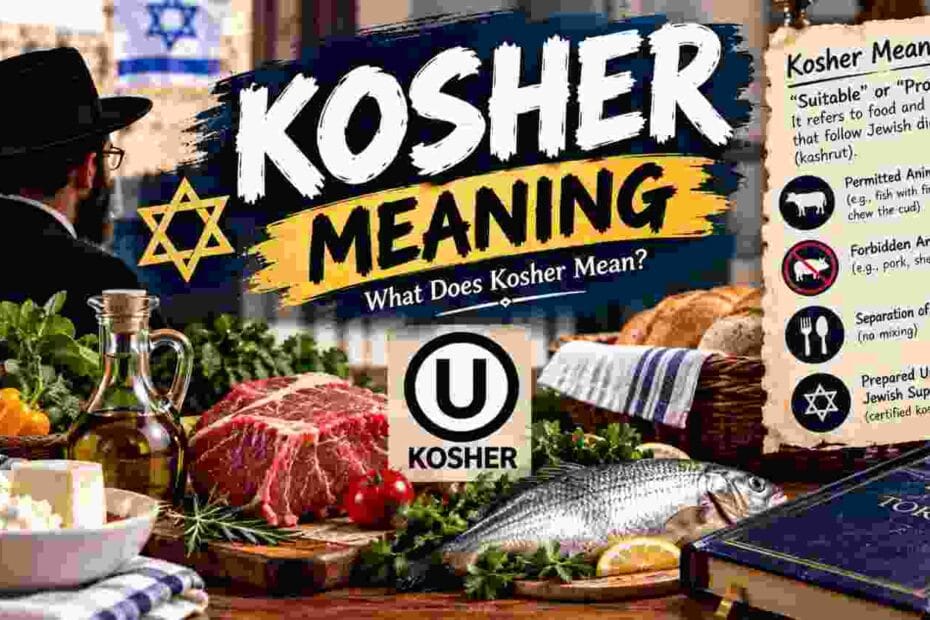
You’re standing in the chip aisle, flipping the bag over to check the label, and there it is: a tiny “U” sitting inside a circle. You’ve seen that stamp on thousands of products, but if someone put you on the spot right now, could you say what it actually promises?
Most people can’t — and that’s exactly why the kosher meaning search term goes vertical every September. Rosh Hashanah, the Jewish New Year, wrapped up at nightfall on Sunday, September 13, 2026, and Yom Kippur, the holiest day on the Jewish calendar, begins at sundown on Sunday, September 20. In the days between, feeds fill up with honey cake, brisket, and braided challah, and millions of curious cooks start hunting for answers. Consider this your crash course, symbol cheat sheet included — we’re breaking down the kosher meaning in plain English, no theology degree required.
The Kosher Conversation at a Glance
Want the kosher meaning in ten seconds before we get into the deep end? Here’s where the conversation is actually happening — and why it’s loud right now.
| Quick Info | The Snapshot |
|---|---|
| @oukosher (the Orthodox Union’s official account) plus the #kosher hashtag — symbol-spotting guides and holiday recipe waves every autumn | |
| TikTok / X | #KosherTok and #kosherrecipes on TikTok; @OUKosher on X, fielding endless “is this kosher?” questions |
| Peak moment | The High Holiday window — Rosh Hashanah (Sept 11–13, 2026) through Yom Kippur (Sept 20–21, 2026) — plus Passover every spring |
| Market value | An estimated $23 billion to $45 billion globally per year, depending on the analyst — bigger than most people assume |
| Key popularity driver | Pareve (dairy-free) labels, the kosher salt boom, and holiday content that puts the word in front of millions of non-Jewish shoppers |
The Real Kosher Meaning Starts With a 3,000-Year-Old Word
Strip away the packaging and the grocery-store noise, and the kosher meaning comes down to one plain Hebrew word: kashér, which translates as “fit,” “proper,” or “in good order.” That’s genuinely it. Kosher isn’t a brand, a cuisine, or a wellness trend. It’s a status. A food either complies with Jewish dietary law — a system called kashrut — or it doesn’t.
Here’s the first myth worth killing: kosher food is not “blessed by a rabbi.” No clergy member waves anything over your pasta sauce. A rabbi’s role in certification is closer to a quality-control auditor — checking ingredients, supply chains, and factory lines against a rulebook that’s been argued over for roughly three millennia. In other words, the kosher meaning is closer to “certified” than “consecrated.”
That rulebook starts in the Torah (the books of Leviticus 11 and Deuteronomy 14 set out the original permitted and forbidden lists). Generations of rabbis then spent centuries interpreting and extending those lists in the Talmud, until the system covered everything from which animal lands on your plate to which plate it lands on.
The word itself went so mainstream that English borrowed it about a century ago. When a character in an old gangster movie growls “that ain’t kosher,” he isn’t discussing dinner. He means the scheme isn’t legit. Same word, same core idea: does it pass inspection?
America then industrialized that inspection. The Orthodox Union, founded in 1898, began certifying national brands in the 1920s, and its tiny symbol quietly became shorthand for trust. Today, more than 40 percent of packaged foods and beverages sold in the United States carry a kosher certification — including items you’d never suspect. In the late 1990s, Oreos became kosher.Ben & Jerry’s is certified. So is Coca-Cola. The kosher meaning may be ancient, but its market penetration is thoroughly modern.
Kosher Meaning in Practice: The Rules, Step by Step
Talking about the kosher meaning in the abstract only gets you so far. Here’s how the system actually works on the ground, step by step, the way an observant household applies it.
Step 1: Check the Animal First
Land animals need two features together: completely split hooves and cud-chewing. Cattle, sheep, goats, and deer qualify. Pigs have the hooves but skip the cud, so pork is out. For water creatures, the test is fins plus visible scales, which rules out shrimp, lobster, crab, clams, and oysters. Chicken, turkey, duck, and goose make the list; eagles and other birds of prey don’t.
Step 2: Slaughter Sets the Standard (and Gave Us Kosher Salt)
A qualifying animal must still be slaughtered correctly. The method, shechita, is performed by a trained specialist called a shochet using a surgically sharp blade in one swift, continuous cut designed to be as quick as possible. Afterwards the meat is inspected, then soaked and salted to remove blood, which Jewish law explicitly forbids consuming.
Care to guess where “kosher salt” got its name? Not from a certification — from this exact salting step. The coarse salt in every celebrity chef’s kitchen is literally the koshering salt, rebranded by history into the most famous religious adjective in American cooking. (“Kosher dill” pickles, meanwhile, usually signal garlic-heavy New York deli style rather than certified cucumbers.)
Step 3: Meat and Dairy Live on Separate Planets
The Torah prohibits “boiling a kid in its mother’s milk,” and rabbinic law built an entire architecture around that one line. Observant kitchens keep separate dishes, utensils, and sometimes even separate sinks for meat (fleishig) and dairy (milchig). Many people wait between one and six hours after a meat meal before touching dairy, depending on family custom.
The third category is where things get interesting for everyone else: pareve (also spelled parve) means neutral. Fish, eggs, fruits, vegetables, and grains can sit next to either team. That’s why pareve labels matter so much to vegans, the lactose-intolerant, and anyone baking dairy-free desserts for a mixed crowd. A surprisingly big slice of the modern kosher meaning story is really the pareve story.
Step 4: Learn to Read the Fine Print
In a supermarket, the kosher meaning of any product is spelled out by its certification symbol plus a few letters beside it. Here’s your cheat sheet:
| Symbol | Agency | Home Base | What It Tells You |
|---|---|---|---|
| Ⓤ (OU) | Orthodox Union | New York | The most common mark in the US; D = dairy, P = Passover, DE = dairy equipment, “Fish” = contains fish |
| Ⓚ (OK) | OK Kosher Certification | Brooklyn, NY | Major global certifier across every food category |
| Kof-K | Kof-K Kosher Supervision | Teaneck, NJ | Large US agency with extensive international plants |
| Star-K | Star-K Kosher Certification | Baltimore, MD | Known for thorough tech-driven supervision |
| cRc | Chicago Rabbinical Council | Chicago, IL | A go-to symbol across the American Midwest |
| KLBD | London Beth Din Kashrut Division | London, UK | The symbol to look for in UK supermarkets |
A lone letter “K” deserves a shrug. A plain K isn’t a trademarked agency logo, so it tells you someone claims kosher status without telling you who verified the claim. When in doubt, look for the full agency marks.
Passover, each spring, adds a stricter layer on top of everything above: no leavened grain (chametz) at all. It’s why Coca-Cola briefly switches to a real-sugar, corn-syrup-free formula stamped OU-P — a version with a genuine cult following that resells online every year.
Step 5: Don’t Confuse Kosher With Healthy
This is the mistake even savvy shoppers make, and part of the kosher meaning boom is built on it. Certification is a compliance standard, not a nutrition label. Kosher-certified candy, soda, and deep-fried everything absolutely exist. What the symbol does reliably guarantee is what’s not in the package: no pork, no shellfish, no undisclosed meat inside an item marked dairy. For shoppers with allergies, religious requirements, or plant-based diets, that negative information is quietly gold.
Kosher vs. Halal vs. No Certification: The Quick Comparison
People ask this constantly, and the two systems rhyme more than they differ — which is exactly why so many Muslim shoppers treat a kosher symbol as a workable pork-free shortcut. But they are not interchangeable. Here’s the honest breakdown:
| The Question | Kosher | Halal | Uncertified |
|---|---|---|---|
| Pork? | Forbidden | Forbidden | Allowed |
| Shellfish? | Forbidden | Varies by school of thought | Allowed |
| Alcohol? | Generally allowed; wine has special production rules | Forbidden across the board | Allowed |
| Slaughter method | Shechita by a trained shochet, one swift cut | Dhabihah by a trained slaughterman | Conventional industrial methods |
| Blessing at slaughter? | Not required — a common myth | The name of God is invoked | N/A |
| Meat and dairy together? | Forbidden; separate dishes and waiting periods | Completely fine | Fine |
| Who’s behind the label? | Independent agencies (OU, OK, Star-K, KLBD, etc.) | Certification bodies vary by country | Nobody |
The alcohol rules alone split the two systems, so anyone with strict requirements should look for the specific certification that matches their needs.
How Chefs, Analysts, and the Comments Section Reacted
The business world caught onto the crossover appeal decades ago. Journalist Sue Fishkoff, in her book Kosher Nation, reported that more than 11 million Americans regularly buy kosher food — and that at least 86 percent of those shoppers are not religious Jews. Muslims, vegetarians, vegans, and allergen-conscious families drive the market right alongside observant Jews. Depending on which analyst you ask, the global kosher food market is worth somewhere between $23 billion and $45 billion a year, and it keeps growing.
For brands, the math is seductive: one certification fee opens doors to several audiences at once. Supermarkets expand their holiday sections every year, and mainstream chains now run dedicated kosher aisles that would have been unthinkable a few decades ago.
Hollywood keeps the word in rotation too. Ivanka Trump and Jared Kushner have been widely reported to keep a kosher, Sabbath-observant home. Mayim Bialik has written about living an observant Jewish life, keeping kosher included. And every cooking-show host from Ina Garten onward has made “kosher salt” a pantry staple phrase — arguably the single biggest vehicle the word has ever hitched a ride on. Whether the celebrity connection is a fully kosher kitchen or just a salt box, the effect is the same: the vocabulary goes mainstream.
On TikTok, #KosherTok and #kosherrecipes do their biggest numbers every September and every Passover. Braided challah tutorials and honey cake recipes reliably pull millions of views, and the comment sections under them echo one question in a dozen accents: so what does this word actually mean? That’s the kosher meaning conversation playing out in real time, one recipe at a time.
Not everyone applauds. Shechita has faced animal-welfare challenges and legal restrictions in parts of Europe, where critics question slaughter without stunning. Supporters counter that blade checks, audits, and the speed of the cut compare favorably with conventional methods. It remains one of the world’s most contested food-law debates, and it’s worth reading both sides before forming an opinion.
Registered dietitians land somewhere in the middle on the health question. They’ll tell you the certification adds genuine third-party oversight of ingredients, but it says nothing about sugar, fat, or calories. Their advice is blunt: read the nutrition panel and the kosher symbol together, not instead of each other.
Frequently Asked Questions
What is the literal kosher meaning?
Kosher comes from the Hebrew kashér, meaning “fit” or “proper,” so the literal kosher meaning is simply that a food complies with Jewish dietary law. No blessing is involved anywhere in the process.
Is kosher food healthier?
Not automatically. Kosher certification confirms what a product doesn’t contain — pork, shellfish, hidden meat in dairy items — rather than its nutritional quality. Kosher candy and kosher fried food are everywhere.
Is kosher the same as halal?
The two systems overlap on pork and ritual slaughter, but they differ on key points: halal bans all alcohol while kosher allows most of it with special rules for wine, and kosher forbids mixing meat with dairy. Kosher slaughter also doesn’t hinge on a spoken blessing, which surprises many people.
Why can’t meat and dairy be eaten together?
The rule traces back to the Torah’s prohibition on “boiling a kid in its mother’s milk.” Rabbinic law extended it into total separation — separate dishes, separate utensils, and waiting periods of one to six hours between meat and dairy meals.
So, What’s the Takeaway?
If you’ve read this far, you can now win the aisle trivia moment. The kosher meaning boils down to “fit” or “proper” under a 3,000-year-old system of food law, audited in the modern world by independent agencies and stamped on nearly half the packaged food in America. It’s not a blessing, not a diet, and not a health halo — just one of humanity’s oldest continuously running quality-control programs, hiding in plain sight on the back of your chip bag.
What’s a food label or kitchen rule you grew up with that everyone asks you to explain? Drop it in the comments — we read every single one.