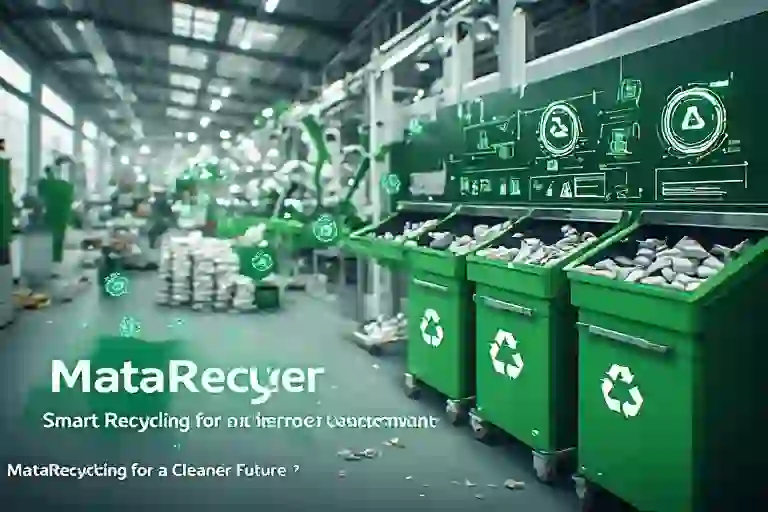
Recycling often fails before materials reach a processing plant. People place food-soiled packaging, plastic bags, batteries, and mixed materials in the wrong bins, which can lower material quality and increase handling costs. MataRecycler offers a clearer model: identify waste earlier, guide users, track collection, improve sorting, and turn useful data into practical action.
What Is This Smart Recycling Concept? A Short Answer
MataRecycler is a smart recycling concept that uses connected bins, cameras, sensors, software, and sorting tools to identify, collect, separate, and track recyclable materials. Its purpose is to reduce contamination, recover more usable material, and help homes, businesses, campuses, facilities, and cities make better waste decisions.
It should not be viewed as a magic machine that makes every discarded item recyclable. A successful system still depends on local recycling rules, clean materials, safe handling, reliable collection, suitable processing facilities, and real demand for recovered material.
Why Does Smart Recycling Matter?
Waste production is increasing more quickly than many local systems can handle. The World Bank reports that the world generated about 2.56 billion tonnes of waste in 2022 and projects 3.86 billion tonnes under a business-as-usual path by 2050.
UNEP also warns that growing waste creates direct financial costs as well as wider costs linked to pollution, health, and climate damage. Its Global Waste Management Outlook supports waste prevention, stronger collection, reuse, recycling, and circular systems rather than uncontrolled disposal.
Smart tools matter because they can address specific weak points:
- Confusing labels and local recycling rules
- Overflowing bins and inefficient collection routes
- Mixed or food-contaminated recyclables
- Poor visibility into the type and volume of waste
- Manual sorting risks and repetitive work
- Limited proof that materials reached the right destination
Technology cannot replace waste prevention. The U.S. Environmental Protection Agency places reduction and reuse ahead of recycling because avoiding waste usually preserves more value than processing it after disposal.
How Does the Smart Recycling System Work?
A typical MataRecycler system can follow six connected stages.
1. Waste Is Deposited
A user places an item in a smart bin, collection point, reverse-vending unit, or facility intake line. Clear instructions should show what the system accepts.
2. The Item Is Detected
A camera, weight sensor, barcode reader, near-infrared sensor, metal detector, or another device records basic information. The exact sensor depends on the material stream and operating environment.
3. Software Classifies the Material
The collected data is compared with recognized material patterns using a rules engine or machine learning model. It may classify the item as paper, cardboard, metal, glass, a plastic type, organic waste, e-waste, or non-recyclable residue.
4. The System Directs or Sorts the Item
A screen can tell the user which opening to use. In an industrial setting, conveyors, air jets, robotic arms, magnets, screens, and optical sorters may move the material into the correct stream.
5. Collection Data Is Recorded
Fill level, material type, weight, contamination events, time, and location can be added to a dashboard. This helps operators plan pickups and compare performance across sites.
6. Materials Enter the Correct Recovery Route
Accepted materials go to a material recovery facility, specialist recycler, composting operation, reuse partner, repair program, or approved hazardous-waste handler.
MataRecycler Process Table
| Stage | Main Tool | What It Does | Practical Value |
|---|---|---|---|
| Deposit | Smart bin or intake point | Receives the discarded item | Makes disposal easier to control |
| Detection | Camera, scale, scanner, or sensor | Captures item characteristics | Reduces guesswork |
| Identification | Classification software | Predicts the material type | Supports faster decisions |
| Separation | Gate, air jet, magnet, robot, or conveyor | Moves material into a selected stream | Improves material purity |
| Monitoring | IoT connection and dashboard | Tracks fill levels and activity | Supports timely collection |
| Reporting | Waste analytics platform | Shows volume, contamination, and trends | Guides purchasing and waste reduction |
| Recovery | Recycler or treatment facility | Processes or safely handles the material | Keeps useful resources in circulation |
This process table describes a possible system architecture, not a guaranteed specification for one commercial machine.
What Technology Powers Smart Recycling?
A MataRecycler setup may combine several tools rather than depend on one device.
Computer Vision
Cameras capture shape, colour, labels, logos, and surface features. Vision software can help distinguish an aluminium can from a plastic bottle or identify an item that does not belong in a recycling stream.
Image quality affects performance. Poor lighting, dirt, overlapping items, crushed packaging, and hidden labels can make identification more difficult.
Optical and Material Sensors
Near-infrared systems can help identify certain polymers. Metal detectors and magnets separate ferrous and non-ferrous materials.
Weight, moisture, temperature, and fill-level sensors provide additional operating data. A combination of sensors can be more reliable than a camera alone.
Internet of Things Connectivity
Connected containers can report when they are nearly full, damaged, blocked, or used unusually often. Operators can schedule pickups based on actual need instead of relying only on fixed collection routes.
A connected system may also send alerts when a container becomes too hot, receives a dangerous item, or stops communicating.
Automated Sorting Equipment
At larger facilities, conveyors, screens, ballistic separators, magnets, eddy-current separators, air jets, and robotic arms can separate materials at speed. Human quality-control staff may still inspect difficult items and remove contamination.
Data Dashboards
Dashboards can show waste by location, department, material, time, and contamination rate. A school may compare different buildings, while a retailer may compare stores or product categories.
The dashboard should give staff clear actions rather than display numbers without context.
What Materials Can the System Handle?
A smart recycling platform may support common materials, but acceptance always depends on local infrastructure.
Paper and Cardboard
Clean, dry paper and flattened cardboard are widely collected. Wet, greasy, waxed, laminated, or heavily coated items may not be accepted.
Smart monitoring can identify locations where paper bins regularly receive food waste or liquids.
Glass
Some programs accept bottles and jars by colour or as mixed glass. Ceramics, mirrors, drinking glasses, heat-resistant cookware, and window glass often need separate handling because they have different properties.
Broken glass also creates a safety risk during collection and sorting.
Metals
Steel and aluminium containers are valuable recycling streams. Magnets can separate steel, while eddy-current systems can help separate non-ferrous metals such as aluminium.
Larger metal items may require a scrap-metal facility rather than a household recycling bin.
Plastics
Plastic recycling is complex. Resin type, colour, shape, additives, labels, food residue, local equipment, and end-market demand all affect whether an item can be recycled.
A recycling symbol does not always mean that an item is accepted by every local program.
Organic Material
Food scraps and garden waste can enter composting or anaerobic-digestion systems where available. Organic waste should not be mixed into dry recycling.
Businesses that prepare or sell food can use weight data to identify avoidable food waste before it reaches a collection container.
Electronics and Batteries
Phones, computers, rechargeable batteries, button cells, and other electronic products require specialist collection. Damaged lithium-ion batteries can create fire risks and should never be placed casually in a general recycling bin.
A smart system should direct these products to a secure and approved collection point.
Textiles
Reusable clothing should usually go to reuse first. Worn textiles may enter fibre-recovery programs where suitable collection and processing exist.
Dirty, wet, mouldy, or chemically contaminated textiles may not be suitable for ordinary reuse programs.
How Can Smart Technology Reduce Recycling Contamination?
Contamination happens when the wrong material enters a recycling stream or when an accepted item is too dirty to process well. Common examples include food-filled containers, plastic film tangled in equipment, liquid left in bottles, and batteries placed among paper.
MataRecycler can reduce these problems through:
- On-screen disposal instructions
- Real-time rejection of clearly incorrect items
- Separate openings for different materials
- Alerts when contamination rises
- Staff dashboards that reveal problem locations
- Simple feedback for users
- Better signs based on actual disposal mistakes
- Inspection records for quality control
- Notifications for hazardous or unusual items
- Material-specific collection instructions
The best system teaches rather than merely rejects. A message such as “Empty liquid before recycling” gives the user a useful next step.
Messages should remain short, specific, and easy to understand. Long technical explanations can frustrate users and slow down disposal.
What Are the Main Benefits?
A well-designed MataRecycler program can create operational, environmental, financial, and educational value.
Cleaner Recovered Materials
Better identification and separation can improve the quality of paper, metal, glass, and plastic streams. Cleaner materials are easier for downstream processors to use.
Low contamination can also reduce the amount of collected material that must be rejected or sent for disposal.
More Efficient Collections
Fill-level monitoring can avoid overflowing containers and cut down on pointless pickups. Route planning may also lower vehicle time and fuel use, although savings should be measured locally.
A fixed collection schedule may remain necessary for food waste, hazardous materials, or high-traffic locations.
Better Waste Data
Manual waste audits offer useful snapshots. Connected systems can add ongoing information about volume, location, material type, and repeated disposal errors.
This information can help an organization decide where to place bins, improve labels, change suppliers, or reduce unnecessary packaging.
Safer Handling
Automation can reduce some direct contact with sharp, dirty, or repetitive waste streams. Hazardous items still require trained staff and approved procedures.
Safety controls should include emergency stops, fire detection, protective barriers, warning signs, and safe maintenance access.
Stronger Participation
Immediate instructions make recycling easier for people who do not understand local rules. Schools and workplaces can use results in practical education campaigns.
Positive comments can boost involvement, but incentives should not motivate consumers to purchase or discard additional packaging.
Clearer Performance Reporting
Organizations can report what they collected, where contamination occurred, and which reduction projects worked. Reports should state the measurement method and avoid claiming that collection automatically equals successful recycling.
Who Can Use This Smart Recycling Model?
The model can be adapted to several settings.
Homes and Apartment Buildings
Shared smart bins can provide clear guidance and alert building managers before containers overflow. Access controls may also help prevent commercial dumping in residential collection areas.
Schools and Universities
Campuses can track waste by building, improve student education, and test reduction programs in dining halls, libraries, offices, laboratories, and residences.
Student competitions can support engagement, but they should measure contamination and waste prevention rather than only total collected weight.
Offices
Companies can identify avoidable packaging, compare floors or departments, and improve purchasing policies. Office systems may focus on paper, cardboard, drink containers, food waste, and electronic equipment.
Retail and Hospitality
Stores, restaurants, hotels, and venues can monitor cardboard, containers, food waste, damaged stock, and back-of-house disposal.
Waste data may also reveal packaging that is difficult to separate or products that are regularly damaged before sale.
Factories and Warehouses
Industrial sites can separate production scrap, packaging, pallets, metals, and controlled waste streams while maintaining traceability.
Industrial waste may require specialist analysis because it can contain oils, chemicals, sharp materials, or regulated substances.
Municipalities
Cities can use connected public bins, route information, contamination data, and community education to improve collection services.
Municipal systems must also consider accessibility, language needs, vandalism, severe weather, privacy, and compatibility with existing collection vehicles.
Material Recovery Facilities
Processing plants can use optical sorters, robotics, sensors, and quality-control systems to separate mixed recyclables. The technology can support workers but should not remove the need for training and safe working conditions.
How Is It Different From Traditional Recycling?
| Area | Traditional Approach | Smart Recycling Approach |
| User guidance | Static signs | Interactive instructions and feedback |
| Collection schedule | Fixed calendar | Fill-level or demand-based scheduling |
| Sorting | Manual and mechanical | Mechanical sorting supported by sensors and software |
| Data | Periodic reports | Frequent operational data |
| Contamination response | Found after collection | Detected at the bin, route, or facility |
| Performance review | Total weight collected | Weight, material mix, contamination, location, and outcome |
| Education | General campaigns | Messages based on repeated local mistakes |
| Maintenance | Routine inspection | Routine inspection supported by system alerts |
| Traceability | Paper records or basic logs | Digital movement and processing records |
Traditional recycling already uses many mechanical systems. The “smart” difference is the addition of connected data, faster feedback, and more detailed classification.
How Should an Organization Implement the System?
Buying equipment before understanding the waste stream often leads to poor results. A practical rollout should begin with the problem rather than the technology.
Step 1: Complete a Waste Audit
Measure the main materials, contamination sources, disposal locations, pickup frequency, and current costs. Include a safe sampling method and trained staff.
Record what people throw away, what could have been reused, what local recyclers accept, and which materials create the highest costs.
Step 2: Confirm Local Recycling Rules
Ask collectors and processors what they accept, how items should be prepared, and where the materials go. The European Commission’s waste hierarchy prioritizes prevention, preparation for reuse, recycling, other recovery, and disposal in that order.
Do not copy recycling labels from another country or city without checking local rules.
Step 3: Select One Measurable Goal
Useful goals include:
- Cutting food contamination in paper bins
- Preventing batteries from entering mixed recycling
- Reducing overflowing public bins
- Improving cardboard separation
- Lowering unnecessary collection trips
- Increasing reusable packaging
- Improving downstream acceptance
A narrow goal makes it easier to select suitable technology and measure results.
Step 4: Run a Limited Pilot
Test the system in one building, route, store, department, or material stream. A pilot should compare results before and after installation.
Include a control area where possible. This can help determine whether improvement came from the technology, new signage, staff training, or another change.
Step 5: Train Users and Staff
Explain what the system accepts, how alerts work, who handles rejected items, and what to do when equipment fails.
Cleaning teams, collection staff, maintenance workers, managers, and regular users may need different instructions.
Step 6: Measure Outcomes
Track contamination, capture rate, downtime, service calls, collection frequency, worker feedback, user behaviour, and downstream acceptance.
Measure enough time to account for seasonal changes, special events, holidays, and changes in building occupancy.
Step 7: Improve the Program
Update labels, bin placement, software rules, collection contracts, and staff procedures based on evidence. Remove equipment that adds complexity without producing measurable value.
What Does MataRecycler Cost?
The total cost depends on the scale and tools involved. A whole sorting line with conveyors, optical scanners, robots, fire controls, and bespoke software is significantly more expensive than a simple connected bin.
A useful budget should include:
- Equipment purchase or rental
- Installation and site preparation
- Electrical work
- Connectivity and data plans
- Software subscriptions
- Integration with existing systems
- Staff training
- Cleaning and preventive maintenance
- Calibration and model updates
- Replacement parts
- Cybersecurity and data management
- Safe handling for rejected or hazardous items
- Downstream collection and processing fees
- Equipment removal or recycling at the end of its life
Decision-makers should calculate total cost of ownership rather than compare purchase prices alone. Savings claims should be based on a pilot using real local collection, labour, disposal, energy, and maintenance costs.
What Metrics Should Be Tracked?
A smart system is only valuable when its data supports better decisions.
| Metric | Meaning | Why It Matters |
| Capture rate | Share of available recyclable material collected correctly | Shows participation and recovery potential |
| Contamination rate | Share of incorrect or dirty material in a stream | Measures material quality |
| Diversion rate | Share kept away from disposal | Gives a broad program view |
| Bin fullness | Container capacity used at pickup | Helps improve collection timing |
| Rejection rate | Items the system could not accept | Reveals user or classification problems |
| Sorting accuracy | Correct classifications in a tested sample | Tests system reliability |
| Downtime | Time equipment is unavailable | Shows operating stability |
| Cost per tonne | Total program cost divided by material handled | Supports financial comparison |
| Downstream acceptance | Share accepted by the processor | Confirms practical recyclability |
| Reuse impact | Items returned to use rather than processed | Measures value preservation |
| Prevention impact | Material avoided before disposal | Supports the highest waste priority |
| User correction rate | Users who follow disposal guidance | Tests whether feedback works |
Publish the definitions behind each number. A high diversion rate can be misleading if waste is transferred but not actually processed.
What Are the Limitations and Risks?
MataRecycler can improve a recycling program, but it cannot solve every waste problem.
Classification Errors
Crushed, dirty, hidden, or unusual items may confuse a vision system. Regular testing with local waste is essential.
Accuracy should be measured using a representative sample rather than a small collection of clean demonstration items.
Local Rule Differences
An item accepted in one city may be rejected in another. Software and signs must reflect the actual processor’s rules.
Rules may also change when a processing contract or end market changes.
Maintenance Needs
Dirty lenses, blocked chutes, damaged scales, poor connectivity, and worn moving parts can lower performance. Maintenance plans should state who responds, how quickly repairs happen, and whether spare parts are available.
Fire and Safety Risks
Batteries, pressurized containers, chemicals, and hot materials need detection and safe isolation procedures. Automated equipment should not create a false sense of security.
Data and Privacy Concerns
Cameras in public or workplace areas should capture only what is necessary. Operators need clear data-retention, access, deletion, and security policies.
Where possible, the system should identify materials without recording faces or personal activity.
Weak End Markets
Accurate sorting does not create a buyer. A material still needs a practical, environmentally sound recovery route.
Organizations should confirm downstream partners before collecting a new material stream.
Rebound Behaviour
A convenient recycling system may make people feel comfortable buying more disposable products. Prevention and reuse messages should remain visible.
Vendor Dependence
Custom hardware and closed software may create long-term dependence on one supplier. Buyers should ask about data export, repair rights, software support, replacement parts, and contract exit terms.
Is Smart Recycling Environmentally Friendly?
It can be, but the answer depends on the full system.
A credible environmental review should compare:
- Materials and energy used to manufacture equipment
- Electricity and connectivity needs
- Changes in collection mileage
- Material recovery and contamination results
- Equipment lifespan and repairability
- Treatment of rejected items
- Actual downstream processing
- Waste prevented through better data
- End-of-life treatment for sensors, batteries, and electronics
A system that adds electronics but does not improve recovery may deliver little value. A smaller pilot that solves a clear contamination or collection problem may produce a stronger result.
Environmental claims should include a baseline, measurement period, method, and defined boundary. Steer clear of ambiguous statements like “totally sustainable” or “zero waste” that lack supporting data.
What Is the Future of Smart Recycling?
The next stage will likely focus on better local classification, simpler user guidance, safer battery detection, interoperable data, equipment repair, and proof of downstream outcomes.
Systems may become better at recognizing flexible packaging, multi-layer materials, damaged items, and region-specific products. However, recognition will remain only one part of the solution.
The strongest systems will connect waste data to purchasing and product design. For example, repeated rejection of a package can prompt a retailer to choose a reusable, refillable, or easier-to-recycle alternative.
That moves the platform beyond bin management and toward circular resource planning.
Topical Cluster Map for Supporting Content
Use this pillar page as the central hub and build supporting articles around clear search intent.
| Cluster | Supporting Article Idea | Search Intent |
| Basics | How Smart Recycling Bins Work | Informational |
| Sorting | AI Waste Sorting: Methods, Benefits, and Limits | Informational |
| Contamination | How to Reduce Recycling Contamination | Problem-solving |
| Plastics | Which Plastics Can Be Recycled Locally? | Informational |
| Business | Smart Waste Management for Offices | Commercial investigation |
| Cities | IoT Waste Collection for Municipalities | Commercial investigation |
| Facilities | How Material Recovery Facilities Sort Waste | Informational |
| Data | Waste Analytics Metrics Every Business Should Track | Informational |
| Safety | How to Dispose of Lithium Batteries Safely | Safety |
| Circularity | Recycling vs Reuse: Which Should Come First? | Comparative |
| Procurement | Smart Recycling System Buying Checklist | Transactional support |
| Education | Recycling Signage That Reduces Common Mistakes | Practical |
| Hospitality | Reducing Hotel and Restaurant Waste | Problem-solving |
| Schools | How to Start a School Recycling Program | Informational |
| Audits | How to Conduct a Workplace Waste Audit | Practical |
All supporting articles should be linked back to this page. Add links from this pillar page only where they genuinely help the reader complete the next task.
Frequently Asked Questions
What Is Smart Recycling in Simple Words?
MataRecycler is a technology-supported way to make recycling easier to understand, collect, sort, and measure. It may use smart bins, sensors, cameras, automated equipment, and data dashboards.
The exact equipment can range from a simple connected container to a complete industrial sorting line.
Is MataRecycler a Real Company or a General Concept?
Public use of the term is inconsistent, so readers should check the specific website, manufacturer, registration details, and technical documentation connected to any commercial claim.
This guide treats it as a general smart-recycling model unless verified company information states otherwise.
Can It Identify Every Recyclable Item?
No. Recognition depends on the sensors, training data, item condition, local rules, and system design.
Dirty, damaged, overlapping, hidden, or unusual items may require manual inspection or a safe fallback stream.
Does Smart Sorting Guarantee That Waste Is Recycled?
No. Collection and sorting are only part of the chain.
The material must also meet quality requirements, reach a suitable processor, and have a viable recovery route or end market.
Can Small Businesses Use Smart Recycling?
Yes. A small business can begin with clear bin stations, fill-level sensors, digital tracking, and a focused waste audit rather than purchasing an expensive automated sorting line.
The best first step is usually to identify one costly or frequently contaminated waste stream.
What Is the Best Way to Evaluate a Smart Recycling Vendor?
Ask for independently verifiable test results, local customer references, accepted-material lists, maintenance terms, uptime data, safety procedures, privacy controls, downstream partners, and total cost of ownership.
Request a pilot using your real waste stream before committing to a large rollout.
Conclusion: Start With One Waste Problem
MataRecycler has value when it solves a defined problem and produces evidence that people can verify. Start with a waste audit, confirm local processing rules, choose one measurable goal, and run a controlled pilot.
Do not judge success by the number of sensors installed. Judge it by cleaner materials, fewer disposal errors, safer handling, lower avoidable waste, reliable downstream acceptance, and decisions that prevent waste before it reaches the bin.
Editorial method: This article uses official guidance and data from UNEP, the World Bank, the U.S. EPA, and the European Commission. Product-specific claims should be supported by test reports, operating data, named customer evidence, and clearly defined measurement methods.
Primary Sources
- United Nations Environment Programme — Global Waste Management Outlook 2024
- World Bank — What a Waste 3.0
- U.S. Environmental Protection Agency — Recycling Basics and Benefits
- European Commission — Waste Framework Directive