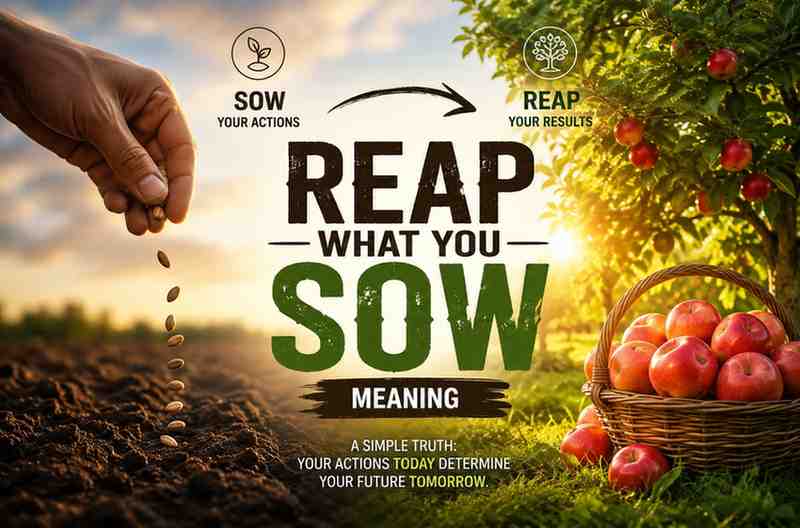
You have heard the phrase “reap what you sow” but its full meaning often gets reduced to a warning. Without understanding the law of harvest, you may miss how daily actions shape long-term results. This guide breaks down the reap what you sow meaning, its biblical roots, and practical steps to use it today.
What Does “Reap What You Sow” Mean?
At its core, the reap what you sow meaning points to a simple agricultural truth: the seed you plant determines the crop you gather. If you plant corn, corn grows. If you plant beans, beans grow. The same pattern shows up in human behavior. Your words, choices, and habits are seeds. The results—trust, health, debt, or stress—are the harvest.
The phrase comes from farming, but it works as a picture of cause and effect. You cannot plant one kind of seed and expect a different kind of harvest. That truth gives the saying its power. ”
The Biblical Origin of Reap What You Sow
The clearest biblical statement appears in Galatians 6:7. The New International Version reads, “Do not be deceived: God cannot be mocked. A man reaps what he sows.” Bible Gateway’s New International Version preserves the direct wording.
The apostle Paul wrote these words to early Christian communities in Galatia. He warned them that spiritual choices carry real consequences. The verse follows a section about doing good and sharing with others. Paul used the farming image because his audience knew how harvests worked. Bible Hub’s Greek Lexicon shows that the word for “sow” means to scatter seed, while “reap” means to gather a harvest. This was not a vague threat. It was a law of the land—and of the spirit.
The Law of Harvest: Core Principles
Farmers live by a few fixed rules. These rules also explain the reap what you sow meaning in practical terms.
- You reap the same kind you sow. Tomato seeds produce tomatoes.
- You reap after you sow. Harvest comes later, not at planting time.
- You reap more than you sow. One seed can produce dozens of fruit.
- You reap in proportion to your sowing. Small effort yields a small harvest; generous effort yields a generous harvest.
- You can start a new row at any time. Past seeds do not stop you from planting better seeds today.
Reap What You Sow Meaning in Everyday Life
In daily life, the law of harvest plays out in relationships, money, health, and work. A person who speaks criticism daily reaps a home filled with tension. A person who saves a small amount each month reaps an emergency fund. This is the reap what you sow meaning applied to daily routines. The principle is not magical. It is practical. Your repeated actions build patterns, and patterns produce results.
Real-World Examples of Sowing and Reaping
These real-world examples show the reap what you sow meaning in action.
- Health: Daily movement and whole foods produce better energy and stronger immunity over time.
- Finances: Consistent saving and budgeting produce financial breathing room.
- Relationships: Honest communication and small acts of kindness produce trust.
- Career: Learning new skills and volunteering for hard projects produce promotions and new opportunities.
- Mindset: Gratitude and reflection produce lower stress and clearer thinking.
Each example follows the same pattern. The seed is small. The harvest is larger. The wait is real.
The Psychology Behind Actions and Consequences
Behavioral science supports the idea that repeated actions create lasting results. Every time you choose an action, you strengthen a neural pathway. That pathway becomes your default. Psychologists call this habit formation. The more often you repeat a behavior, the easier it becomes. So the reap what you sow meaning aligns with what researchers observe: small, repeated choices compound into character and outcomes.
Why the Phrase Applies to Relationships, Work, and Health
Relationships are a clear harvest field. If you plant patience, you grow trust. If you plant blame, you grow distance. Work follows the same rule. Consistent effort and skill-building produce professional growth. Health works through daily choices. Food, sleep, and movement are seeds. The same reap what you sow meaning applies across all three areas. The body, the team, and the home all harvest the results of repeated actions.
Common Misconceptions About Reap What You Sow
Several misconceptions distort the reap what you sow meaning.
- It does not mean every bad event is a direct punishment. Life also includes other people’s choices.
- It does not promise instant results. Harvest takes a season.
- It does not call you to judge others. You focus on your own seeds.
- It does not mean wealth equals virtue. Money is only one possible harvest.
How to Apply the Law of Harvest in Daily Decisions
Applying the reap what you sow meaning starts with one area of life. Name the harvest you want—stronger health, calmer finances, deeper trust. Then choose one small seed you can plant today.
- Write down one specific result you want in 12 months.
- Identify two daily actions that support that result.
- Remove one recurring action that works against it.
- Track your actions for 30 days.
- Review your results every month and adjust.
Reap What You Sow vs. Karma: Key Differences
The reap what you sow meaning sometimes gets compared to karma. Both teach that actions have consequences. But they come from different worldviews. The biblical law of harvest sits inside a relationship with God and personal responsibility. Karma, in many Eastern traditions, ties consequences to reincarnation and cosmic balance. The biblical view focuses on this life and a moral God. It also offers hope: you can change your seeds today and receive forgiveness.
Positive and Negative Sowing: A Practical Table
The table below summarizes the reap what you sow meaning across six life areas.
| Area | Positive Seed | Likely Harvest | Negative Seed | Likely Harvest |
|---|---|---|---|---|
| Relationships | Honest, kind words | Trust and closeness | Criticism and blame | Distance and conflict |
| Health | Daily movement and water | Energy and strength | Chronic inactivity and junk food | Fatigue and illness |
| Finances | Saving 10% of income | Emergency fund | Impulse spending | Debt and stress |
| Career | Learning new skills | Promotions and options | Coasting on old skills | Stagnation |
| Mindset | Daily gratitude | Lower stress | Constant complaining | Anxiety and bitterness |
| Faith/Spirit | Prayer, service, study | Peace and purpose | Neglect | Emptiness and drift |
What Science Says About Cause and Effect
Science and the reap what you sow meaning agree on one thing: small actions repeated over time produce large results. The body adapts to exercise. The mind adapts to thoughts. Relationships adapt to patterns. You do not need a miracle to change your harvest. You need a new seed and a season of consistency.
How to Teach the Principle to Children and Teams
Use concrete examples. Plant a real seed with a child and watch it grow. For teams, map actions to outcomes on a whiteboard. Keep the tone positive. The goal is not fear. The goal is ownership. Teaching the reap what you sow meaning to children and teams helps them see the link between action and result, so they make better choices.
Frequently Asked Questions About Reap What You Sow Meaning
What does the phrase “reap what you sow” mean?
It means your actions produce matching results. The reap what you sow meaning comes from farming: plant corn, harvest corn. In life, plant honesty, harvest trust.
Is “reap what you sow” in the Bible?
Yes. Galatians 6:7 says, “A man reaps what he sows.” The apostle Paul wrote this in his letter to the Galatians.
What is the difference between reap what you sow and karma?
Reap what you sow is a biblical principle centered on personal responsibility and God’s justice. Karma comes from Eastern religions and often includes reincarnation.
Does reap what you sow always happen immediately?
No. Harvest follows a season. Results often appear weeks, months, or years after the original action.
Can you change what you reap?
Yes. You can start planting new seeds today. New actions, repeated consistently, create a different harvest over time.
Why is the law of harvest important?
It helps you take responsibility for your choices. When you understand the reap what you sow meaning, you stop blaming luck and start directing your daily actions.
Start Sowing Today
Your current life is a harvest from past seeds. Your future life will be a harvest from today’s seeds. When you accept the reap what you sow meaning, you stop waiting for better luck and start creating better results. Choose one small action that points toward the result you want. Plant it today. Repeat it this week. The law of harvest does the rest. What will you sow first?