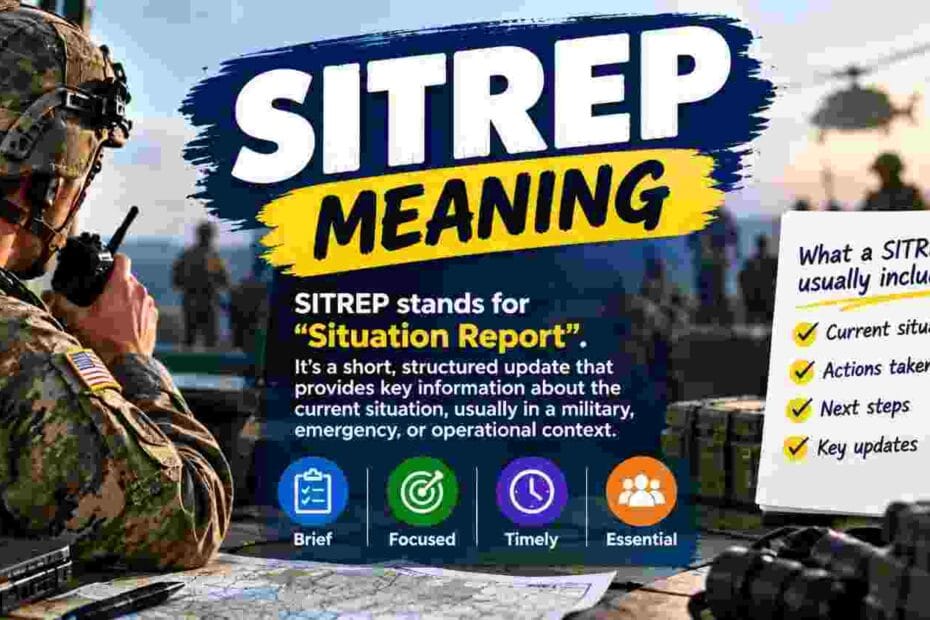
“Send me a sitrep” sounds intimidating until you realize what someone actually wants: a clear update, not every detail of your day. The trick is knowing which details deserve space.
SITREP means “situation report”: an update on the current state of an operation, incident, or activity. Dictionary.com recognizes both its military meaning and its broader use for general status reports.
Below, you’ll find plain-English explanations, practical examples, and seven tips for writing an update that helps someone act. You’ll also get a reusable format for those moments when “we’re working on it” isn’t enough.
What Does SITREP Stand For?
SITREP combines SIT from situation and REP from report. The term has military roots; Dictionary.com documents its use during World War II, including an example from September 1941. 6
Think of it as a snapshot, not the whole photo album. A useful situation report gives readers enough context to understand the present without making them reconstruct it from yesterday’s messages.
Where You’ll Hear SITREP—and What It Means There
In the Military
Merriam-Webster defines a sitrep as a periodic report about the current military situation. Its purpose is more specific than making conversation: it communicates the state of an operation. 2
For an illustrative, nontechnical example, imagine a transport team reporting that it has arrived, one vehicle needs maintenance, and unloading can begin. The useful information concerns status, limitations, and readiness—not a minute-by-minute travel diary.
In Emergency and Humanitarian Response
FEMA describes SITREPs as regular reports covering incident status during the previous operational period and relevant incident details. Its guidance emphasizes a common reporting format so different organizations can access the information. 5
The World Health Organization’s medical-team coordination template includes a reporting period, situation overview, team deployment information, and priority needs. That structure connects conditions on the ground with the response and remaining gaps. 5
At Work or in Everyday Messages
Outside formal operations, sitrep can simply mean a general update. Dictionary.com includes this broader sense, so the word doesn’t automatically signal a military matter or an emergency. 4
A workplace example might read: “Design approved; development is waiting for product photos; marketing needs to send them by noon.” That short message explains progress, the obstacle, and who can remove it.
SITREP vs. Status Report: What’s the Difference?
The terms can overlap, but organizational definitions matter. FEMA distinguishes regular SITREPs from status reports, which are typically function-specific and less formal. It also treats both as types of incident reports—not entirely separate categories. 5
Whatever your team calls the document, specificity makes it more useful. These fictional examples show the difference between reporting activity and giving someone information they can act on.
| Vague update | More useful situation update | Why it helps |
|---|---|---|
| “There’s a delay.” | “Delivery moved to Thursday; Friday’s launch is at risk.” | Connects the change to its impact. |
| “We need help.” | “We need one reviewer by 3 p.m. to approve the revised page.” | Makes the request actionable. |
| “Everything looks fine.” | “Browsing works; card payments still fail; engineers are investigating.” | Identifies the unresolved problem. |
The difference isn’t fancy wording. The stronger versions answer the reader’s next question before another message becomes necessary. Use that as your editing test.
How to Write a SITREP: 7 Smart, Practical Tips
For a general workplace update, use the following checklist. In formal military, medical, or emergency settings, follow your organization’s approved template and reporting procedures instead.
- Add a timestamp and scope. Identify the incident, project, or location. Include the date, time, and time zone when teams work across regions.
- Lead with what changed. Put the most significant development first. Don’t make readers compare several old updates to discover what is new.
- Describe the impact. Explain who or what is affected. Distinguish services that still work from those that are unavailable or limited.
- List actions and owners. Separate completed work from work underway. Name the person or team responsible for the next action.
- Separate facts from estimates. Mark uncertain information clearly. An estimated recovery time is not a confirmed deadline, and an unverified cause is not an established fact.
- Make requests specific. State the resource, approval, or decision you need and when you need it. Replace “please assist” with a concrete ask.
- Set the next update. Give a reporting time or agreed trigger. If there is no meaningful change, say so rather than recycling old progress as new.
Before sending, remove details the audience doesn’t need. Keep sensitive personal or operational information within authorized channels, and check that your wording doesn’t turn an assumption into apparent certainty.
A Short SITREP Example You Can Adapt
Here is a fictional website-outage sitrep, not a report of a real incident. Copy its headings and replace the details with information you have checked.
- Incident: Online checkout failure.
- Report time: 9 September 2026, 14:00 UTC.
- Current situation: Browsing works, but customers cannot complete card payments.
- Change since last update: Engineering has narrowed its investigation to the payment integration.
- Actions underway: Engineering is checking logs; customer support has prepared a response script.
- Unknowns: The cause and restoration time remain unconfirmed.
- Decision needed: Operations lead to approve a checkout notice by 14:10 UTC.
- Next update: 14:30 UTC, or sooner if service is restored.
Notice what this example avoids: a guessed recovery time, unexplained technical jargon, and a vague promise to provide updates “soon.” Readers can see the problem, the response, and the next checkpoint.
Frequently Asked Questions
How do you pronounce SITREP?
Say SIT-rep, with the stress on the first syllable. It sounds like “sit” followed by “rep.” Merriam-Webster lists this pronunciation; you normally say it as a word rather than spelling out all six letters. 2
What does “give me a sitrep” mean?
It means “tell me the current situation.” Respond with the main development, its impact, what you’re doing, and any help needed. If the request is vague, ask which project or incident the person means.
What does sitrep mean in texting?
In a casual message, sitrep means a status update or a quick account of how things stand. 4 For example, a friend asking for a travel sitrep might want to know whether you’ve arrived or need a ride.
How long should a SITREP be?
Use the length your audience and reporting procedure require. For an informal update, a few focused lines may be enough. For a complex incident, don’t cut necessary context just to meet an arbitrary one-page limit.
How often should you send a SITREP?
Follow your team’s agreed reporting schedule rather than assuming a universal interval. WHO’s medical-team coordination template, for example, provides daily and weekly reporting options. 5 Agree separately on which urgent changes require immediate notification.
Should you write SITREP or sitrep?
Use SITREP in report titles if that matches your organization’s style, and sitrep in ordinary prose if you prefer. Stay consistent within a document. For unfamiliar audiences, write “situation report” on first mention to avoid unnecessary jargon.
Make Your Next Update Worth Reading
A good sitrep gives people a reliable picture of what’s happening and what needs attention. Before sending, ask: “Can the reader tell what changed, what it affects, and what happens next?” If yes, you’ve done the job.