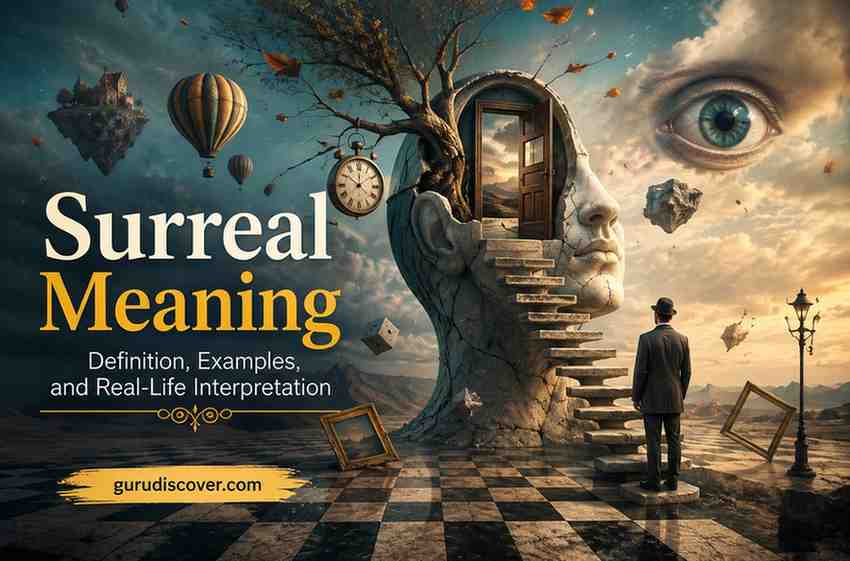
You hear someone whisper “that was surreal” after an uncanny coincidence or a breathtaking sunset. But the word slips away the moment you try to pin it down. Without a clear grip on the surreal meaning, you risk diluting one of the most evocative words in the English language—turning a sharp descriptor into empty noise. This pillar guide erases that confusion. It unpacks the surreal meaning with precise definitions, vivid examples, and practical context, so you can use the term with confidence and depth.
What Exactly Is the Surreal Meaning?
The surreal meaning describes an experience, image, or idea that fuses reality and dream in an unexpected, often disorienting way. The term marks a departure from the logical, everyday world—where objects, emotions, and events follow a bizarre or hallucinatory logic. Think of walking through your childhood home and finding an ocean behind the bathroom door. That jolt of strange familiarity captures the surreal meaning perfectly.
Dictionaries anchor this definition in a blend of the real and the unreal. Merriam-Webster defines “surreal” as “marked by the intense irrational reality of a dream.” The surreal meaning, therefore, is not simply weird; it carries a specific texture of dreamlike displacement and emotional weight.
- Combines recognizable elements with impossible twists
- Evokes the unconscious, memory, and raw emotion
- Feels hyper-real yet logically absurd
The Etymology: Where the Word “Surreal” Comes From
The word “surreal” appeared in the early 20th century, forged by the French avant-garde poet Guillaume Apollinaire. He coined sur-réaliste to describe a new kind of artistic truth lying beyond everyday reality. “Sur” means “above” or “beyond,” so the literal surreal meaning points to a realm beyond the real—a super-reality where the conscious and unconscious minds merge.
Soon after, the poet and critic André Breton adopted the term to name the Surrealist movement, formalizing its intellectual weight. Knowing this origin enriches the surreal meaning by connecting it to a deliberate artistic rebellion against reason.
Surrealism: The Art Movement That Redefined Reality
Breton’s 1924 Surrealist Manifesto declared a war on logic. Artists like Salvador Dalí, René Magritte, and Max Ernst set out to unlock the subconscious through automatic drawing, dream journals, and startling juxtapositions. Their work embodies the surreal meaning at full force.
Dalí’s melting clocks in The Persistence of Memory make time soft, biological, and unreliable. Magritte’s painting of a pipe with the caption “This is not a pipe” challenges the very link between objects and language. These works are not mere fantasy; they tap into a deeper psychological truth, which is the heart of the surreal meaning.
According to Tate Modern, Surrealism aimed to “resolve the previously contradictory conditions of dream and reality.” This core drive still echoes every time we use the word today.
- Placed everyday objects in impossible contexts
- Embraced chance, absurdity, and the irrational
- Influenced film, fashion, and advertising permanently
Everyday Uses of Surreal Meaning
The surreal meaning flourishes outside of galleries in journalism and everyday speech. People reach for “surreal” when life feels scripted by a whimsical, sometimes unsettling director. You might describe a job promotion after years of struggle as surreal, or the quiet streets during a global lockdown as a surreal snapshot of a paused world.
These moments share a common thread: a mismatch between what is happening and what the mind can comfortably accept. Recognizing the precise surreal meaning stops you from using the word as a lazy synonym for “strange” and turns it into a precise emotional tool.
- Landing a dream role after a decade of rejection
- Running into a childhood friend in a foreign city with no prior plan
- Watching a historic event unfold on your phone screen while sitting in a quiet room
Surreal vs. Bizarre vs. Uncanny: Key Differences
Words like “bizarre” and “uncanny” orbit the surreal meaning but fall short of its specific flavor. Bizarre points to something extremely odd or grotesque, often with a comedic edge. A creeping familiarity that turns unsettling, like to an overly human-looking doll, is described as uncanny. The surreal meaning layers dream logic and emotional displacement on top of strangeness.
| Word | Core Meaning | Example | How It Differs from Surreal |
| Surreal | Dreamlike, reality-bending, emotionally charged | A fish swimming through a city street | Carries an irrational, subconscious logic and often a poetic tone |
| Bizarre | Strikingly odd, outlandish, often grotesque | A person wearing a hat made of live frogs | Lacks the dream-reality fusion; may be simply weird for shock value |
| Uncanny | Familiar yet eerily wrong, disturbing | A robot with an almost-human smile | Relies on a creepiness of resemblance, not the free-form illogic of dreams |
| Fantastic | Related to fantasy, magic, or the impossible | A dragon sleeping on a castle tower | Belongs to a clearly separate magical world, not our reality merging with unreality |
| Absurd | Ridiculously unreasonable, nonsensical | A courtroom trial where the judge is a parrot | Focuses on meaninglessness and irrationality without the dreamlike beauty |
Use the surreal meaning when the experience feels like a piece of your unconscious has leaked into the waking world.
The Psychology Behind Feeling Surreal
Psychologists recognize moments when the surreal meaning becomes a lived bodily sensation. Derealization—a dissociative state—makes the world appear foggy, artificial, or dreamlike. People describe feeling as though they are watching their own life from behind glass. This clinical experience shares deep roots with the surreal meaning because both disrupt the brain’s reality-testing machinery.
Studies on dream cognition note that during REM sleep, the prefrontal cortex dials down logic while the limbic system surges with emotion. The surreal meaning replicates that neurochemical recipe: high emotion, low logical filtering, and vivid imagery. When you call a waking event surreal, you touch a very real cognitive shift.
- Derealization affects about 1–2% of the population at some point
- Sleep deprivation can trigger spontaneous surreal-like perceptions
- The brain’s default mode network links self-reflection with dreamlike associative thinking
Surreal Meaning in Literature and Storytelling
Writers weaponize the surreal meaning to shake readers out of passive consumption. Franz Kafka’s The Metamorphosis opens with a man waking up as a giant insect—and the horror lies in how mundanely everyone reacts. Haruki Murakami builds entire novels on a surreal meaning where talking cats, parallel worlds, and vanishing elephants feel as natural as rain.
This literary move does more than decorate a plot. It forces the brain to create new neural connections, linking unrelated concepts until a fresh understanding emerges. A story that harnesses the surreal meaning becomes a gymnasium for empathy and flexible thinking.
- Gabriel García Márquez’s magical realism often brushes against the surreal meaning
- Lewis Carroll’s Wonderland operates on a strict dream-logic
- Contemporary authors like Helen Oyeyemi use surreal elements to explore identity
How Filmmakers Create Surreal Experiences
Cinema translates the surreal meaning directly into sensory overload. Directors like David Lynch build scenes where lighting, sound design, and pacing tilt reality sideways. In Mulholland Drive, a nightmare man behind a diner, a blue box, and disjointed timelines carve out a world that obeys emotional truth, not physics.
Christopher Nolan’s Inception folds cities onto themselves. Gaspar Noé’s Enter the Void drifts through memories and afterlives in a continuous floating point-of-view shot. These techniques exploit the surreal meaning to provoke visceral reactions—heart racing, skin prickling—before the logical brain catches up.
- Unreliable narrators shatter the audience’s grounding
- Slow motion and reversed footage mimic dream fluidity
- Layered soundscapes blur the line between diegetic and imagined noise
The Surreal in Advertising and Branding
Brands borrow the surreal meaning to stop thumbs mid-scroll. A perfume ad might show a woman diving into a giant bottle and swimming through clouds of fragrance. A sneaker commercial might have basketball stars floating through constellations. This strategy hijacks the brain’s fascination with the impossible, creating memorable mental snapshots that traditional rational ads cannot match.
Marketers rely on the surreal meaning because it generates emotional arousal and open-ended interpretation. The viewer completes the image with personal associations, making the brand feel intimately relevant. When done well, the surreal meaning transforms a product into a feeling.
- Absolut Vodka’s legendary bottle-shaped worlds
- Apple’s “Welcome Home” short film by Spike Jonze, twisting apartment walls
- Old Spice’s rapid-fire scene changes that defy spatial logic
Common Misconceptions About Surreal Meaning
Misuse dilutes the word’s power. One frequent mistake treats the surreal meaning as a synonym for “unbelievable” or “amazing.” A great pizza is not surreal; a pizza that whispers your name and floats off the plate might be. Another error strips away the emotional and psychological charge, leaving only a hollow label for anything slightly odd.
Understanding the surreal meaning means protecting it from exaggeration. Reserve the word for moments that genuinely fuse the inner world of dreams and the outer world of facts. That discipline makes your communication sharper and more trustworthy.
- Not everything unexpected qualifies as surreal
- The surreal meaning requires an element of the dreamlike—not just surprise
- Overuse causes semantic satiation, weakening its impact
How to Use “Surreal” Correctly in Your Writing
Apply the surreal meaning with surgical intention. Before typing the word, pause and ask: Does this scene feel like a dream spilling into waking life? Is there a collision of the ordinary and the irrational that creates emotional static? If yes, the surreal meaning fits. Pair it with concrete sensory details—smells, textures, sounds—to anchor the strange in something tangible.
Avoid using “surreal” as a standalone punchline. Layer it into a sentence that already paints the absurdity. For example, “The surreal meaning of the empty stadium hit her: 50,000 seats breathing silence, and the grass glowing under floodlights for nobody.”
- Show the specific dreamlike contrast first, then name it
- Use sparingly for maximum effect; once or twice per piece
- Trust your reader’s intelligence—imply the surreal meaning through imagery
Famous Surreal Moments That Shook Pop Culture
Certain public events tattoo the surreal meaning onto collective memory. When David Bowie appeared as Ziggy Stardust, gender and alien identity blurred into a glam-rock hallucination. The fall of the Berlin Wall felt surreal to those who chipped away at concrete that had divided families for decades. More recently, the 2020 pandemic empty Times Square photographs delivered a chilling surreal meaning: a city that never sleeps, finally put to bed.
These cultural snapshots teach us that the surreal meaning often arrives uninvited, rewriting the rules of what we consider normal.
- The moon landing broadcast, where Earth watched itself from another world
- Banksy’s self-shredding painting the moment the auction gavel fell
- The sudden global switch to remote work, offices frozen in time
The Dream Connection: Why Surreal Feels Like a Dream
The surreal meaning lives so close to dreaming because both states dissolve the ego’s tidy storylines. In dreams, a table can melt, a stranger can feel like your oldest friend, and time loops without apology. Science shows that during REM sleep, the brain suppresses norepinephrine, a chemical linked to logical decision-making, while amplifying acetylcholine, fueling bizarre associations.
This biological recipe produces the same cocktail we label surreal in waking life. The surreal meaning, then, is not a fanciful exaggeration. It’s the brain’s native creative mode bleeding through.
- Hypnagogic imagery—the visions at sleep onset—often drips with surreal meaning
- Lucid dreamers report intentionally shaping surreal landscapes
- Many artists keep dream journals to harvest surreal meaning daily
Surreal Meaning Across Different Languages
Languages shape the surreal meaning with their own textures. In Japanese, fushigi (不思議) wraps mystery, wonder, and the inexplicable into one word, often without the Western emphasis on psychological depth. Spanish surrealista carries a political edge still tinged with the energy of early 20th-century avant-garde circles. Translating the surreal meaning forces a culture to decide whether to import the European art baggage or grow a local equivalent.
Exploring these nuances reminds us that the surreal meaning is both universal—all humans dream—and culturally coded, colored by history and storytelling traditions.
Why Understanding Surreal Meaning Enriches Your Life
Grappling with the surreal meaning sharpens your perception. You start noticing the odd little breaks in the matrix: the cloud shaped exactly like a childhood dog, the stranger who laughs exactly like your late grandmother, the coincidence that rearranges your afternoon into a poem. Instead of dismissing these moments, you welcome them as proof that reality is wider and more mysterious than any spreadsheet can capture.
Owning the surreal meaning also deepens your creativity. When you let dream logic into your problem-solving, you unlock solutions that pure rationality overlooks. The surreal meaning becomes a permission slip to imagine without apology.
- Enhances mindfulness and appreciation of the present
- Strengthens storytelling, design, and communication skills
- Reduces the fear of the unknown by reframing it as a gateway
Frequently Asked Questions About Surreal Meaning
What is the simplest definition of surreal meaning?
The surreal meaning describes something that feels like a dream intruding on reality—strange, emotionally intense, and logically disorienting at the same time.
Can a person look surreal?
Yes. A person can carry a surreal meaning through uncanny style, an otherworldly calm, or an appearance that mixes mismatched eras and identities, as if a painting stepped into the room.
Is surreal always positive?
No. The surreal meaning can be unsettling, frightening, or melancholic. It depends on the emotions carried by the dreamlike elements—a beautiful floating forest feels very different from a room where walls bleed.
What’s the difference between surreal and magical realism?
Magical realism treats the impossible as mundane within an otherwise realistic world. The surreal meaning usually highlights the clash between the impossible and reality, creating a sharper sense of dislocation.
Why do I feel surreal during big life events?
Intense emotions and information overload can briefly alter your perception, triggering adreamlike state. Your brain processes overwhelming experience by distancing you from it, which matches the surreal meaning exactly.
Does the surreal meaning only apply to art?
Absolutely not. The surreal meaning thrives in everyday life, psychology, film, advertising, and personal experiences. Any moment where dream and reality collide carries it.