You read the word “concurrent” in a legal document, a job posting, or a tech article, and your brain just stalls. That confusing pause ends today.
By the time you finish this guide, you’ll understand exactly what does concurrent mean, how it shifts meaning across different fields, and why getting it wrong can actually cost you money or time.
What Does Concurrent Mean In Simple Terms?
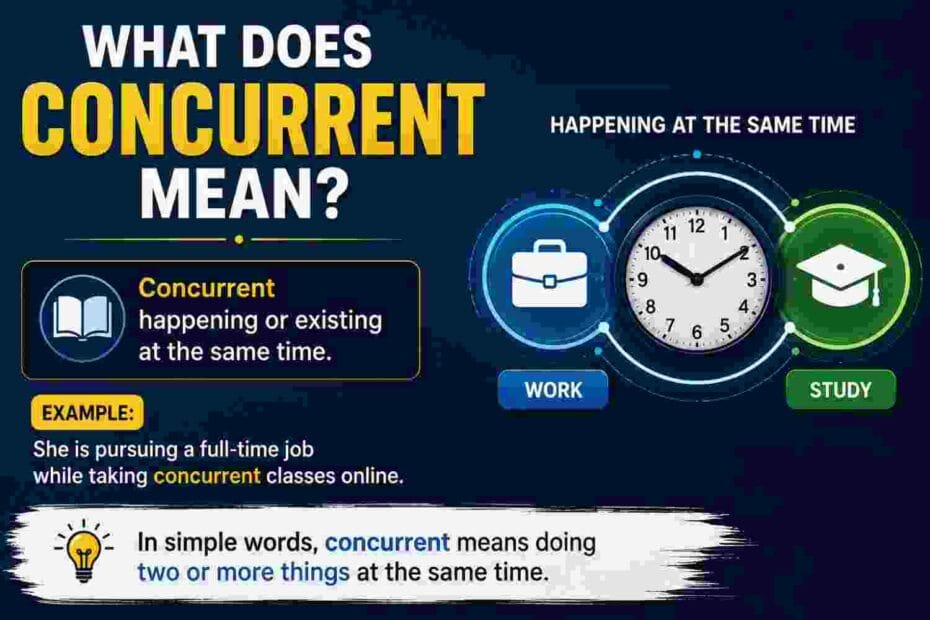
Concurrent means two or more things happening at the same time, running alongside each other rather than one after another. Think of two trains leaving the station at the exact same moment on parallel tracks.
Nothing here is sequential. Concurrent events overlap in time, sharing the same window rather than waiting their turn.
The Latin “concurrere,” which means to run together, is where the word originates.That origin actually explains the modern meaning perfectly, since concurrent things really do run together in time.
Concurrent vs Consecutive: The Key Difference
People confuse these two words constantly, and the mix-up creates real problems in legal and business settings. Here’s the simple distinction that clears it up instantly.
- Concurrent means things happen simultaneously, overlapping in the same timeframe
- Consecutive means things happen one after another, in sequence, without overlap
If you serve two sentences concurrently, you serve them at the same time. If you serve them consecutively, you finish one before the next begins.
What Does Concurrent Mean In Legal Terms?
Legal contexts use “concurrent” constantly, especially around sentencing and jurisdiction. Getting this wrong can mean the difference between years of freedom.
Concurrent Sentences Explained
A concurrent sentence means a person convicted of multiple crimes serves all sentences at the same time. If someone receives two five-year sentences concurrently, they serve a total of five years, not ten.
Judges often choose concurrent sentencing for related offenses committed during a single event. This differs sharply from consecutive sentencing, where time gets added together.
- Concurrent sentences run simultaneously, overlapping fully or partially
- Total time served equals the longest single sentence, not the combined total
- Judges typically use discretion based on the severity and connection between charges
- Some jurisdictions have mandatory concurrent or consecutive rules for specific crimes
Concurrent Jurisdiction
This term describes a situation where more than one court has legal authority over the same case. Both state and federal courts, for example, might have concurrent jurisdiction over certain disputes.
That overlap gives plaintiffs a choice about where to file their case. Attorneys often study this option carefully since different courts can produce very different outcomes.
What Does Concurrent Mean In Computer Science?
Tech professionals use “concurrent” in a way that trips up beginners constantly. This meaning focuses on how a computer manages multiple tasks.
Concurrent Programming Basics
Concurrent programming allows a system to handle multiple processes during overlapping time periods. It doesn’t always mean tasks execute at the exact same instant.
Instead, a processor might rapidly switch between tasks, creating the illusion of simultaneous execution. This differs from true parallel processing, where separate processors handle separate tasks at the exact same moment.
- Concurrency manages multiple tasks that can start, run, and complete in overlapping periods
- Parallelism actually executes multiple tasks at the exact same instant using multiple processors
- Concurrent systems improve efficiency by not letting one slow task block everything else
- Common examples include web servers handling thousands of user requests simultaneously
Why This Distinction Matters For Developers
Confusing concurrency with parallelism leads to bad architecture decisions. A single-core processor can run concurrent tasks but cannot truly run tasks in parallel.
Understanding this difference helps developers pick the right tools for performance problems. It’s a small distinction with a massive impact on how software actually behaves under load.
What Does Concurrent Mean In Everyday Business Language?
Outside courtrooms and code, “concurrent” shows up constantly in workplaces and scheduling. The core meaning stays the same, but the stakes look different.
Concurrent Enrollment In Education
High school students sometimes take concurrent enrollment courses, earning college credit while still completing high school requirements. Both enrollments exist at the same time, hence the term.
This setup saves families real money on future tuition costs. It also gives students a genuine preview of college-level coursework before they commit to a full campus experience.
Concurrent Employment
Some professionals hold concurrent jobs, working two positions during the same general time period. This differs from switching jobs sequentially over separate years.
Many employment contracts include clauses addressing concurrent employment directly. Employers want clarity about whether outside work creates conflicts of interest.
Concurrent Meaning Across Different Fields: Quick Comparison
Seeing all these meanings side by side makes the pattern click faster than reading each definition separately.
| Field | What Concurrent Means | Real Example |
|---|---|---|
| Law (Sentencing) | Multiple sentences served at the same time | Two 3-year sentences served together as 3 years total |
| Law (Jurisdiction) | Multiple courts having authority over a case | State and federal courts both eligible to hear a dispute |
| Computer Science | Multiple processes running in overlapping time | A server handling thousands of requests at once |
| Education | Enrolled in two programs simultaneously | High school student earning college credit early |
| Employment | Holding two jobs during the same period | Freelancing while working a full-time position |
| Insurance | Multiple policies covering the same period | Two health plans active during identical dates |
Notice the pattern across every single row. Every field keeps the same core idea: things overlapping in time rather than lining up one after another.
That consistency is actually good news for anyone trying to master this word. Once the base concept clicks, applying it to a new field becomes almost automatic.
Common Mistakes People Make With “Concurrent”
Even fluent English speakers misuse this word regularly. Here are the slip-ups worth avoiding.
- Using “concurrent” when they actually mean “consecutive” or “sequential”
- Assuming concurrent computing always means instant simultaneous execution
- Mixing up concurrent jurisdiction with exclusive jurisdiction in legal writing
- Writing “concurrently” when a simpler word like “simultaneously” would read more naturally
Small wording mistakes like these can genuinely change the meaning of a legal document or technical report. Precision matters more than people expect, especially in professional writing.
How To Use “Concurrent” Correctly In A Sentence
Seeing the word in real sentences helps cement the meaning far better than definitions alone. Here are natural examples across different contexts.
- “The judge ordered the sentences to run concurrently, reducing the total prison time.”
- “Our servers handle over ten thousand concurrent users during peak traffic hours.”
- “She completed her degree through a concurrent enrollment program in high school.”
- “Both companies filed lawsuits under concurrent jurisdiction in separate courts.”
- “He worked two concurrent jobs during his final year of college.”
Each sentence keeps the same core idea intact: overlap in time. Once you spot that pattern, using the word correctly becomes second nature.
Frequently Asked Questions
What does concurrent mean in one simple sentence?
Concurrent means two or more things happening or existing during the same period of time, rather than one after another.
Is concurrent the same as simultaneous?
They’re extremely close in meaning, though “simultaneous” often implies the exact same instant, while “concurrent” allows for overlapping time periods that don’t have to start together.
What does concurrent sentence mean in prison terms?
A concurrent sentence means someone serves multiple prison sentences at the same time, so the total time served equals the longest sentence rather than the sum of all sentences.
What’s the opposite of concurrent?
The opposite is “consecutive,” meaning events happen one after another in sequence rather than overlapping in time.
What does concurrent mean in computer science specifically?
In computing, concurrent means a system manages multiple tasks during overlapping time periods, even if it processes them by rapidly switching rather than executing them at the exact same instant.
Can concurrent and consecutive sentences be combined?
Yes, judges often mix both, ordering some charges to run concurrently with each other while running consecutively with a separate group of charges.
Why do employment contracts mention concurrent employment?
Employers include this language to clarify rules around employees holding a second job during the same time period, often to prevent conflicts of interest.
Final Takeaway
Understanding what does concurrent mean really comes down to one image: things running side by side instead of standing in line. Whether it shows up in a courtroom, a codebase, or a college transcript, that overlapping-time concept never changes.
Next time you see this word in a contract or a tech article, you won’t pause in confusion anymore. You’ll know exactly what’s happening, and that small bit of clarity can save you from a costly misunderstanding down the road.