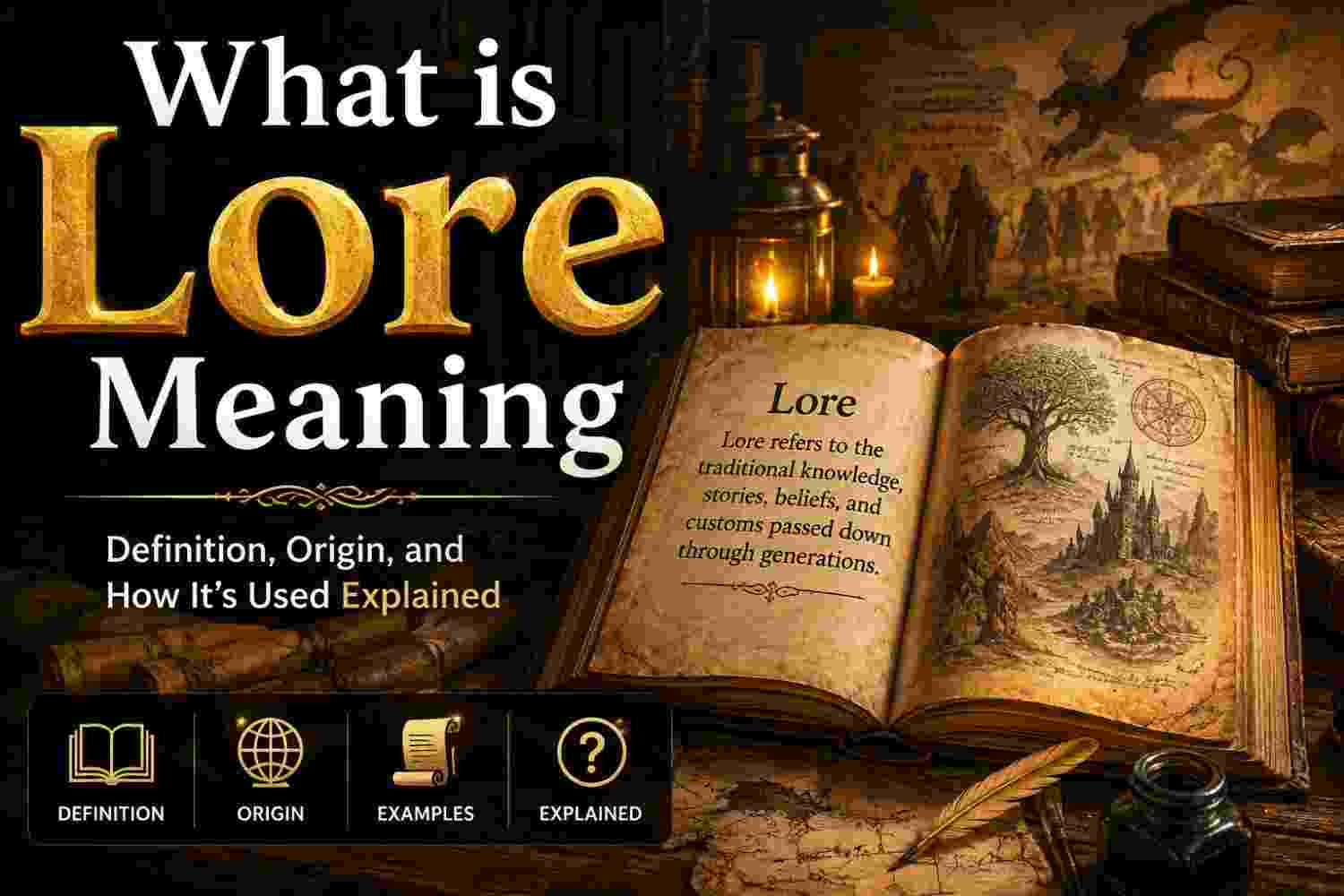
Have you ever finished a movie or closed a book and felt a strange ache, like you were leaving a real place behind? That isn’t just good writing; that is the gravitational pull of well-crafted lore. If you have found yourself scratching your head asking, “What is lore meaning, exactly?”, you are not alone. Most people feel it, but very few can define it.
It is more than just a backstory. It is the difference between a flat character and a person you feel you have known your whole life.
In this guide, we are going to tear apart the definition of lore, show you why it matters more than plot, and give you the secrets to building a universe that audiences refuse to leave.
Understanding the True Definition of Lore
Before we get into the weeds of storytelling, we need to strip the word down to its core. It is a term that gets thrown around in fan forums and writer’s rooms constantly, but its meaning often gets muddy.
The Etymology and History
The word “lore” comes from the Old English lār, which simply meant instruction or knowledge. Historically, it was the passing down of customs, laws, and beliefs through spoken word rather than written text. Think of folklore or herbal lore—these weren’t just trivia; they were survival guides wrapped in narrative.
That historical context is crucial. Lore is not just information. It is information that has been lived in. It carries the weight of generations. When you apply that to a modern setting, you are creating a sense that the world existed long before the protagonist arrived on the scene.
Lore vs. Plot vs. Backstory
A common mistake is thinking these three terms are interchangeable. They are not. Understanding the distinction is the first step to mastering narrative structure.
- Plot is what happens.
- Backstory is the history of a specific character.
- Lore is the history of the world and the rules that govern it.
If a character is afraid of fire, that is backstory. If the entire kingdom is afraid of fire because dragons ruled the sky a thousand years ago, that is lore. Lore sets the stakes for the world. Backstory sets the stakes for the individual.
Why Lore is the Ultimate Retention Weapon
Why do we care so much about the deeper meaning of lore? Because it creates obsession. When an audience understands the rules of your universe, they start engaging with it on a predictive level. They theorize, they argue, and they speculate.
This is the holy grail for creators. You want people to think about your story when they are in the shower or stuck in traffic.
Lore provides the sandbox for the audience to play in. When the plot stops moving, the lore keeps the audience engaged. It gives them a reason to re-read or re-watch to look for hidden clues they missed the first time.
The 7 Powerful Secrets to Building Addictive Lore
Creating compelling lore meaning isn’t about dumping a history textbook on your reader in the first chapter. It is an art of trickle-feeding information. Here are the seven secrets used by the best world-builders in the business.
1. The Iceberg Theory (Show, Don’t Tell)
Ernest Hemingway’s principle applies perfectly here. You should only show the reader about 10% of the lore you have created. The other 90% should be implied.
If you have a religious system, don’t explain the entire theology. Have a character light a candle for the “Lost Sun” and walk away. The reader’s brain will fill in the gaps. That act of filling gaps is what creates immersion. It turns the audience from a passive observer into an active participant.
2. Establish Clear Rules and Limitations
Nothing kills a story faster than a magic system or a technology that can do anything. Lore exists to establish boundaries. If your universe has interstellar travel, what is the cost? Is it fossil fuel, human energy, or time dilation?
When you define what characters cannot do, you create conflict. If a hero cannot cross running water because of an ancient pact (lore), that limitation forces the writer to be creative. Constraints breed innovation.
3. Economy of Language
You do not need a thousand words to explain a war. You need a single, visceral image.
Instead of saying, “There was a great battle ten years ago that killed many people,” you say, “The battlefield is still white with bone dust.” That is lore working efficiently. It tells the reader a fact about the past while setting a mood for the present.
4. The “Unreliable Narrator” Approach
Human history is messy. We lie, we exaggerate, and we have biases. Your fictional lore should be the same. Have two different factions tell two different versions of the same origin story.
This not only adds realism but also forces the reader to pay attention. They must choose whom to believe. This engagement is what separates a forgettable story from a classic.
5. Integrate Lore into Daily Life
Lore should not just exist in temples and libraries. It should be in the slang people use, the food they eat, and the way they greet each other.
If a dragon burned the capital city 500 years ago, perhaps the people now have a greeting that means “Keep the flame low.” Maybe their architecture lacks wooden roofs. Weaving the history into the mundane details makes the world feel tangible and logical.
6. Mystery Over Exposition
Never explain the monster. The moment you fully explain the lore, the mystery dies. Keep a “black box” element in your universe.
There should always be a “Forbidden Zone” on the map or a “Nameless God” in the pantheon. This leaves room for sequels, spin-offs, and, most importantly, fan theories. The unknown is always scarier and more exciting than the known.
7. Emotional Truths
The best lore is metaphorical. It explains something about the human condition. A zombie virus isn’t scary because of the gore; it is scary because of the lore implication that “we are the virus.”
If your lore doesn’t connect back to a real-world fear or desire, it will feel hollow. Ask yourself: what is the theme of my story? Ensure the lore of your world reinforces that theme.
How to Format Lore Without Boring Your Reader
The biggest hurdle for writers is the “info dump.” You have all this great lore meaning, and you want to show it off. Resist the urge. Here is how you layer it in naturally.
The Rule of Cool vs. The Rule of Logic
There is a constant tug-of-war in world-building between doing something awesome and doing something that makes sense.
| Element | Rule of Cool (High Risk) | Rule of Logic (High Reward) |
|---|---|---|
| Weapons | Giant swords that explode for no reason. | Swords forged from meteorite metal, making them magnetic. |
| Magic | Spells that do whatever the plot needs. | Magic that requires equivalent exchange or physical sacrifice. |
| Geography | A city floating because it looks neat. | A city floating to escape a toxic gas layer on the surface. |
| Audience Feel | Momentary excitement, long-term confusion. | Deep satisfaction, long-term trust. |
Analysis: While the “Rule of Cool” can get a reader to turn the page initially, it breaks trust over time. If anything can happen, nothing matters. The “Rule of Logic” makes the audience feel smart. If they can predict the lore-based solution before the hero figures it out, you have won.
What is Lore Meaning in Different Genres?
The application of lore changes drastically depending on where you are building your world. The mechanics remain the same, but the focus shifts.
Fantasy and Sci-Fi Lore
In speculative fiction, lore is often the most visible part of the story. You are building physics, biology, and religion from scratch. The danger here is over-complexity.
If your sci-fi lore requires a flowchart to understand how the warp drive works, you have lost 90% of your audience. The lore should serve the character arc. How does the existence of cloning (lore) affect a person’s sense of identity (theme)?
Corporate and Brand Lore
We don’t just see this in books. Brands use lore heavily. Think about fast-food mascots or luxury car manufacturers.
A brand like Rolex has lore. The story of Sir Edmund Hillary wearing one up Everest is lore. It is history that adds value to the product. It tells you, “This isn’t just a watch; it is a piece of history.” This proves that lore meaning is not just fictional; it is a psychological pricing tool.
Real-World Family Lore
You likely have lore in your own family. Those stories you tell at Thanksgiving about your grandfather’s journey to the country or the time the house almost burned down—that is family lore.
It is the narrative glue that holds cultures together. We tell these stories to teach values (resilience, caution, humor) to the next generation. The “meaning” of this lore is identity. It tells us who we are and where we came from.
Common Lore Mistakes That Kill Reader Interest
Even seasoned professionals fall into these traps. If you are seeing low engagement on your stories, check if you are guilty of one of these narrative sins.
- The Prequel Trap: Explaining every detail of a character’s past until they no longer feel mysterious.
- Retconning Chaos: Changing the established rules of the lore because you wrote yourself into a corner. This breaks the audience’s trust immediately.
- The “Chosen One” Cliché: Lore that conveniently revolves entirely around the main character. Real history doesn’t care about one person; it is vast.
- Static Worlds: The lore never changes. History should be moving, even in the background of the story.
Frequently Asked Questions
1. Is lore more important than character development?
They are two sides of the same coin. A character is a product of their environment. If the lore (environment) is weak, the character’s motivations often feel baseless. You cannot have a deeply religious character without the lore of the religion that shaped them.
2. How do I reveal lore without exposition?
Use artifacts. Have a character walk through a town square and look at a statue. The inscription on the statue can tell the reader about a war, a victory, and a societal value without a single line of dialogue or narration.
3. What is the difference between lore and canon?
Canon is the “official” fact of the story as determined by the creator. Lore is the accumulation of history and customs within that canon. Sometimes, “fan lore” contradicts canon, leading to what fans call “headcanon.”
4. Can video games have better lore than books?
Video games have a unique advantage: environmental storytelling. The player can find a skeleton clutching a bottle under a desk. The lore is told through the environment, not just text. This interactivity makes the lore feel more personal to the player.
5. Why does everyone love “lore” so much right now?
In a world that often feels chaotic, diving into a fully realized universe with clear rules (lore) provides a sense of order and control. It is a form of escapism that rewards attention to detail.
6. Should I write all my lore down before starting the story?
You should have the rules written down to ensure consistency. However, do not write the entire history book before writing the story. You will waste time and likely over-explain in the manuscript. Build the scaffolding, not the paint.
Final Verdict: Stop Explaining, Start Implying
If you take one thing away from this guide, let it be this: the meaning of lore is found in the weight of time. It is the dust on the windowsill of your narrative house. To use it effectively, you must trust your audience.
Stop trying to explain everything. Leave shadows in the corner of your map. The moment you allow the reader to fill in the blanks, the world becomes partially theirs. And we never stop caring about the things we helped build. Master this, and you won’t just have readers; you will have disciples.