Skink Definition & Meaning: What Is a Skink and Why Does It Matter?
Introduction
You spotted a shiny, fast-moving creature darting through leaf litter, and now you’re asking — what exactly was that? If it had smooth, overlapping scales and tiny legs that seemed almost decorative, you likely just met a skink. The skink meaning goes beyond a simple dictionary entry. These lizards are ancient, adaptable, and found on nearly every continent. This guide covers everything — from biology and behavior to habitat, diet, and what it means to keep one as a pet.
What Is the Skink Meaning? A Clear Definition
The word skink refers to any lizard belonging to the family Scincidae, one of the largest lizard families on Earth. The term traces back to the Latin scincus and Greek skinkos, both used in ancient texts to describe smooth-scaled lizards of North Africa and the Middle East.
Today, the skink meaning in modern biology is straightforward: a member of Scincidae characterized by overlapping, cycloid scales, a cylindrical body, and — in many species — reduced or even absent limbs.
There are over 1,500 recognized skink species worldwide, making Scincidae the second-largest family of lizards. That number alone tells you something important: the skink is not a single animal. It is an entire evolutionary lineage that has radiated across the globe over roughly 100 million years.
Skink Definition & Meaning: Quick-Reference Table
| Feature | Detail |
|---|---|
| Scientific Family | Scincidae |
| Total Known Species | 1,500+ |
| Size Range | 3 cm (dwarf skinks) to 72 cm (Solomon Islands skink) |
| Body Shape | Elongated, cylindrical, with smooth overlapping scales |
| Limb Status | Fully limbed to completely limbless (varies by species) |
| Distribution | Every continent except Antarctica |
| Diet | Omnivorous to insectivorous (species-dependent) |
| Reproduction | Oviparous and viviparous species both exist |
| Lifespan (wild) | 5–20 years depending on species |
| Popular Pet Species | Blue-tongued skink, fire skink, five-lined skink |
How Do You Pronounce Skink?
The word skink rhymes with “drink” — one syllable, hard K sounds on both ends: /skɪŋk/. There is no silent letter, no tricky vowel shift. Say it fast and firm, and you have it right.
What Does a Skink Look Like?
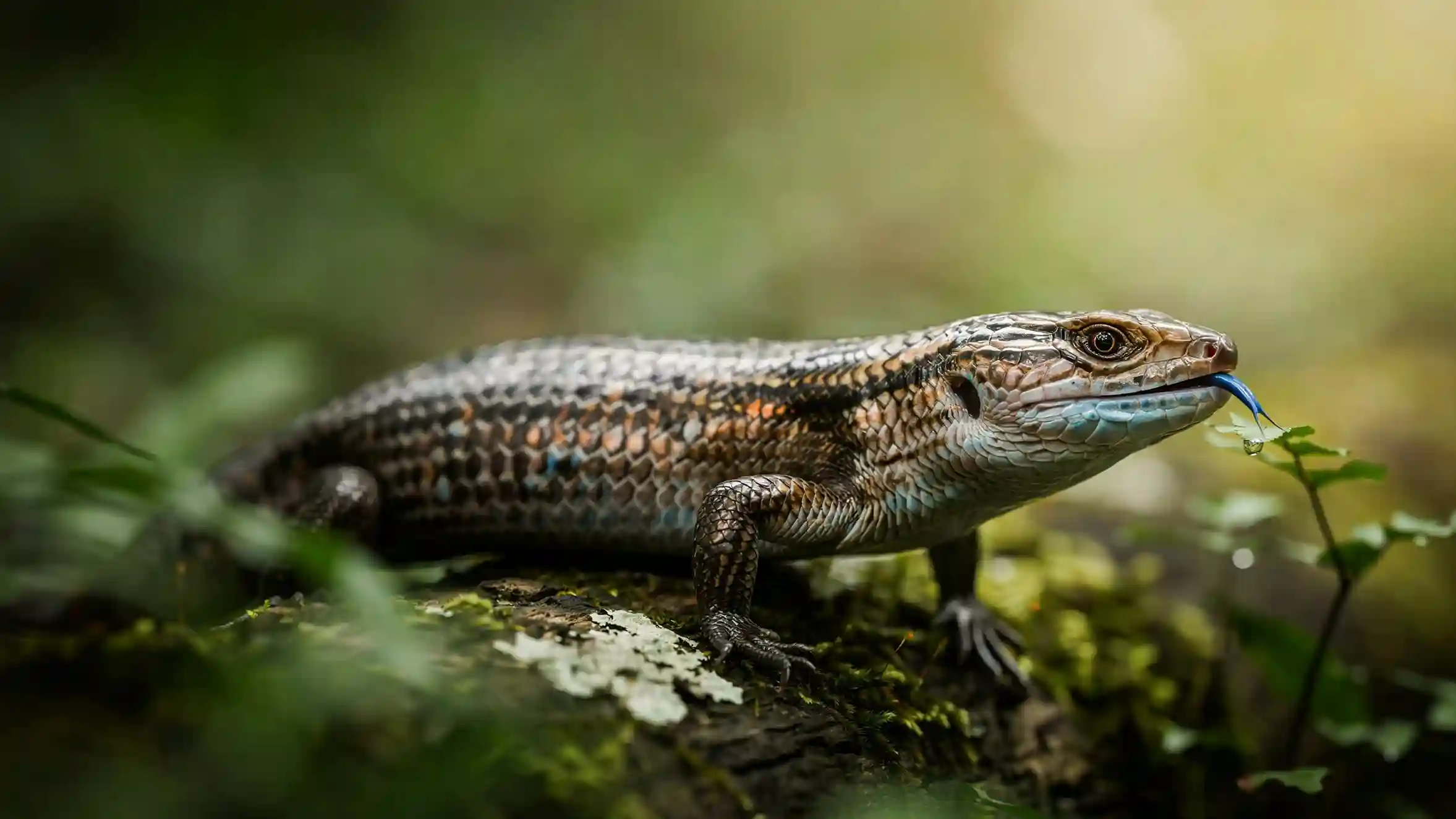
Most people recognize a skink immediately once they know what to look for. The body is long and narrow, almost snake-like in proportions. The scales are smooth and glossy, not rough or bumpy like some lizards. When light hits a skink’s back, you often see an almost metallic shimmer — which is why many people describe skinks as looking “polished.”
The legs on most skink species are short and positioned to the sides of the body. They move with a sinuous, wave-like motion that uses the whole spine, not just the legs. Some species, like the sandfish skink (Scincus scincus) of North Africa, have evolved such reduced limbs that they swim through sand rather than walk on it.
Common physical traits across skink species:
- Smooth, overlapping scales — cycloid (rounded) in shape
- Recessed ear openings — visible but small
- Pointed or slightly flattened snout
- Long, tapering tail — often brightly colored in juveniles as a predator-distraction device
- Moveable eyelids — unlike snakes, skinks blink
What Is the Skink Meaning in Different Contexts?
Biological Context
In biology, the skink meaning refers specifically to members of Scincidae. Herpetologists use the term to distinguish these lizards from geckos, iguanas, monitor lizards, and other groups. Skinks occupy a unique ecological role as mid-level consumers — eating insects and small invertebrates while serving as prey for birds, snakes, and small mammals.
Cultural and Folklore Context
In ancient Egypt and Rome, skinks (particularly the North African Scincus scincus) appeared in medical texts as ingredients in remedies. Pliny the Elder described them in Naturalis Historia as having aphrodisiac and healing properties — a claim modern science has not supported, but one that placed skinks in written records over 2,000 years ago.
In parts of West Africa and Southeast Asia, certain skink species carry symbolic meaning in local traditions — sometimes representing speed, adaptability, or protection.
Common Name Confusion
The word “skink” sometimes gets confused in casual conversation. People occasionally use it loosely to describe any small, fast lizard. Technically, not all small lizards are skinks — geckos, anoles, and fence lizards belong to entirely different families. A true skink is only a member of Scincidae.
Where Do Skinks Live? Habitat and Distribution
Skinks are among the most geographically widespread reptiles on Earth. Their ability to colonize different environments explains why the skink meaning in ecology often includes the phrase “habitat generalist.”
Primary skink habitats include:
- Tropical rainforests — home to arboreal species like the emerald tree skink (Lamprolepis smaragdina) of Southeast Asia
- Arid deserts — including the sandfish skink of the Sahara and sand skinks of the American Southwest
- Temperate woodlands — where species like the five-lined skink (Plestiodon fasciatus) thrive under logs and leaf litter
- Grasslands and savannas — many African skink species occupy open country with sparse vegetation
- Coastal and island environments — island species are particularly species-rich in the Pacific and Indian Oceans
- Urban areas — several skink species have adapted successfully to gardens, parks, and suburban green spaces
The Solomon Islands skink (Corucia zebrata) holds the record as the largest living skink species, reaching up to 72 centimeters in total length and living exclusively in the forest canopy of the Solomon Islands.
What Do Skinks Eat? Diet and Feeding Behavior
Diet varies significantly by species, but most skinks fall into one of three feeding categories:
1. Insectivorous Skinks The majority of skink species eat insects, spiders, worms, and small arthropods. The five-lined skink, common across eastern North America, hunts actively through leaf litter for beetles, crickets, and caterpillars.
2. Omnivorous Skinks Blue-tongued skinks (Tiliqua spp.) of Australia eat a wide range — insects, snails, fruit, berries, flowers, and even carrion. Their broad diet makes them highly adaptable and successful in varied environments.
3. Herbivorous Skinks True plant-eaters among skinks are rare but exist. The Solomon Islands skink is one of the few predominantly herbivorous skink species, eating leaves, fruit, and flowers almost exclusively.
Hunting strategy: Most skinks are active foragers — they move through their environment searching for food rather than sitting still and ambushing prey. Their sharp senses of smell and vibration detection guide them to meals.
How Do Skinks Reproduce?
The skink meaning in reproductive biology reveals something genuinely unusual: unlike most reptile families, skinks include both egg-laying (oviparous) and live-bearing (viviparous) species — and some that fall in between (ovoviviparous, where eggs hatch internally).
Egg-laying species: The five-lined skink lays 4–15 eggs in moist soil or rotting wood, and the female stays with the eggs until they hatch — a relatively rare maternal behavior in lizards.
Live-bearing species: Blue-tongued skinks give birth to fully formed young — litters of 5 to 25 offspring depending on the individual. Newborns are miniature adults, fully capable of foraging within days of birth.
This reproductive flexibility is one reason skinks have thrived across such varied environments. Live-bearing works better in cold climates where buried eggs might not receive enough warmth; egg-laying works well in stable, warm soil conditions.
Are Skinks Dangerous? Safety Facts You Should Know
No. Skinks pose no meaningful danger to humans. They carry no venom, have no toxic bite, and their teeth — though present — are too small to break skin in any significant way on most species.
Common skink defense mechanisms include:
- Tail autotomy — dropping the tail when grabbed by a predator; the tail regrows over several months
- Burrowing — retreating underground or under leaf litter at speed
- Color warning — blue-tongued skinks open their mouths wide and display their vivid blue tongue to startle predators
- Camouflage — many species have striped or speckled patterns that break up their outline in vegetation
A few large species like the blue-tongued skink can deliver a firm bite if handled roughly, but it causes no more harm than a pinch. Skinks are not aggressive animals; they flee before they fight.
Types of Skinks: Most Well-Known Species
Understanding the skink meaning fully means knowing the range of diversity within the family. Here are the most recognized species:
Blue-Tongued Skink (Tiliqua spp.)
Native to Australia and parts of Indonesia. Heavy-bodied, slow-moving, and famous for their cobalt-blue tongues. Popular as pets due to their docile temperament and manageable size (40–60 cm).
Five-Lined Skink (Plestiodon fasciatus)
Common across the eastern United States. Young individuals have a brilliant electric-blue tail that fades to brown with age. Often seen basking on logs, fence posts, and rocky outcrops.
Sandfish Skink (Scincus scincus)
Found across North Africa and the Middle East. Their fringed toes and streamlined body allow them to “swim” beneath sand — a remarkable evolutionary adaptation to desert life.
Fire Skink (Mochlus fernandi)
Native to West Africa. Striking red, black, and gold coloration. Active and curious, which makes them popular in the reptile hobby.
Emerald Tree Skink (Lamprolepis smaragdina)
Found across Southeast Asia and the Pacific. Bright green, arboreal, and fast-moving — one of the few skink species adapted to life entirely in the tree canopy.
Schneider’s Skink (Eumeces schneiderii)
Native to North Africa, the Middle East, and Central Asia. The species Pliny the Elder likely wrote about in ancient Roman texts. Considered the original “skink” in Western historical records.
Solomon Islands Skink (Corucia zebrata)
The world’s largest skink species. Arboreal, herbivorous, and one of the few reptiles with a prehensile tail. Females give birth to a single large offspring rather than a litter.
Skink vs. Lizard: What Is the Difference?
Every skink is a lizard, but not every lizard is a skink. The skink meaning fits within the broader category “lizard” the same way “terrier” fits within “dog.”
| Feature | Skink | General Lizard |
|---|---|---|
| Family | Scincidae only | Any of 40+ lizard families |
| Scale texture | Smooth, polished, cycloid | Varies widely (keeled, granular, etc.) |
| Body shape | Elongated, low-profile | Highly variable |
| Leg development | Often reduced | Usually well-developed |
| Eyelids | Moveable | Varies (geckos have fused lids) |
| Ear opening | Small, visible | Varies |
| Tail behavior | Autotomy common | Varies by family |
The most common confusion is between skinks and glass lizards (Ophisaurus spp.), which are legless and look snake-like. Glass lizards belong to family Anguidae, not Scincidae — so despite looking similar to limbless skinks, they are a completely separate evolutionary lineage.
Can You Keep a Skink as a Pet?
Yes — and for the right person, skinks make excellent pets. The skink meaning in the context of captive care centers on providing conditions that match their natural habitat.
Best pet skink species for beginners:
- Blue-tongued skink — calm, handleable, adaptable to captivity, long-lived (15–20 years)
- Fire skink — active and visually striking; needs humid conditions
- Schneider’s skink — hardy and curious; does well in dry setups
Basic care requirements for most pet skinks:
- Enclosure size: Minimum 120 × 60 cm floor space for adult blue-tongued skinks
- Temperature gradient: Warm end 32–35°C, cool end 22–24°C
- Lighting: Full-spectrum UVB lighting for 10–12 hours daily
- Substrate: Coconut fiber, topsoil mix, or cypress mulch — deep enough to allow burrowing
- Diet: Species-appropriate mix of protein (insects, lean meat) and plant matter
- Humidity: Varies — sandfish skinks need dry conditions; fire skinks need 60–80% humidity
Always source skinks from reputable captive breeders rather than wild collection. Wild-caught animals carry higher parasite loads and experience significant stress in captivity.
What Role Do Skinks Play in Ecosystems?
Skinks are more ecologically important than their size suggests. As insect predators, they regulate populations of beetles, caterpillars, and other invertebrates that would otherwise damage plant life. As prey animals, they transfer energy up the food chain to birds, snakes, foxes, and larger reptiles.
Several island skink species also serve as seed dispersers — eating fruit and depositing seeds in new locations through their droppings, which contributes to forest regeneration. Research published in Proceedings of the Royal Society B has documented this seed dispersal role as critical on certain Pacific islands where skinks are among the only native fruit-eating vertebrates remaining.
In agricultural settings, skinks actively consume pest insects — making them quiet allies for farmers who allow natural habitat at field margins.
Are Skinks Endangered? Conservation Status
Many skink species face serious conservation pressure. Habitat destruction, invasive species (particularly rats and cats on islands), and illegal collection for the pet trade have pushed multiple species toward extinction.
The IUCN Red List currently lists hundreds of skink species with conservation concern designations, including:
- Christmas Island blue-tailed skink (Cryptoblepharus egeriae) — extinct in the wild; now survives only in captive insurance colonies
- Cunningham’s skink (Egernia cunninghami) — vulnerable due to habitat fragmentation in Australia
- Gran Canaria skink (Chalcides sexlineatus) — under pressure from tourism development and invasive species
Conservation organizations including the Zoological Society of London and the IUCN SSC Lizard Specialist Group actively manage captive breeding programs for the most threatened skink species.
6 Frequently Asked Questions About Skink Meaning
Q1: What is the simple skink meaning for kids?
A skink is a type of lizard with smooth, shiny scales and a long body.
Q2: Is a skink poisonous or venomous?
No — skinks are neither poisonous nor venomous.
Q3: What does a skink meaning look like in appearance terms?
Smooth, shiny, elongated body with short legs and a long pointed tail.
Q4: Where did the word “skink” originally come from?
From the Latin scincus and Greek skinkos, both meaning a type of small lizard.
Q5: What is the difference between a skink and a gecko?
Skinks have moveable eyelids, smooth cycloid scales, and belong to Scincidae; geckos have fused transparent eyelids, granular or tuberculate scales, and belong to Gekkota.
Q6: Can a skink live in a house as a pet?
Yes — several skink species make excellent, manageable pets for people who research their needs beforehand.
How to Identify a Skink in the Wild
Follow these steps when you encounter a small lizard and want to confirm the skink meaning applies:
- Check the scales — Are they smooth and glossy? Skink scales overlap and reflect light.
- Look at the body shape — Is it long and cylindrical with a pointed snout? That matches the skink profile.
- Observe the legs — Short legs positioned to the sides, or possibly absent. The animal moves with a full-body wave even if it has legs.
- Check the ear — Skinks have a small but visible ear opening on the side of the head.
- Watch the eyelid — Does it blink? Skinks blink; geckos do not.
- Note the tail — Is it long and tapering? Does it look slightly different in color or texture from the body? In juveniles, a bright blue tail is a strong skink indicator.
If you are in North America and the animal has five cream or yellow stripes running head-to-tail, you almost certainly have a five-lined skink (Plestiodon fasciatus) — one of the most commonly seen skinks on the continent.
Interesting Skink Facts Worth Knowing
- The sandfish skink can completely submerge itself in loose sand within 0.15 seconds — one of the fastest burrowing movements recorded in any animal.
- Blue-tongued skinks are ovoviviparous — they carry eggs internally that hatch before birth, producing live young without a placenta in the way mammals have one.
- Some skink species in Australia and New Zealand show true social behavior — living in family groups where adults help protect offspring, which is extremely rare in reptiles.
- A skink tail, once dropped through autotomy, will continue moving on the ground for several minutes — a deliberate mechanism designed to distract predators long enough for the skink to escape.
- The Mola skink (Eutropis macularia) of South and Southeast Asia is among the most studied skinks in reproductive biology due to its variation between egg-laying and live-bearing populations across its range.
Sources and References
- Uetz, P. et al. (2024). The Reptile Database. reptile-database.org — primary taxonomic reference for Scincidae species count and classification.
- Pianka, E.R. & Vitt, L.J. (2003). Lizards: Windows to the Evolution of Diversity. University of California Press — foundational text on lizard ecology and evolution.
- IUCN Red List of Threatened Species (2025). Scincidae assessment data. iucnredlist.org — conservation status for skink species worldwide.
- Pliny the Elder (77 CE). Naturalis Historia, Book VIII — historical documentation of Scincus scincus in Roman natural history writing.
- Blackburn, D.G. & Flemming, A.F. (2012). “Invasive implantation and intimate placental associations in a placentotrophic African lizard, Trachylepis ivensi.” Journal of Morphology, 273(2), 137–159 — peer-reviewed research on skink reproductive diversity.
What You Now Know About Skink Meaning
The skink meaning stretches from a simple dictionary label to a full picture of one of nature’s most successful lizard lineages. These animals have existed for over 100 million years. They have adapted to deserts, rainforests, grasslands, and even urban gardens. Some lay eggs; some give birth to live young. Some have four legs; some have none. The family holds over 1,500 species and spans every continent except Antarctica.
If you spotted a shiny, fast-moving lizard in your garden or on a hiking trail, now you know exactly what you were looking at — and why it matters. Skinks keep insect populations in check, disperse seeds, and feed the animals higher up the food chain. They are quiet, harmless, and ecologically valuable.
Want to go deeper? Explore species profiles for blue-tongued skinks, five-lined skinks, or sandfish skinks to see how each one has taken the basic skink blueprint and pushed it in a completely different direction. Or, if you’re considering a pet skink, connect with a reptile specialist vet in your area before making any decision — the right start makes all the difference for a 15-year companionship.
Article reviewed for accuracy against current Scincidae taxonomy (The Reptile Database, 2024) and IUCN conservation data (2025). All care recommendations align with current captive husbandry standards published by the British Herpetological Society and the Association of Reptilian and Amphibian Veterinarians (ARAV).
By a Reptile Biology & Wildlife Educator | Updated June 2026