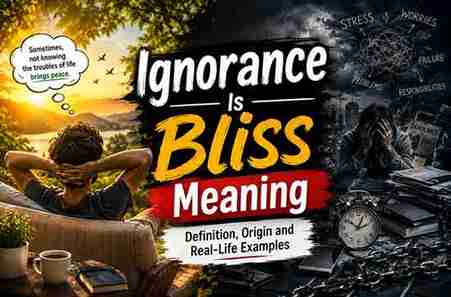
You’ve heard the phrase “ignorance is bliss” tossed around, but its true meaning often gets twisted. Many people assume it’s a blanket endorsement of sticking your head in the sand, which can lead to poor decisions and missed opportunities. This guide untangles the real ignorance is bliss meaning, so you can understand when not knowing genuinely protects your peace—and when it puts you at risk.
The Core Ignorance Is Bliss Meaning
At its simplest, the ignorance is bliss meaning points to the idea that not knowing uncomfortable truths can bring more happiness than facing them head‑on. When you remain unaware of a hurtful comment, a looming problem, or an unsettling fact, your mind stays calm. The moment that knowledge enters, peace often evaporates.
The phrase doesn’t tell you to avoid all information. It observes a basic human pattern: what you don’t know can’t hurt your feelings right now. Grasping the full ignorance is bliss meaning requires stepping beyond this surface definition. You’ll need to see where it came from, why our brains work that way, and how the principle plays out in real life.
Where Did “Ignorance Is Bliss” Come From? The Thomas Gray Connection
The line first appeared in Thomas Gray’s 1742 poem “Ode on a Distant Prospect of Eton College.” While watching schoolboys at play, Gray reflected on the innocence of childhood and wrote, “Where ignorance is bliss, ’tis folly to be wise.” He wasn’t celebrating a permanent state of cluelessness. The poet recognized that children enjoy a temporary shield from the harsh truths adulthood will later dump on them.
Gray’s own life, shaped by loss and disappointment, gave his words a bittersweet weight. Once you know his context, the ignorance is bliss meaning stops being a shallow catchphrase. It becomes a snapshot of a fleeting moment before life gets complicated.
Psychological Roots of Blissful Ignorance
Psychologists call the drive behind this proverb “information avoidance.” A landmark study from the Max Planck Institute for Human Development found that people routinely sidestep knowledge that could trigger negative emotions—even when that knowledge would help them make better choices (Hertwig & Engel, 2016). Your brain isn’t just lazy. It’s actively protecting your mood.
This protective instinct explains the ignorance is bliss meaning on a neurological level. When a topic threatens your self-image or stability, your mind can pull the blinds. Short‑term relief wins over long‑term growth. Recognizing this pattern is the first step toward deciding whether to open those blinds or keep them shut.
When Ignorance Really Is Bliss: 5 Everyday Examples
Real life hands you moments where the ignorance is bliss meaning fits perfectly. You feel the benefit immediately—less anxiety, fewer mental spirals, more energy for what matters.
- Not checking your ex‑partner’s social media: Peace hangs intact.
- Skipping spoilers for a new movie: Pure surprise stays on the table.
- Refusing to Google mild symptoms: A headache doesn’t turn into a self‑diagnosed tumor.
- Ignoring petty office gossip: Your focus remains on work, not drama.
- Eating a favorite meal without counting calories: A small joy stays untarnished.
The table below shows how the same scenario flips depending on whether you seek or avoid the truth.
| Situation | If You Stay Ignorant (Bliss) | If You Seek the Truth (Pain) | Verdict |
|---|---|---|---|
| Ex’s social media | You avoid jealousy and rumination. | A single photo pulls you into comparison and hurt. | Bliss wins temporarily. |
| Movie spoilers | Suspense and delight remain intact. | The climax lands flat because you already know it. | Bliss enhances enjoyment. |
| Mild symptoms | No unnecessary panic, stress stays low. | A web search suggests dozens of catastrophic illnesses. | Bliss guards mental health. |
| Office gossip | Relationships stay neutral, work gets done. | You get dragged into factions and second‑guessing. | Bliss preserves professionalism. |
| Favorite meal | You enjoy the taste fully. | You feel guilt or shame, ruining the experience. | Bliss protects simple pleasure. |
The Dark Side of Choosing Not to Know
Apply the ignorance is bliss meaning in the wrong place, and trouble brews silently. A partner who ignores early signs of emotional distance wakes up to a breakup that blindsides them. A person who skips the doctor because they’d rather not know about a lump risks a late‑stage diagnosis. Financially, avoiding a bank balance until bills pile up turns small oversights into debt spirals.
Willful ignorance sets a trap. What begins as comfort mutates into crisis. The very bliss you chase now charges interest later. The line between helpful avoidance and harmful denial sits right where concrete harm starts outweighing temporary peace.
How Willful Ignorance Affects Your Relationships
Couples often weaponize the ignorance is bliss meaning without realizing it. One partner stops asking tough questions. The other stops offering honest answers. Communication shrinks to safe small talk. Under that quiet surface, resentment breeds.
Research on conflict avoidance shows that unspoken issues don’t disappear—they fester and reappear as explosive arguments or icy distance. Long‑term partnerships thrive on chosen vulnerability, not curated blindness. When you hide behind “I’d rather not know,” you trade connection for an illusion of calm.
Ignorance Is Bliss in Literature and Philosophy
Sophocles didn’t use the exact phrase, but Oedipus Rex is a masterclass in its meaning. Oedipus relentlessly hunts the truth about his origins, only to discover he killed his father and married his mother. The knowledge destroys him. The play asks whether a merciful god would have let him stay ignorant.
Voltaire’s Candide flips the lens. Pangloss insists everything happens for the best, clinging to optimism while horrors pile up around him. His deliberate ignorance becomes absurd. Together, these works frame the ignorance is bliss meaning as a tension—sometimes truth crushes you, but willed blindness erodes your humanity.
The Role of Cognitive Dissonance in Staying Uninformed
Cognitive dissonance describes the mental discomfort you feel when facts clash with your beliefs. To resolve that tension, your brain often discards the facts rather than the beliefs. This mechanism keeps the ignorance is bliss meaning alive in daily habits.
A person who smokes may avoid reading studies on lung cancer. A voter may refuse to fact‑check a favored politician. In both cases, staying uninformed protects a comfortable identity. The mind chooses blissful ignorance because the alternative demands painful change.
Can Ignorance Be a Strategic Life Choice? Experts Weigh In
The Hertwig and Engel study on deliberate ignorance identifies scenarios where avoiding information is a rational strategy. When knowledge carries no actionable benefit and only adds emotional weight, choosing not to know can preserve mental bandwidth.
Take the 24‑hour news cycle. Constant exposure to tragedies you can’t fix raises cortisol without improving a single outcome. Filtering that stream isn’t cowardice; it’s emotional hygiene. The ignorance is bliss meaning, applied strategically, becomes a tool for curating your inner world rather than a blanket excuse.
How to Balance Awareness and Peace of Mind
You don’t have to live at either extreme—blissfully numb or anxiously informed. A middle path exists.
- Set a “worry window.” Schedule 10 minutes daily to face one uncomfortable fact, then move on.
- Curate your notifications. Silence news alerts that don’t serve your immediate decisions.
- Ask the “action test.” Before digging into information, ask, “Will this change what I do tomorrow?” If not, you can delay the pursuit.
- Write it out. Journaling separates real threats from imagined ones so you can act without spiraling.
- Talk to a professional. A therapist helps you build the tolerance to hold difficult truths without crumbling.
These steps let you honor the protective instinct behind the ignorance is bliss meaning while staying clear‑eyed enough to handle life’s demands.
Common Misinterpretations of the Ignorance Is Bliss Proverb
Too many people twist the ignorance is bliss meaning into an endorsement of laziness. It’s not a green light to ignore your tax filings, skip medical screenings, or dodge hard conversations. The original line speaks to a child’s fleeting innocence, not a grown‑up’s permanent escape hatch.
Another mistake is treating the proverb as universally true. Painful knowledge often leads to growth, healing, and stronger bonds. Accepting that duality frees you from using the phrase as a shield against responsibility.
FAQ: Your Burning Questions About Ignorance Is Bliss
What does ignorance is bliss mean in simple terms?
It means that sometimes not knowing something upsetting makes you happier than knowing it would.
Is ignorance really bliss according to psychology?
In specific contexts, yes. Studies confirm that people avoid information to protect their mood, but this backfires when the avoided knowledge is critical for their health or safety.
Who first said ignorance is bliss?
The poet Thomas Gray in 1742, in the line “Where ignorance is bliss, ’tis folly to be wise” from Ode on a Distant Prospect of Eton College.
What is an example of ignorance is bliss in daily life?
Refusing to look up the plot of a movie before watching it so you can enjoy the twists naturally. The lack of spoilers preserves your enjoyment.
Can ignorance is bliss be a good philosophy to live by?
Not as a blanket rule. Strategic ignorance can protect your mental peace, but applied broadly, it leads to denial, damaged relationships, and preventable crises.
What’s the opposite of ignorance is bliss?
Knowledge is power—or the painful truth that sets you free. The opposite is the belief that facing hard facts, even when painful, leads to a fuller and more authentic life.
Now You Know the Real Story
The ignorance is bliss meaning isn’t a command to hide from reality. It’s a mirror showing you a choice you make dozens of times a day—what to look at and what to let pass. You can use that insight to shape a life where truth sharpens your strength rather than stealing your calm.
Take one small step today. Pick a silent worry you’ve been dodging and give it a dedicated five minutes of your attention. Notice how the fear deflates once it has a shape and a plan. If this guide shifted your perspective, share it with a friend who’s wrestling with what they don’t want to know.