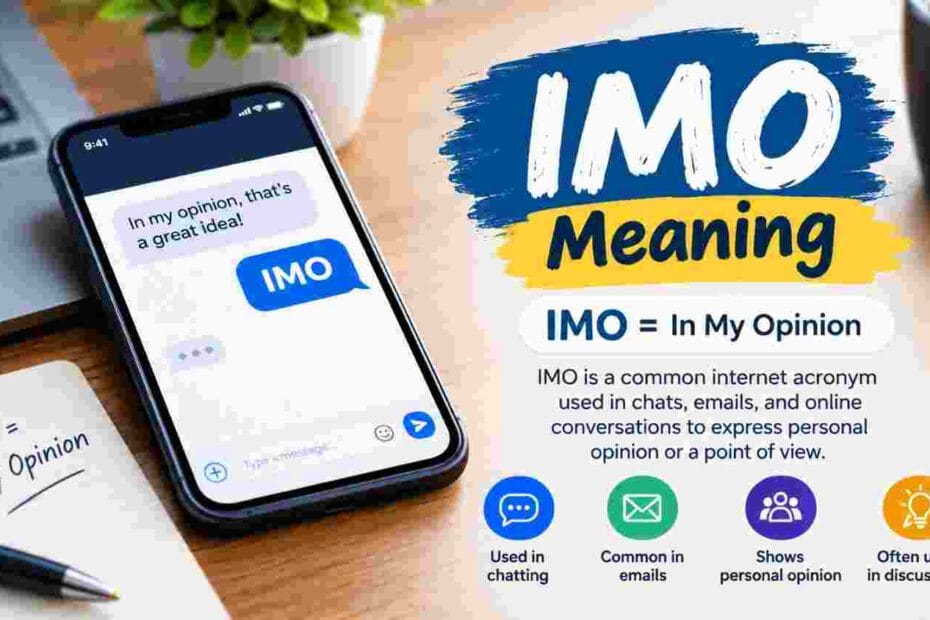
A group chat is moving fast, opinions are flying, and someone drops three small letters before making a bold statement: “IMO, that album deserved better.” If you have ever paused at that abbreviation, the IMO meaning is simple: “in my opinion.”
The term remains popular because online conversations are becoming shorter, faster, and more dependent on tone markers. From celebrity debates on X to TikTok comment sections and private Instagram messages, IMO helps people present a personal view without making it sound like an unquestionable fact.
IMO Quick Facts and Social Media Snapshot
IMO is an abbreviation, not a celebrity, company, or individual social media personality. It does not have an official account, follower total, career, or net worth, but it appears across nearly every major communication platform.
| Quick information | Details |
|---|---|
| Instagram Handle/Followers | No official handle; widely used in captions, comments, Stories, and direct messages |
| TikTok/X Handles | No official account; frequently appears in TikTok comments, video captions, X posts, and replies |
| Career Peak/Net Worth | Not applicable; IMO is an internet abbreviation |
| Key Popularity Driver | Fast communication, online debates, personal recommendations, and opinion-based content |
What Does IMO Mean?
The basic IMO meaning is “in my opinion.” People place it before or after a statement to show that they are sharing a personal judgment rather than reporting a verified fact.
For example, “IMO, the original movie was better than the sequel” means the speaker personally prefers the original. They are not claiming that every viewer, critic, or box-office analyst agrees.
The abbreviation can be written in uppercase as “IMO” or lowercase as “imo.” Capitalization rarely changes its definition, although lowercase letters can make a message feel more casual.
Is IMO an Acronym or an Initialism?
Technically, IMO is usually classified as an initialism because people pronounce its individual letters: “I-M-O.” An acronym is generally pronounced as a word, as with NASA or UNESCO.
In everyday conversation, however, many people casually call all shortened phrases acronyms. That label will not normally cause confusion, especially in informal online discussions.
Where Did IMO Come From?
IMO developed through early forms of digital communication, including internet forums, bulletin boards, chat rooms, and email groups. Users needed efficient ways to express ideas when typing was slower and messages were often expected to be brief.
Similar abbreviations became common during the same broad period. These included LOL for “laughing out loud,” BRB for “be right back,” and BTW for “by the way.”
Text messaging helped move those expressions beyond computer communities. Character limits, physical phone keypads, and rapid conversations made shortened phrases practical for everyday users.
Social platforms later brought IMO into entertainment commentary, political discussions, sports debates, product reviews, and fandom conversations. It remains useful because so much online content asks users to react immediately.
Why People Use IMO in Text Messages
Understanding the literal definition is easy. Understanding what the abbreviation does to the tone of a message requires more attention.
The IMO meaning can change the social effect of a sentence even though it does not change the subject being discussed. It may soften criticism, introduce advice, signal uncertainty, or invite other people to disagree.
It Separates Opinion From Fact
Compare these two messages:
- “That restaurant is overpriced.”
- “IMO, that restaurant is overpriced.”
The first statement sounds direct and potentially definitive. The second clearly frames the price judgment as a personal assessment.
This distinction matters when the subject is subjective. Food, films, fashion, music, celebrity performances, and travel experiences often produce different reactions from different people.
It Can Make Criticism Sound Less Aggressive
Someone might write, “IMO, the second outfit does not match the theme.” Adding IMO can reduce the force of the criticism because the writer admits that the judgment comes from an individual perspective.
That does not automatically make every comment polite. A cruel remark can still sound cruel when it begins with an abbreviation.
Tone depends on the complete sentence, the relationship between the participants, and the setting in which the message appears.
It Signals Honesty or a Strong Personal View
In some conversations, IMO works almost like “honestly” or “personally.” A person may use it before sharing a view that differs from the popular response.
Consider a fan writing, “IMO, the bonus track is the best song on the album.” The user expects that others may choose the lead single, but still wants to state a clear preference.
It Saves Time and Space
Shortened language remains useful on mobile devices. Typing three letters is faster than writing the full phrase, especially in a busy group chat or live discussion.
The abbreviation is also easy to recognize. Many users understand it instantly without needing to reread the sentence.
How to Use IMO Step by Step
The IMO meaning stays consistent across most platforms, but effective usage depends on context. These steps can help you decide whether it belongs in your message.
Step 1: Decide Whether the Statement Is Subjective
Ask whether reasonable people could hold different views. If you are discussing a favorite singer, the best episode of a show, or the attractiveness of a design, you are dealing with opinion.
IMO is suitable in each of those cases. It tells readers that you recognize the issue is open to personal interpretation.
Do not use it to disguise easily verified information. “IMO, the concert starts at 8 p.m.” is awkward if the official ticket already confirms the time.
Step 2: Place It at the Beginning or End
The most common placement is at the beginning:
Beginning placement announces the personal perspective before readers reach the claim. End placement can feel more casual, almost like an afterthought.
Step 3: Match the Capitalization to the Setting
Uppercase “IMO” is clear and conventional. Lowercase “imo” fits casual texting and can blend more naturally into a relaxed sentence.
Using lowercase does not create a separate IMO meaning. It mainly changes the visual style and perceived level of formality.
Step 4: Check the Tone Before Sending
Read the whole message, not just the abbreviation. “IMO, you have no talent” still sounds hostile because the central statement is insulting.
If your goal is constructive feedback, explain the reason behind your view. “IMO, the slower version works better because the vocals are easier to hear” offers useful context.
Step 5: Use It Selectively
You do not need IMO before every personal statement. Repeated use can make writing feel hesitant, defensive, or cluttered.
Most readers already understand that reviews, recommendations, and rankings contain subjective judgments. Use the term when the difference between personal opinion and fact needs extra emphasis.
IMO Compared With IMHO, TBH, I Think, and AFAIK
Several online expressions appear similar to IMO, but they serve different purposes. Choosing the right one can make a message more precise.
| Expression | Full form | Main purpose | Typical tone | Example |
|---|---|---|---|---|
| IMO | In my opinion | Marks a personal view | Neutral and direct | “IMO, season two was better.” |
| IMHO | In my humble opinion | Marks an opinion with added modesty | Polite, cautious, or sometimes sarcastic | “IMHO, the edit needed more time.” |
| TBH | To be honest | Introduces honesty or bluntness | Personal and candid | “TBH, I stopped watching halfway.” |
| I think | Written phrase | States a belief or judgment | Natural and conversational | “I think the first dress works better.” |
| AFAIK | As far as I know | Shows limited factual knowledge | Cautious and informational | “AFAIK, no release date has been announced.” |
| FWIW | For what it’s worth | Offers a potentially useful view | Mild and low-pressure | “FWIW, I liked the acoustic version.” |
The biggest difference between IMO and IMHO is the word “humble.” IMHO may sound more courteous, but users sometimes employ it sarcastically before a very confident or harsh statement.
TBH focuses on honesty rather than subjectivity. Someone using TBH may be admitting an unpopular preference, revealing information, or preparing to speak bluntly.
AFAIK should usually relate to knowledge rather than taste. If someone writes, “AFAIK, the actor has not confirmed the role,” the speaker is admitting that their information may be incomplete.
Is IMO Rude?
The IMO meaning is not inherently rude. In most cases, it is a neutral label that identifies a personal opinion.
Problems arise when people treat those three letters as permission to say anything. Adding IMO before an insult does not remove the insult or protect the writer from criticism.
Context also affects interpretation. Among close friends, “IMO, that haircut was a mistake” may be playful honesty. Under a stranger’s photo, the same comment can feel invasive and needlessly negative.
If a message could embarrass someone publicly, consider sending helpful feedback privately. You should also ask whether the person requested your opinion in the first place.
Common Mistakes People Make With IMO
Using It for Confirmed Facts
A factual statement does not become subjective simply because a writer adds IMO. Dates, prices, measurements, official announcements, and verified results should usually be stated with a source.
Instead of writing, “IMO, tickets go on sale Monday,” check the organizer’s announcement. Then write, “Tickets go on sale Monday, according to the official event page.”
Assuming It Makes Harsh Language Acceptable
One common mistake is treating the abbreviation as a shield. “IMO, this creator is embarrassing” still targets the person rather than evaluating the work.
More useful criticism focuses on a specific choice. You could write, “IMO, the video would be clearer with shorter transitions.”
Confusing IMO With IMHO
Both expressions introduce personal opinions, so confusing them rarely destroys the meaning of a message. Still, IMHO includes an extra note of humility, whether sincere or ironic.
IMO is usually the cleaner option when you want a direct, neutral tone. IMHO may be better when you genuinely want to sound cautious, though some readers may detect sarcasm where none was intended.
Overusing It in Professional Writing
Formal reports, academic papers, press releases, and business proposals usually need stronger language than casual internet shorthand. The phrase “in my opinion” may also be unnecessary unless the document specifically asks for personal reflection.
Use evidence-based wording instead. For example, “Customer retention improved after the redesign” is stronger than “IMO, the redesign worked.”
How Entertainment Fans Use IMO
Pop culture thrives on personal rankings. Fans compare albums, movie franchises, red-carpet looks, casting decisions, reality-show contestants, and award winners every day.
The IMO meaning is especially useful in fandom spaces because there may be no single correct answer. Sales figures and review scores can be measured, but emotional impact, artistic quality, and personal taste cannot be settled entirely by numbers.
A fan might post, “IMO, her debut era had the strongest visuals.” Another might reply, “The third album had better styling, but I understand your choice.”
That exchange shows the abbreviation working well. Both users express different views without pretending that taste is an objective rule.
Fan disputes become less productive when people attack each other or insist that popularity proves quality. IMO can signal openness, but respectful wording and a willingness to listen matter more.
Expert and Industry Views on Tone Markers
Language researchers often describe expressions such as IMO as stance markers. A stance marker tells readers how strongly a writer supports a claim or what relationship the writer has to the statement.
Digital editors and social media managers also pay close attention to these signals. A short caption must communicate personality without creating avoidable confusion, and familiar abbreviations can make a brand or creator sound conversational.
However, communication professionals generally adapt language to the audience. A youth-focused entertainment account may use IMO naturally, while a legal statement or formal corporate update would avoid it.
Fans tend to respond well when creators speak in a recognizable, human style. They respond less positively when slang appears forced, outdated, or copied without understanding how a community uses it.
When You Should Avoid IMO
Avoid the term in formal documents unless the style allows internet shorthand. Job applications, contracts, academic assignments, medical instructions, and official complaints usually require complete, precise language.
You should also avoid it when urgent clarity matters. Safety directions need direct wording, not personal framing.
Be careful when communicating with an international audience. Many English speakers know the IMO meaning, but not every reader will recognize it immediately.
Writing “in my opinion” in full is safer when the audience includes language learners or people who rarely use social media.
Frequently Asked Questions
What does IMO mean in texting?
IMO means “in my opinion” in texting. It shows that the sender is expressing a personal belief, preference, or judgment rather than an established fact.
What does “IMO” signify on Instagram and TikTok?
The IMO meaning on TikTok and Instagram is still “in my opinion.” Users commonly place it before reactions to trends, outfits, songs, celebrity news, products, and videos.
Is IMO the same as IMHO?
IMO means “in my opinion,” while IMHO means “in my humble opinion.” Both mark subjective views, but IMHO may sound more modest or, depending on context, sarcastic.
Can IMO sound rude?
IMO itself is neutral, but the sentence following it may sound rude, dismissive, or insulting. Adding the abbreviation does not excuse an unnecessary personal attack.
The Takeaway on Using IMO Naturally
The IMO meaning may be easy to learn, but using it well requires awareness of context and tone. It can distinguish opinion from fact, soften a recommendation, introduce an unpopular view, or make an online conversation feel more relaxed.
The abbreviation works best in texts, comments, captions, group chats, and casual posts. In formal or high-stakes communication, complete wording and clear evidence are usually better choices.