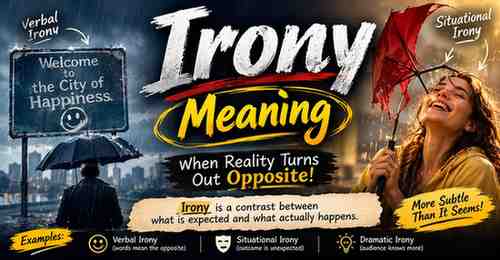
You hear “that’s ironic” tossed around, yet the real irony meaning often slips through the cracks. Mislabeling a coincidence as irony muddies communication and weakens your writing. This guide cuts through the confusion. You’ll grasp the clear definition, explore the three core types of irony with vivid examples, and learn to spot it every time.
What Is the Exact Irony Meaning?
At its core, the irony meaning centers on a gap between expectation and reality. You expect one thing to happen, but the opposite occurs — or someone says the opposite of what they truly mean. Merriam-Webster defines irony as “the use of words to express something other than and especially the opposite of the literal meaning” or “incongruity between the actual result of a sequence of events and the normal or expected result.” <sup>1</sup>
Literary scholar M.H. Abrams, in A Glossary of Literary Terms, frames irony as a device where the implied meaning stands in sharp contrast to the surface statement or situation. This contrast sparks surprise, humor, or deeper insight. Understanding the irony meaning helps you decode literature, film, and everyday conversations with greater clarity.
The Origin of the Word Irony
The word travels back to the Greek eirōneía, meaning “dissimulation” or “feigned ignorance.” Ancient Greek playwrights often used a character — the eirōn — who pretended to know less than they did to expose the arrogance of others. Over centuries, the term evolved from a rhetorical tactic into a broad literary and situational concept. Knowing this origin enriches your grasp of the irony meaning because it highlights the intentional mismatch between appearance and truth.
Why Understanding Irony Meaning Matters in Daily Communication
When you nail the irony meaning, your conversations gain precision. Instead of calling a simple twist of fate “ironic,” you can accurately label verbal irony, situational irony, or dramatic irony. This skill:
- Sharpens your critical reading of news, social media, and fiction.
- Prevents misunderstandings with friends and colleagues.
- Adds a sophisticated layer to your own storytelling.
People who master the irony meaning often notice nuances others miss, making them better communicators and more empathetic listeners.
The Three Main Types of Irony at a Glance
Literature and everyday life hand you three primary flavors of irony. Below is a quick-reference table that unpacks each one.
| Type | Simple Definition | Real‑World / Literary Example | Key Signal |
|---|---|---|---|
| Verbal Irony | Saying the opposite of what you mean | Stepping into a rainstorm and remarking, “What lovely weather we’re having.” | Tone or context clues reveal the true intent. |
| Situational Irony | An outcome that directly contradicts what was expected | A fire station burning down; a professional swimmer drowning in a shallow pool. | Events reverse the anticipated result. |
| Dramatic Irony | The audience knows something characters do not | In Romeo and Juliet, the audience knows Juliet is alive, but Romeo believes she is dead. | Tension comes from the audience’s superior knowledge. |
This table anchors the irony meaning in real instances, so you can identify each type quickly.
Verbal Irony: Saying One Thing, Meaning Another
Verbal irony unfolds when a speaker’s literal words clash with their intended message. Unlike lying, the audience usually catches the undercurrent. Sarcasm, a sharper form of verbal irony, often carries a bite — “Oh, great, another flat tire. Just what I needed.”
Writers deploy verbal irony to reveal character or inject humor. Jane Austen’s opening line in Pride and Prejudice — “It is a truth universally acknowledged, that a single man in possession of a good fortune, must be in want of a wife” — drips with verbal irony. The statement sounds factual, but Austen immediately undercuts it, exposing society’s marriage obsession. Spotting verbal irony demands attention to context, tone, and word choice, all central to the irony meaning.
Situational Irony: When Life Flips the Script
Situational irony fires when an event betrays what everyone logically expected. The outcome feels almost intentionally contrary. If a police station gets robbed, that’s situational irony. If a marriage counselor files for divorce, the twist stings with irony.
O. Henry’s short story “The Gift of the Magi” supplies a textbook case. A wife sells her long hair to buy a chain for her husband’s pocket watch. The husband, meanwhile, sells his watch to buy combs for her hair. Each sacrifice renders the other’s gift useless — a poignant, perfectly ironic loop. This story crystallizes the irony meaning far better than any abstract definition can.
Dramatic Irony: The Power of Audience Knowledge
Dramatic irony thrives when the reader or viewer holds information that the characters lack. This gap creates suspense, dread, or even comedy. Shakespeare used dramatic irony masterfully. In Macbeth, the audience knows the witches’ prophecies are twisted traps, but Macbeth barrels toward his doom in blissful misreading.
Horror films lean heavily on dramatic irony. You see the villain hiding in the closet; the protagonist, blissfully unaware, opens the door. Your heart pounds because you possess the truth. That emotional grip demonstrates why the irony meaning resonates so deeply in storytelling.
Socratic Irony: Playing Dumb to Uncover Wisdom
The philosopher Socrates famously pretended ignorance to draw out contradictions in others’ thinking. He would ask seemingly naïve questions, then reveal the flaws in his opponent’s beliefs. This method, Socratic irony, functions as a teaching tool rather than mockery. It invites critical thought and humility. Teachers, coaches, and therapists still use this form of the irony meaning to guide people toward their own insights.
Irony vs. Sarcasm, Coincidence, and Misfortune: Key Differences
Many people blur the irony meaning with related concepts. Clearing up these distinctions prevents misuse.
- Irony vs. Sarcasm: Sarcasm is a subset of verbal irony laced with intent to wound or mock. All sarcasm contains verbal irony, but not all verbal irony is sarcastic. “Nice parking job” after a flawless parallel park might be a lighthearted ironic compliment, not a sarcastic jab.
- Irony vs. Coincidence: A coincidence is two events happening simultaneously by chance. Running into your neighbor at a distant airport is a coincidence, not irony — unless you had just bragged about never bumping into anyone you know while traveling.
- Irony vs. Bad Luck: Losing your wallet is unfortunate, not ironic. If you bought an anti-theft wallet that gets stolen the first day, that’s situational irony. Irony requires a deliberate reversal of expectation, not mere bad luck.
Grasping these borders deepens your command of the irony meaning and sharpens your everyday language.
How to Identify Irony in Literature and Film
Use a simple three-step check whenever you suspect irony:
- Pinpoint the expected outcome based on the setup.
- Compare that expectation with what actually happens or is said.
- If the two oppose each other in a meaningful way, you’ve found irony.
Consider The Truman Show. The audience knows Truman’s world is a constructed TV set (dramatic irony). When Truman finally sails into the painted sky, the audience expects a wall; the scene delivers a door. The twist, both situational and dramatic, packs an emotional punch. Keeping this checklist in mind makes the irony meaning stick every time you watch a film or crack open a novel.
Using Irony Effectively in Your Own Writing
Writers who truly understand the irony meaning can wield it as a precision tool. Follow these guidelines:
- Anchor the expectation first. Give readers a clear, logical prediction before you flip it.
- Match the type to your goal. Use dramatic irony for suspense, situational irony for surprise, and verbal irony for character voice.
- Avoid overuse. A story crammed with ironic twists feels contrived. Sprinkle irony where it carries the most emotional weight.
- Test with a reader. If a peer misses the irony, your setup may need tightening.
When you place irony thoughtfully, your prose gains texture and keeps readers alert.
Common Misunderstandings About Irony Meaning (Like “Isn’t It Ironic”)
Alanis Morissette’s 1995 song “Ironic” ignited decades of debate about the irony meaning. Most of the situations she lists — rain on a wedding day, a traffic jam when you’re already late — are coincidences or annoyances, not genuine irony. Critics point out that the true irony lies in a song called “Ironic” containing almost no actual irony. This pop-culture example offers a perfect teaching moment: once you can dissect why most lines miss the mark, you’ve internalized the concept.
The Psychology Behind Why We Love Ironic Twists
Ironic moments capture our attention because they violate our brain’s predictive model. Neurocognitive research suggests that when an outcome contradicts a strong expectation, the brain registers a surprise signal that amplifies memory and emotional engagement. <sup>2</sup> That jolt explains why we laugh at a well-timed ironic remark and why a plot twist sticks with us for years. The irony meaning, therefore, isn’t just a literary label — it’s wired into how we process the world.
Irony in the Digital Age: Memes and Social Media
Online culture thrives on layered irony. Memes often layer absurd images with deadpan captions, creating a kind of visual verbal irony that only certain communities decode. A photograph of a perfectly calm dog with the caption “This is fine” while the room burns around it became a viral symbol of denial. Recognizing this type of irony helps you navigate internet humor and avoid taking posts at face value. The irony meaning evolves, but the core of expectation-flip remains constant.
Frequently Asked Questions About Irony Meaning
1. What is the simplest irony meaning I can teach a child?
Irony happens when what you expect and what really happens are total opposites. If you plan a beach day and it snows, that’s ironic.
2. How is verbal irony different from a lie?
A lie intends to deceive. Verbal irony intends to be caught — the speaker wants the listener to recognize the contrast between words and meaning.
3. Can you give a clear example of situational irony outside of books?
A sign company that misspells the word “signs” on its own storefront offers a flawless real-world case of situational irony.
4. What is dramatic irony in a popular movie?
In Jaws, the audience sees the shark prowling beneath the swimmers long before the characters do. That gap creates iconic suspense.
5. Is the song “Ironic” really ironic?
Most instances in the song are coincidences or unfortunate events. The real irony is that a song titled “Ironic” contains almost no irony, which is itself an ironic twist.
6. How can I get better at recognizing irony in everyday life?
Practice the expectation-versus-reality check. Whenever a situation surprises you, ask, “Did the exact opposite of what I reasonably expected just occur?” If yes, you’re looking at the irony meaning in action.