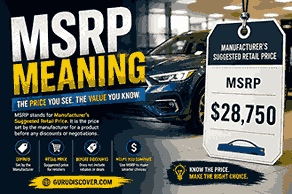
Understanding the msrp meaning turns you from a passive browser into an informed buyer. This guide strips away the jargon, shows you how that printed number comes together, and gives you a clear path to paying less. You will find exactly what steps to take before you ever set foot in a showroom.
What Exactly Does MSRP Stand For
MSRP stands for Manufacturer’s Suggested Retail Price. Car companies set this price as a recommendation for dealers. It appears on the Monroney sticker, the official window label required by federal law. The sticker breaks down the base vehicle price, factory-installed options, packages, and the destination charge.
That suggestion does not come from thin air. Automakers calculate it based on production costs, market positioning, and expected profit margins. Yet a suggested price is not a mandate. Dealerships remain free to sell above, at, or well below that figure. The msrp meaning lives in that gap between suggestion and final transaction.
Where Did the Term MSRP Originate?
The Automobile Information Disclosure Act of 1958 created the requirement for a clear price label on every new passenger vehicle sold in the United States. Before that law, buyers had almost no way to know a fair starting point. Senator Mike Monroney sponsored the bill, and the window sticker still carries his name.
This legislation gave birth to the msrp meaning consumers rely on today. The sticker must list the base price, optional equipment charges, freight costs, and the total suggested retail amount. The Federal Trade Commission enforces these rules so buyers can compare vehicles across different brands and dealerships on a level field.
MSRP vs. Invoice Price: What’s the Difference?
Dealer invoice price is what the dealership pays the manufacturer for the vehicle. The msrp meaning becomes clear when you place the two numbers side by side. MSRP sits higher on purpose; that spread creates room for profit. A car with a $35,000 sticker might carry a dealer invoice around $33,000.
That difference is not pure profit. Automakers often include holdback—a percentage of MSRP returned to the dealer after the sale—that cushions the bottom line. Knowing both numbers arms you with a realistic target. Dealers can sell below invoice and still make money once incentives and holdback flow in.
Why Is the MSRP Meaning So Important for Car Buyers?
Grasping the msrp meaning early in your shopping process saves you from anchoring to an inflated number. Anchoring happens when the first price you see shapes every thought about value. If you treat the sticker as the real cost, you start negotiations from the weakest position.
When you view MSRP as merely the opening sentence of a long conversation, your mindset shifts. You begin to see destination charges, option bundles, and market adjustments as negotiable components, not fixed lines on a receipt. That shift alone can cut your final price by hundreds or thousands of dollars.
How Do Dealerships Use MSRP in the Selling Process?
Salespeople often present the sticker as the official price. They might circle the number, tap it with a pen, and ask, “How does this payment look?” That small gesture frames the msrp meaning as the price you are supposed to pay. It is a psychological nudge, nothing more.
Dealers then layer on additional profit centers: dealer-installed accessories, fabric protection, etching, and extended warranties. These extras, often called “back-end products,” ride on top of the MSRP. Separating the suggested price from these add-ons stops you from financing charges you never wanted.
Can You Pay Below MSRP? Yes, and Here’s How
Paying under sticker is common outside of supply-constrained vehicles. Start by researching the invoice price and current market selling prices on sites like Kelley Blue Book and Edmunds. Print out that data. Contact the internet sales department of three dealerships and ask for an out-the-door price breakdown on a specific stock number.
Make the dealers compete. When one sends a quote, forward it to the next and ask if they can beat it. Keep the conversation centered on the vehicle’s selling price before trade-in or financing. This method uses the msrp meaning as a ceiling you intend to walk right through.
What Factors Influence the Final MSRP of a Vehicle?
Several concrete items build the number on the sticker:
- Base price: The manufacturer’s starting point for the trim level.
- Factory options: Upgraded audio, sunroof, performance packages.
- Destination charge: The fee to transport the vehicle from the factory to the dealer. It is non-negotiable on paper, but you can negotiate the total deal to offset it.
- Market adjustment: An extra markup added by dealers when demand outstrips supply. This line item is pure negotiation fodder.
The msrp meaning shifts when a rare model commands a market adjustment. In that case, the sticker shows the manufacturer’s suggestion plus the dealer’s premium, and you need to decide if availability is worth the surcharge.
MSRP on New Cars vs. Used Cars: Does It Still Matter?
Original MSRP holds surprising weight on the used lot. Lenders look at the original sticker when setting loan-to-value limits. A three-year-old car with a higher original MSRP can sometimes qualify for better financing terms than a newer model with a lower original sticker.
From a buyer’s perspective, the original msrp meaning helps you gauge depreciation. You can calculate what the vehicle lost in value each year and spot a used deal that sat too long on the lot. Sellers who cling to the original sticker as a reference point are ignoring market reality—use that to your advantage.
How to Find the MSRP of Any Vehicle Quickly
Pull the VIN from a listing or the windshield. Visit the manufacturer’s official website and build the same configuration. The configurator shows the current MSRP including destination. Third-party research tools like Kelley Blue Book, Edmunds, and J.D. Power also list sticker prices down to individual options.
Another way: ask the dealer for a photo of the actual Monroney label. Federal law requires its display on new vehicles. The label spells out every piece of the msrp meaning right there in black and white, giving you a checklist to verify no surprise charges appear later.
The Role of MSRP in Lease and Finance Calculations
Lease payments spin around a number called the capitalized cost. Lenders compare that cost to the vehicle’s residual value, which is a percentage of the original MSRP. A higher MSRP paired with a strong residual percentage can produce a lower monthly payment, even if the negotiated sale price stays the same.
Finance contracts also reference the MSRP when lenders decide advance amounts. The msrp meaning in a loan context is the benchmark against which loan-to-value ratios are measured. Putting enough money down to stay below a certain loan-to-value threshold can unlock better interest rates.
Common Mistakes Buyers Make When They Misunderstand MSRP Meaning
- Treating the sticker as the final price and never negotiating.
- Focusing only on the monthly payment, which hides high selling prices.
- Ignoring the destination charge and paying it without pushing back on the total deal.
- Accepting market adjustments without cross-shopping other dealers.
- Paying for dealer-installed accessories that inflate the effective price well above MSRP.
Each mistake traces back to one error: misreading the msrp meaning as a fixed sum instead of a starting point. Correct that, and you remove the dealership’s biggest advantage.
How to Negotiate Based on MSRP Without Feeling Awkward
Reframe the conversation. You are not haggling; you are solving a math problem together. Start with, “I see the MSRP is $35,000. Based on my research, invoice is around $33,200, and fair market value in this area is $33,800. I’d like to make a deal at $33,500 plus tax and title. Is that something we can do today?”
You just demonstrated that you understand the msrp meaning cold. You named concrete numbers backed by data. The salesperson recognizes you as an informed buyer who will not be swayed by emotional pleas. If they say no, you walk—quietly and politely. Another dealer will say yes.
Detailed Breakdown: MSRP Components vs. Invoice Price
| Component | Typical MSRP (Example) | Estimated Invoice | Notes |
| Base Vehicle Price | $32,000 | $30,400 | Reflects trim and powertrain. |
| Destination Charge | $1,200 | $1,200 | Same on both; non-negotiable in name only. |
| Options & Packages | $2,800 | $2,380 | Invoice is typically 10–15% below MSRP for factory options. |
| Marketing Assessment | Built into price | Varies by region | Dealer may pay a regional advertising fee. |
| Dealer Holdback | Not shown | 2–3% of MSRP | Paid back to dealer after sale; reduces true net cost. |
| Total | $36,000 | ~$33,980 (net after holdback) | Your target price lives between invoice and MSRP. |
Use this table as a negotiation map. The msrp meaning reveals itself layer by layer, and each layer is a chance to shave dollars off the final number.
Frequently Asked Questions
Does MSRP include taxes and fees?
No. The msrp meaning covers the vehicle, factory options, and destination. Sales tax, registration, title fees, and documentation charges all sit on top of that number.
Is MSRP the final price I have to pay?
Rarely. It is the manufacturer’s suggestion. Actual sale prices often fall below MSRP, except for high-demand models where market adjustments push the price above sticker.
What does MSRP mean on a car window sticker?
On the Monroney label, the msrp meaning is the total of base price, options, and destination charge. It is the number the automaker recommends as the selling price before tax and licensing.
Can MSRP change during the model year?
Yes. Manufacturers sometimes adjust MSRP mid-year due to rising material costs or feature changes. The window sticker reflects the price in effect at the time of production.
How does MSRP differ from dealer asking price?
The dealer asking price may be higher or lower than MSRP. Dealers can add market adjustments, protective coatings, or markups that push the asking price well beyond the sticker’s msrp meaning.
Why do some cars sell for over MSRP?
Limited supply and strong demand create conditions where buyers will pay a premium to secure a vehicle immediately. The msrp meaning stays printed on the sticker, but a separate addendum sheet shows the additional market adjustment.