You’ve said it. You’ve heard your yoga teacher whisper it. But do you actually know what namaste means, or have you just been nodding along this whole time?
Most people think it’s a fancy way to say “hello” or “goodbye.” That’s only half the story. There’s a deeper, almost spiritual layer hiding inside this word, and once you understand it, you’ll never say it the same casual way again.
By the end of this article, you’ll know exactly where namaste comes from, why it’s used the way it is, and how to use it correctly without sounding disrespectful or out of place.
What Does Namaste Actually Mean?
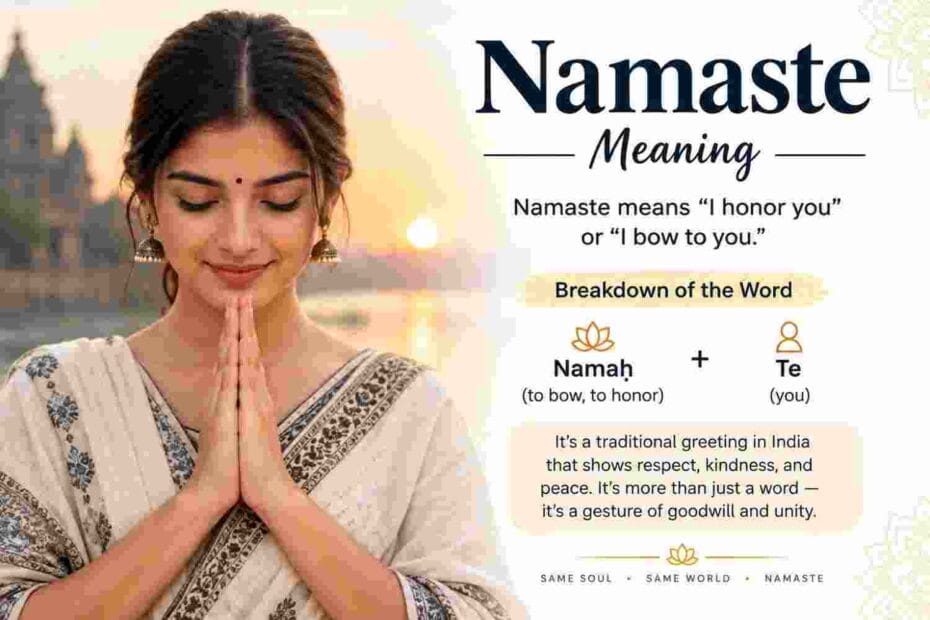
Namaste is a Sanskrit word, and like most Sanskrit words, it carries layers most translations miss. Break it down and you get “namah” (bow) and “te” (to you).
Put together, it roughly translates to “I bow to you.” But that’s the literal version, not the emotional one.
The real meaning goes something like this: the divine light in me honors the divine light in you. It’s less of a greeting and more of a small act of respect between two souls.
Why This Definition Surprises Most Westerners
Many people outside India assume namaste is purely religious. It isn’t strictly tied to one faith.
It’s cultural before it’s religious, used across Hindu, Buddhist, Jain, and even secular contexts in everyday Indian life. That’s part of why it has traveled so well across the globe.
The Origin Story Nobody Talks About
Namaste didn’t start in a yoga studio in California. Its roots trace back thousands of years to ancient India, appearing in early Sanskrit texts and Vedic traditions.
Historians believe the gesture predates the word itself. Folded hands as a sign of respect show up in ancient sculptures and temple carvings long before namaste became the go-to verbal greeting.
How It Spread Beyond India
Yoga’s global boom in the 20th century is the real reason namaste became a household word outside Asia. Western yoga teachers adopted it as a closing ritual, and pop culture ran with it.
Today you’ll find it printed on t-shirts, tattooed on wrists, and used as a caption under sunset photos. Somewhere along the way, the original depth got a little diluted.
The Hand Gesture That Comes With It
Namaste is rarely said alone. It’s almost always paired with a specific hand position called “Anjali Mudra.”
Here’s what that gesture actually involves:
- Palms pressed together at the chest, near the heart center
- Fingers pointing upward, thumbs resting gently against the chest
- A slight bow of the head, showing humility rather than superiority
- Eyes often closed or softly lowered during formal greetings
This isn’t just decorative. The hand position is believed to activate a moment of stillness, forcing both people involved to pause and actually acknowledge one another.
Why The Gesture Matters As Much As The Word
Saying namaste without the gesture is like giving a hug through text. It’s the physical form of the message. Without it, the greeting loses most of its warmth and intention.
Common Situations Where Namaste Is Used
You’ll hear this word in more places than a yoga class. Understanding the context helps you use it appropriately instead of awkwardly.
| Situation | How Namaste Is Used | Formality Level |
|---|---|---|
| Meeting elders | Sign of deep respect | High |
| Greeting strangers | Polite daily greeting | Medium |
| Yoga class closing | Gratitude and unity | Medium-High |
| Temple visits | Spiritual acknowledgment | High |
| Casual friend greeting | Rarely used this way | Low |
A quick look at the table shows something interesting. Namaste shifts meaning depending on who’s involved and where you are, which is exactly why context matters more than the literal translation.
Formal vs Casual Use
In India, namaste is often reserved for elders, guests, or formal occasions. Younger generations frequently use simpler greetings like “hi” or regional words in casual settings.
This is one reason travelers sometimes get confused. The word feels formal to locals but feels exotic and spiritual to outsiders, creating two very different emotional reactions to the same phrase.
Is Namaste Religious Or Cultural?
This is where most people get it wrong. Namaste is not a prayer, and it’s not exclusive to Hinduism.
- It appears in Hindu greetings and temple customs
- Buddhist traditions use similar gestures with slightly different intent
- Jain practitioners incorporate it into respectful daily interactions
- Secular Indian households use it simply as good manners
Think of it less like a religious chant and more like a bow in Japanese culture. It’s respectful body language first, spiritual symbolism second.
Why Yoga Studios Use It Differently
Western yoga studios often use namaste as a symbolic closing statement, implying “the light in me honors the light in you” as a unity message between teacher and students.
This usage isn’t wrong, but it is a slightly Westernized, more poetic interpretation compared to how it functions in daily Indian conversation.
Why Namaste Still Matters In A Digital World
We live in a world of quick texts, emojis, and rushed interactions. Namaste forces a rare pause.
It asks two people to stop, make eye contact, and acknowledge each other as equals for just three seconds. That tiny pause is oddly powerful in a hyper-distracted culture.
Wellness experts increasingly point to small rituals like this as tools for grounding and presence, especially in high-stress environments like offices, hospitals, and classrooms.
Frequently Asked Questions
What is the real meaning of namaste?
Namaste literally means “I bow to you,” but its deeper meaning suggests mutual respect, acknowledging the good or divine energy in another person.
Is namaste a Hindu word only?
No. While it has roots in Hindu tradition, it’s also used across Buddhist, Jain, and secular Indian contexts as a general greeting of respect.
Why do yoga instructors say namaste at the end of class?
It symbolizes gratitude and unity between teacher and students, closing the practice with a shared moment of mutual respect.
Do you say namaste when greeting or leaving?
Both. It works as a hello and a goodbye, depending on the region and situation.
Is saying “namaste” offensive to non-Indians?
Not inherently. Using it respectfully and understanding its meaning shows appreciation rather than disrespect, as long as it’s not mocked or used sarcastically.
What is the correct hand position for namaste?
Palms pressed together at chest level, fingers pointing up, paired with a slight head bow.
Does namaste have any negative connotations?
Only when it’s used mockingly or stereotypically without understanding its cultural weight, which can feel dismissive to those who use it seriously.
Final Thoughts
Namaste isn’t just a trendy yoga buzzword slapped onto tote bags and coffee mugs. It’s a small, quiet act of respect that has survived thousands of years for a reason.
Next time you say it, pause for a second. Mean it. That tiny shift in intention is exactly what separates a real namaste from an empty one.