Your friend keeps saying “SMP this, SMP that,” and you have been nodding along like you understand. Nobody has explained what it actually means, and Google gives you nothing but confusing server ads.
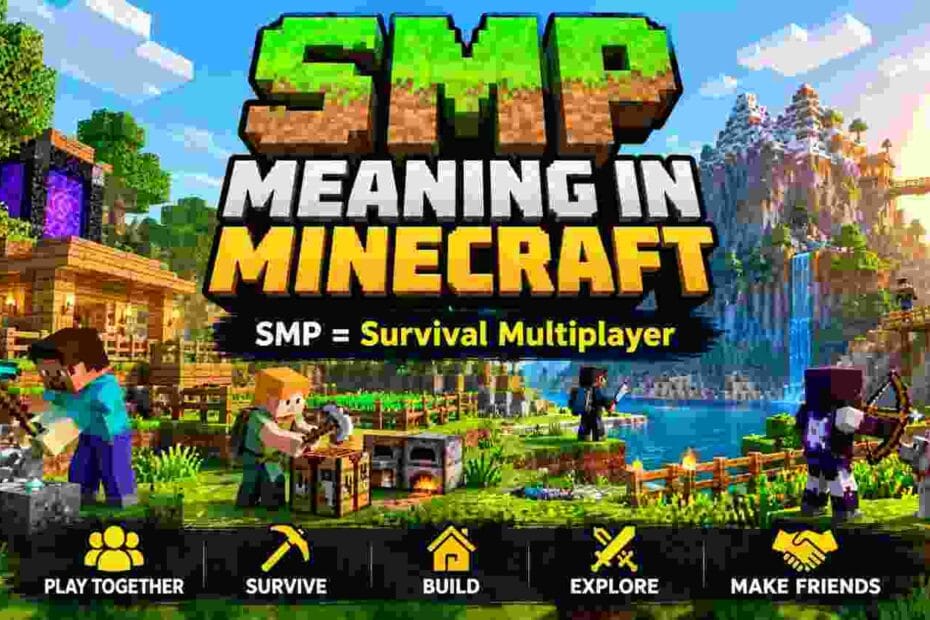
Here is the secret in one line: SMP means Survival Multiplayer, a Minecraft world where real players survive together on the same server. That sounds simple, but the real answer has layers — how SMPs work, why some servers call themselves an SMP and others don’t, and why millions of players prefer them over single-player worlds.
Stick around, and you will learn the full story behind SMP servers, the famous names that made the term legendary, and a step-by-step plan to join your first one without looking like a total noob.
What Does SMP Stand For in Minecraft?
SMP is the short form of Survival Multiplayer. Break the phrase down and it tells you everything:
- Survival means the classic gamemode: hunger, health, mining, crafting, creepers, and the constant risk of losing your stuff.
- Multiplayer means other players share the same world, in real time, on the same server.
So the SMP meaning in Minecraft boils down to one idea: normal survival rules, shared world, living community. No creative-mode flying, no admin giving everyone diamond gear, just people playing Minecraft the way it was designed — together.
A tiny twist: not every SMP stays fully vanilla. Most well-run servers add plugins for land claiming, teleporting, and shops to make life smoother. The spirit stays survival-based either way.
A Quick History Lesson: Where Did SMP Servers Come From?
Minecraft’s earliest multiplayer only allowed creative building on classic servers. True survival multiplayer only arrived with Alpha 1.0.4 in July 2010, and players went wild. Suddenly, you could raid caves, build bases, and fight each other in the same world.
Small communities started renting servers, and the label “SMP” became the community’s shorthand for a server running the survival gamemode. No official menu calls it that — players created the term, and it stuck.
Then YouTube happened. Around 2010 to 2013, channels like Mindcrack turned private survival servers into entertainment, and the format exploded. Since then, the idea of an SMP as a shared home for content creators has never slowed down.
How Does an SMP Server Actually Work?
Survival Rules With a Community Layer
The base gameplay matches your single-player world: you spawn, punch trees, build a shelter before night, and grow stronger over time. What changes is the social layer. Server owners set rules about griefing, stealing, PvP, and chat behavior, and players vote with their feet if those rules feel unfair.
The Whitelist Wall
Many SMPs use a whitelist — an approved player list. You apply, sometimes through a Discord interview, and only accepted players can log in. It sounds strict, but that small gate keeps griefers out and makes the server feel like a private club rather than a chaotic public lobby.
Plugins Running Behind the Scenes
Most modern SMPs lean on plugins or data packs for protection. Land claim systems stop strangers from breaking your builds. Economy plugins let players trade with virtual currency. Sleep plugins skip the night when one person sleeps. None of these change survival core rules, but they remove the annoyances that ruin friendships.
The Most Popular Types of SMP Servers
Not every SMP plays the same. The label covers several flavors, and knowing them helps you pick the right home:
- Vanilla SMP — pure survival with light quality-of-life plugins. Think HermitCraft: bases, redstone, shops, and long-term mega projects.
- Roleplay and lore SMP — players act out storylines with character arcs and dramatic events, like the Dream SMP era that broke Twitch records.
- Hardcore and limited-life SMP — one death or a set number of lives ends your run. Tension runs high and every creeper hiss matters.
- Economy-focused SMP — jobs, player-run shops, and currency systems turn Minecraft into a trading simulator with swords.
- Modded SMP — survival rules layered over mods like Create or tech packs, adding machines and possibilities vanilla never dreamed of.
Famous SMPs That Made the Term Legendary
A few servers deserve credit for pushing the SMP concept into mainstream gaming culture. Here is the short list every player should know:
| SMP Name | Started | Why It Became Famous |
|---|---|---|
| HermitCraft | April 2012 | A whitelisted vanilla SMP of famous YouTubers; still running after 14 years and well over 10 seasons of pure survival content |
| Dream SMP | 2020 | Scripted-style lore arcs and alliances; its January 2021 finale drew over 650,000 simultaneous viewers on TommyInnit’s stream |
| SMP Live | 2023 | The next-gen creator SMP, proving the format still draws massive audiences years later |
Read those numbers again: 650,000 people watching one Minecraft survival stream at the same time. That single event ranked among the biggest Twitch streams ever recorded at that point.
HermitCraft’s longevity tells an even deeper story. Since April 2012, its members have rebuilt the world season after season, showing that an SMP can survive years of updates, drama, and real life. That is the quiet proof that survival multiplayer, done right, never gets old.
SMP vs Anarchy vs Factions: What Is the Difference?
Beginners mix up these three labels constantly, so let’s settle it with a clean comparison:
| Feature | SMP | Anarchy Server | Factions Server |
|---|---|---|---|
| Core goal | Survive and build together | Survive with zero rules | Claim land and raid rivals |
| Griefing | Banned on most SMPs | Fully allowed | Allowed against enemies |
| PvP | Usually off or optional | Always on, no limits | On, war-driven |
| Community feel | Friendly neighborhood | Chaotic wasteland | Team vs team warfare |
| Base safety | High, thanks to claims | Near zero | Depends on your faction |
The human analysis here is simple: an SMP is the only one of the three designed for lasting progress. Anarchy servers reset your progress constantly, and factions servers make enemies of everyone. An SMP trades chaos for community, which is exactly why it fits survival gameplay so well.
How to Join Your First SMP Server (Without Embarrassing Yourself)
Joining your first SMP feels intimidating, but the process is straightforward if you follow these steps:
- Find a server that matches your style. Browse r/mcservers, server listing sites, or ask friends. Decide first: vanilla, modded, or roleplay?
- Read the rules before you apply. Most SMPs post rules on Discord. Skipping them is the fastest way to get rejected.
- Complete the application honestly. Mention your experience level. Whitelist owners prefer honest beginners over exaggerated pros.
- Get whitelisted and note the server IP. Save the IP, the version number, and any required mods before you log in.
- Spawn, then walk far before building. A base within 200 blocks of spawn gets discovered fast. Walk a few thousand blocks and claim your corner.
- Introduce yourself in chat or Discord. A friendly hello opens doors. SMPs are social places, and silent players stay outsiders.
Rookie Mistakes That Kill the SMP Experience
Even experienced players ruin their first SMP run with avoidable errors. Watch out for these traps:
- Sharing coordinates too early. Trust builds over months, not minutes. Keep your base location private until you know people.
- Ignoring the griefing rules. Some servers allow stealing, others ban it. Assuming is how you get banned or raided.
- Building right at spawn. Tourist traffic means looters, lag, and zero privacy.
- Sprinting into the nether day one. The nether has its own brutal rules; bring gear or stay home.
- Quitting after one death. Dying is part of survival. Recovery stories are half the fun of an SMP.
- Treating it like single-player. An SMP’s real content is other players. Hide away forever, and you might as well play alone.
SMP FAQs
What does SMP mean in Minecraft?
SMP stands for Survival Multiplayer. It means a multiplayer server where everyone plays by survival rules — health, hunger, mining, and crafting — inside one shared world instead of creative or minigame modes.
Is it free to join an SMP server?
Joining costs nothing extra beyond a Minecraft account. Running one, however, needs a server host, which usually costs a few dollars a month, or free options like Aternos that come with limitations and queues.
Can Bedrock players join SMP servers?
Yes, if the server enables crossplay plugins like Geyser, which let Bedrock players join Java Edition servers. Without that setup, Java and Bedrock players cannot share the same world.
What is a whitelist SMP?
A whitelist SMP is a server that only allows approved players to log in. You apply through a form or Discord, get reviewed, and receive access if accepted. This setup creates safer, tighter communities.
Is griefing allowed on SMP servers?
It depends on each server’s rules. Most classic SMPs ban griefing and use land claim plugins to protect builds, while a few “anything goes” SMPs allow it. Always read the rules before trusting anyone with your base.
Can I start my own SMP server?
Absolutely. Start a world with friends on a hosted server, set clear rules early, and add claim plugins when the group grows. Small SMPs of five to twenty players often deliver the best experiences.
Final Thoughts: Time to Find Your People
The SMP meaning in Minecraft is easy to memorize, but the real value lives in the experience: shared bases, community builds, in-game economies, and the friendships that survive server wipes. Minecraft becomes a different game when every mountain you climb has someone else’s name on it.
Insider tip before you go: skip the giant public servers and hunt for a small whitelist SMP of ten to thirty active players. The biggest servers feel like busy lobbies, but a small tight-knit group gives you the true survival multiplayer magic. Pick a server, say hello, and start punching trees with new friends tonight.