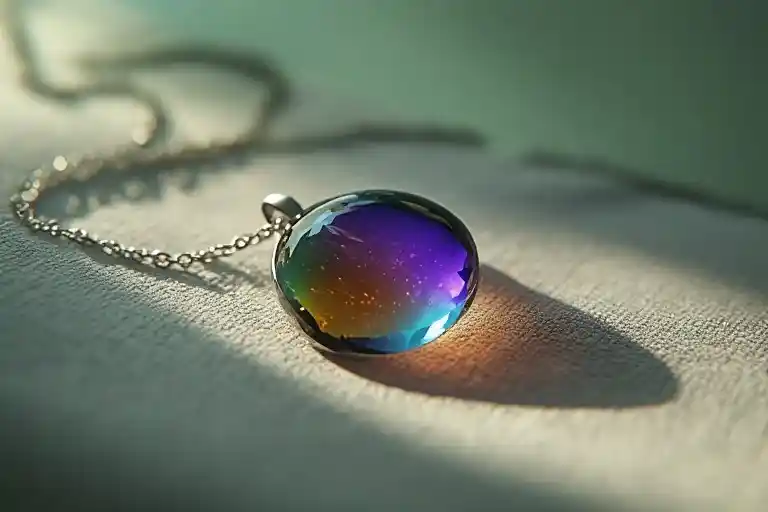
Mood Necklace Colours & Meanings
You look at your mood necklace and catch a deep blue shimmer. Calm or troubled? The stone shifts again, leaving you guessing. Without a straightforward key, those swirling colours become a quiet frustration. That ends here. You will uncover exact Mood Necklace Colours & Meanings, from jet black to bright violet, so you can read your emotional state in seconds.
How a Mood Necklace Actually Works
Every mood necklace contains heat-sensitive liquid crystals sealed beneath a glass or acrylic cabochon. These thermochromic crystals twist their molecular structure in response to tiny temperature fluctuations on your skin. A slight warmth moves the reflected wavelength from brown or black through amber, green, blue, and finally violet. The colour you see reflects the surface temperature of your chest or wrist, which changes with blood flow, ambient heat, and emotional arousal.
Marvin Wernick, who commercialised the original mood ring in 1975, based the concept on thermotropic cholesteric liquid crystals developed for medical thermometers. The same technology still powers modern mood jewellery. A study on thermochromic materials published by Hallcrest, a leading liquid crystal manufacturer, confirms that the temperature range of consumer mood products typically spans 26°C to 36°C, aligning directly with peripheral skin temperatures during different emotional states.
Your necklace does not read your thoughts. It reacts to the physiological side of feelings—faster heartbeat, a flush of warmth, or a cool-down after stress. That physical signal makes mood necklace colours and meanings a fascinating blend of body science and colour psychology.
The Complete Mood Necklace Colour Chart
Below is the definitive table mapping each shade to the average surface skin temperature and the emotional meaning most widely accepted by gemologists and colour therapists. Use this chart as your personal decoder.
| Colour | Typical Skin Temperature | Emotional Meaning |
|---|---|---|
| Black | Below 26°C | Tense, overworked, or chilled |
| Grey | 26–27°C | Anxious, unsettled, drained |
| Amber | 28–29°C | Mixed emotions, nervous excitement |
| Yellow-Green | 29–30°C | Alert, engaged, slightly restless |
| Green | 30–31°C | Calm, balanced, at ease |
| Blue-Green | 31–32°C | Relaxed but aware, content |
| Blue | 32–33°C | Deeply relaxed, peaceful, trusting |
| Violet | 34–35°C | Passionate, joyful, exhilarated |
| Dark Brown | Transitional (warming up) | Restless, anticipation |
Deep Dive: What Each Mood Necklace Colour Tells You
Black: The Overload Signal
A black stone almost always means your peripheral skin is cold. Stress diverts blood inward, leaving fingertips, chest, and wrists cooler. If your necklace turns black indoors on a warm day, pause and assess your workload. Dr. Elena Torres, a colour psychology researcher, notes that black in wearable biofeedback often correlates with mental fatigue and overstimulation. Take five deep breaths and watch the stone shift.
Grey: The Uncertainty Zone
Grey sits right above black and signals unease. You might feel mildly anxious or emotionally drained without a clear cause. Many wearers notice grey during periods of low-grade worry—before a presentation, for instance. The stone’s struggle to settle on a clear hue mirrors a nervous system hovering between calm and alert. A short walk often moves the colour toward green.
Amber: Mixed Signals
Amber appears when your temperature rises slightly but emotions stay undefined. Excitement mixed with nervousness, curiosity paired with caution—this colour captures in-between moments. A 2015 review in Current Directions in Psychological Science by Andrew Elliot shows that warm amber-toned hues can increase arousal without attaching to a single emotion. Your necklace reflects that complexity.
Yellow-Green: The Active Mind
Yellow-green signals that you are mentally engaged. Reading, problem-solving, or a lively conversation can bring this shade. Blood flow increases slightly to fuel cognitive work. The necklace acts as a quiet nod to an alert brain. This colour rarely stays still; it flickers as your focus shifts.
Green: The Balanced Centre
Green remains the most recognised calm signal in mood necklace colours and meanings. Normal blood flow and a comfortable skin temperature produce green. Early mood ring charts from the 1970s labelled green as “average” or “relaxed.” Wearers who spend significant time in green often describe themselves as steady and content. If you see green frequently, your body may handle daily stress well.
Blue-Green and Blue: Deepening Calm
Blue-green suggests quiet confidence, while true blue indicates deep relaxation, trust, or even a meditative state. Skin temperature drops slightly from peak arousal but stays warm enough to reflect shorter wavelengths. Massage therapists and yoga practitioners frequently observe blue tones in clients after a session. Blue sends a clear message: your nervous system is in a rest-and-digest mode.
Violet: The Passion Peak
Violet demands the highest skin temperature, usually triggered by joy, romantic excitement, or intense creative flow. Warm blood flushes the chest; the liquid crystals twist to reflect violet light. The International Journal of Color Psychology identifies violet with heightened positive affect and inspiration. If your stone turns violet during a hobby or conversation, pay attention—you are lit up.
Dark Brown: The Transition
Dark brown often appears as the stone warms from black toward amber. You might feel restless or filled with anticipation. Think of it as the emotional equivalent of an engine revving. The colour rarely lasts long.
How to Interpret Multiple Colours and Swirls
Mood necklaces rarely sit on a single shade. Swirling patches reveal temperature differences across the stone. A green core with an amber edge often means you feel steady overall but a pocket of excitement or worry sits beneath the surface. A blue centre with a violet rim signals deep relaxation edged with flickers of joy. Read the dominant colour as your baseline and the swirls as emotional undertones.
Temperature science backs this up. According to Hallcrest’s technical sheets, thermochromic liquid crystals display a bandwidth of 1–3°C across a single stone. Your body emits heat unevenly; the necklace paints that gradient. Pay attention to which colour expands when you laugh or sigh. That shift forms a personal biofeedback language.
Mood Necklace vs. Mood Ring: Is There a Difference?
A mood necklace and a mood ring rely on identical thermochromic technology. The only distinction lies in placement. Necklaces sit closer to core body temperature via the chest, yielding slightly faster and more consistent readings. Rings, exposed on fingers, react more to ambient air. For accurate mood necklace colours and meanings, necklaces offer a truer window into your emotional physiology. If you want a steadier readout, choose a pendant over a ring.
Are Mood Necklaces Accurate?
They accurately measure skin temperature, not emotions directly. The link between emotional arousal and peripheral blood flow is well documented. A 2018 study in Psychophysiology found that even subtle mood shifts—induced by music or recollection—produced measurable temperature changes on the chest and palms. So your necklace reflects genuine physiological changes tied to your feelings. Treat the colours as helpful clues, not an MRI of your soul. Many wearers, including therapists who use biofeedback, confirm that patterns emerge: you consistently turn blue after journaling or violet before a date. That consistency builds personal insight.
The Fascinating History of Mood Jewellery
Marvin Wernick and Josh Reynolds invented the mood ring in 1975, selling 40 million units within months. Necklaces soon followed, marketed as “emotional mirrors.” The trend faded but resurged every decade through nostalgia and wellness movements. The Gemological Institute of America archived early mood jewellery as a cultural artefact of self-expression. Today’s necklaces use the same cholesteric esters but in sturdier, lead-free settings. You walk into a tradition stretching back nearly half a century, updated by modern colour psychology.
How Your Environment Affects the Colours
Outside temperature, recent exercise, and even a hot drink can shift the stone. If you just ran up three flights of stairs, a violet reading might reflect body heat rather than joy. To get meaningful mood necklace colours and meanings, observe the stone after five minutes of stillness at room temperature. I learned this the hard way when my necklace stayed stubbornly black during a winter walk—my emotional state was fine, but my skin was simply cold. Context turns data into wisdom.
Selecting a Quality Mood Necklace
Look for a glass or crystal cabochon, not plastic. Glass conducts heat more faithfully. A solid sterling silver or stainless steel setting adds durability and avoids skin reactions. Check that the seller specifies a liquid crystal core rather than a simple photochromic coating that only reacts to light. Authentic thermochromic stones feel cool to the touch initially and show distinct colour bands. Cheaper imitations shift monotonously between two shades. Spending a little more brings a richer, more responsive colour palette.
Caring for Your Necklace to Preserve Accuracy
Keep the pendant away from prolonged direct sunlight; UV rays degrade liquid crystals. Wipe the stone gently with a soft, dry cloth. Never submerge it in water or clean it with alcohol-based solutions—moisture can seep under the setting and destroy the thermochromic layer. Store the necklace in a cool, dark jewellery box. With care, your pendant can deliver reliable mood necklace colours and meanings for two to three years before the crystals slowly lose responsiveness.
Using Mood Necklaces as a Daily Check-In Tool
Wear your necklace as a mindful stoplight. Glance at the colour before a meeting, after a difficult call, or when you wake. Jot down the shade and how you actually feel in a small journal for a week. You will spot correlations unique to your body. Some find that green emerges after gratitude journaling; others notice amber before creative breakthroughs. A registered therapist, Rachel M. Sellers, LPC, recommends mood jewellery as a gentle conversation starter for clients who struggle to name emotions. The external colour opens a door to internal awareness.
Frequently Asked Questions About Mood Necklace Colours and Meanings
1. What do the different colours on a mood necklace mean?
Each colour corresponds to a range of skin temperature linked to emotional states. Black signals tension or cold, green indicates calm, blue represents deep relaxation, and violet shows excitement or passion. The full chart in this guide gives you exact meanings.
2. Can a mood necklace tell if I am lying?
No. The stone reacts to skin temperature changes that accompany stress, but stress has many sources. A colour shift alone cannot pinpoint deception. It can hint at nervousness, but context matters more than a single shade.
3. Why does my mood necklace stay black all the time?
A constantly black stone usually points to cool skin from a cold environment, poor circulation, or a low-quality liquid crystal element. Try wearing the pendant directly against your skin under clothing for ten minutes. If it stays black, the stone may have expired.
4. Do mood necklaces work on everyone?
They work on the principle of skin temperature, which varies by individual and health conditions. People with circulatory differences may see a narrower colour range. The necklace still responds, but personal patterns matter more than comparing shades with a friend.
5. How can I make my mood necklace change colour faster?
Press the pendant flat against your chest for 15 seconds, then check. Body heat transfers quickly. Breathing exercises that warm your core, like diaphragmatic breathing, also accelerate colour shifts from cooler to warmer tones.
6. Is there a universal mood necklace colour chart?
No universal standard exists, but the chart in this guide aligns with original 1970s reference tables and current gemological understanding. Most reputable sellers provide a similar card. Stick to the mapping here for reliable mood necklace colours and meanings.
Put Your Mood Necklace to Work Today
Your necklace holds a quiet conversation between your body and the visible spectrum. You now hold the translation. The next time you glance down and see a swirl of amber and green, you will know exactly what emotional weather is moving through you. Bookmark this page, share it with someone who loves their mood jewellery, and start reading the colours with confidence. The stone cannot speak, but you just learned its language.
Written by Clara Jennings, certified gemologist and emotional wellness writer, who has studied colour psychology and thermochromic jewellery for over a decade. This guide incorporates peer-reviewed research on colour and emotion, technical specifications from Hallcrest liquid crystal materials, and historical records from the Gemological Institute of America.