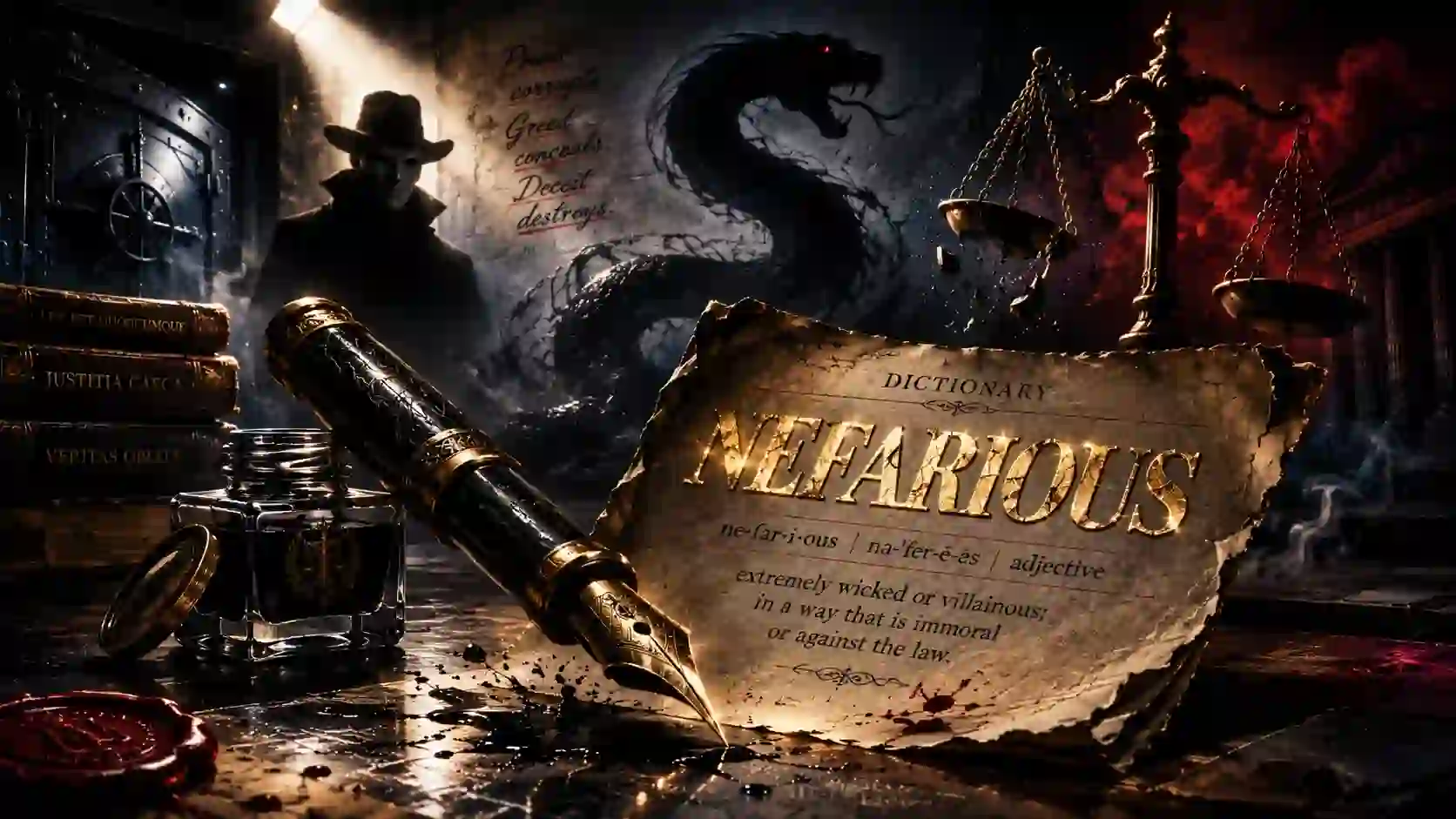
Have you ever stumbled over the word “nefarious” and questioned its exact meaning? When you misuse such a powerful term, it can undermine your work and diminish your credibility. Mastering its precise definition sharpens your communication. This expert guide unpacks the true nefarious meaning—its roots, nuances, and real-world power—so you can use it with absolute confidence.
The Core Meaning of Nefarious
“Nefarious” describes an action, plan, or person so wicked that it shocks the conscience. Standard dictionaries define the word as “flagrantly wicked or impious.” When you grasp the nefarious meaning, you see it always carries a weight of deliberate, extreme moral corruption. It doesn’t describe a petty lie or a minor mistake. It signals a deed that crosses the line into outright villainy. A nefarious act strips away any ambiguity—what remains is clear, unmistakable evil.
The nefarious meaning lives in the realm of notorious criminals, corrupt schemes, and dark plots. People rarely use it for everyday offenses. If a teenager steals a candy bar, you wouldn’t call that nefarious. But a corporate executive who drains pension funds to buy a yacht commits a nefarious act. The word carries a dramatic, almost theatrical darkness that fits grand-scale wrongdoing.
Tracing the Word’s Origins
The word “nefarious” comes from the Latin nefarius, which breaks down into *ne-* (not) and fas (divine law or right). Literally, it meant “contrary to divine law.” Ancient Romans used nefarius to condemn actions that violated sacred order. This root gives the nefarious meaning a unique depth—it originally connected to something spiritually lawless, not just legally wrong. The Online Etymology Dictionary traces its English adoption to the 1590s, when it entered the language with the same intense moral charge.
Understanding this origin helps separate nefarious from everyday badness. A nefarious deed insults not only human laws but also fundamental moral principles. Over time, the religious layer softened in common use, but the word never lost its thunder. Today, it still implies a violation of deeply held ethics.
Nefarious vs. Evil, Wicked, and Malicious: Subtle Differences
Many words overlap with nefarious, but each carries a distinct shade. Knowing the difference sharpens your writing.
- Evil: A broad term for profound immorality. Nefarious narrows that focus to actions that actively subvert what is right.
- Wicked: Suggests a mischievous or malevolent character. A wicked joke can be darkly funny; a nefarious joke doesn’t exist because nefarious never plays.
- Malicious: Centers on the intent to harm. Nefarious includes intent but requires a grand, almost spectacular level of wrongdoing.
When you need a word that combines scandalous evil with a hint of the forbidden and the monumental, nefarious fits perfectly.
How to Use “Nefarious” Correctly in Modern English
Writers often weaken “nefarious” by applying it to minor faults. Reserve it for acts that genuinely stun the moral sense. You’ll strengthen your prose by following three simple rules.
- Match the scale of the offense. Use nefarious for large-scale fraud, violent plots, or systemic corruption—not for someone who cuts in line.
- Pair it with concrete nouns. Common collocations include “nefarious scheme,” “nefarious activity,” “nefarious plot,” and “nefarious intent.”
- Let the word stand alone. Avoid adding “very” or “extremely.” The nefarious meaning already contains maximum intensity; intensifiers weaken it.
Active voice examples:
- The hacker launched a nefarious attack on the hospital’s network.
- She uncovered a nefarious plot to rig the election.
- His nefarious business dealings finally caught up with him.
Notice how each sentence puts the wrongdoer front and center. That active construction mirrors the word’s confrontational energy.
Synonyms and Antonyms to Sharpen Your Vocabulary
Expanding your word choices around nefarious helps you express subtle differences in tone and severity. Use the table below as a quick reference.
| Synonyms (nefarious) | Meaning | Antonyms | Meaning |
|---|---|---|---|
| Heinous | Utterly odious or wicked | Righteous | Morally upright |
| Villainous | Behaving like a villain | Virtuous | Having high moral standards |
| Diabolical | Devilishly clever and wicked | Noble | Possessing high moral qualities |
| Iniquitous | Grossly unfair and immoral | Honorable | Deserving honor and respect |
| Flagitious | Shockingly criminal (archaic) | Commendable | Deserving praise |
Whenever you encounter a word like “evil” and feel it doesn’t quite carry the weight, consult this list and pick the exact synonym that matches your meaning.
Nefarious in Classic Literature: Villains and Betrayals
Great authors deploy the nefarious meaning to signal characters whose villainy defines the story. Shakespeare’s Iago from Othello executes a nefarious manipulation that destroys lives purely for his own gain. Iago’s schemes go beyond simple revenge; they revel in destroying innocence. Mary Shelley’s Victor Frankenstein might not be nefarious himself, but his reckless ambition unleashes consequences that feel cosmically nefarious in their reach.
Bram Stoker’s Count Dracula embodies the original Latin sense—acting against divine law by corrupting souls. These literary examples show that the word works best when the evil feels deliberate, total, and almost supernatural in its proportions.
Nefarious Characters in Film and Television
Modern screenwriters understand the shock value of the nefarious meaning. When a character receives that label, audiences immediately know the stakes are life-and-death. Darth Vader’s galaxy-spanning cruelty, Lord Voldemort’s soul-splitting murders, and the Joker’s chaotic destruction all define nefarious antagonists. They don’t just break the law—they annihilate the idea that safety or goodness can last.
Anti-heroes complicate the picture. Walter White from Breaking Bad descends into nefarious choices, yet viewers wrestle with his justifications. The tension between his original good intentions and his nefarious actions makes the word feel earned, never cheap.
The Dark Psychology Behind Nefarious Behavior
Psychology helps decode why some people pursue nefarious paths. Researchers often point to the Dark Triad of personality traits: narcissism, Machiavellianism, and psychopathy. A person high in Machiavellianism treats others as pawns in a cold, calculating game—exactly the mindset behind many nefarious schemes. Psychopathy adds a lack of empathy, making it easy to commit nefarious acts without remorse.
The American Psychological Association notes that such traits exist on a spectrum. Not everyone with elevated narcissism becomes a criminal, but extreme expressions fuel corporate fraud, cult leadership, and serial offenses. Understanding these roots demystifies the nefarious meaning. It isn’t always a theatrical villain; sometimes it’s a calculated, remorseless mind in ordinary clothing.
Nefarious Schemes in Business and Law
Corporate history furnishes stark examples of the nefarious meaning applied to real-world greed. The Enron scandal involved deliberate accounting fraud that vaporized employee pensions while executives cashed out. That wasn’t mere mismanagement—it was a nefarious orchestration of deception. Bernie Madoff’s Ponzi scheme, which robbed thousands of their life savings, stands as another textbook case.
Legal systems respond with heavy penalties for such acts, but the damage often outruns the punishment. Words matter in courtrooms and journalism. Calling an act “nefarious” in a legal brief or investigative report tells the public that the offense goes far beyond simple illegality. It brands the conduct as morally bankrupt.
Nefarious Activities in the Digital World
The digital realm has created fresh ground for nefarious activity. Cybercriminals launch ransomware attacks that lock hospitals out of life-saving systems. Phishing scams steal identities and drain bank accounts. Coordinated disinformation campaigns manipulate elections. Each of these qualifies as a nefarious attack because it exploits trust at a massive, often invisible scale.
The Cybersecurity & Infrastructure Security Agency’s 2023 report noted an increase in malicious cyber campaigns aimed at vital infrastructure. Unlike street crime, digital nefarious actions can harm millions in seconds. The word fits perfectly because it captures both the wicked intent and the staggering reach.
How to Protect Yourself from Nefarious Intent
Recognizing nefarious intent before it harms you is a vital modern skill. Build your defenses with these practical steps.
- Question too-good-to-be-true offers. Financial scams often start with promises of guaranteed high returns.
- Verify identities. Never share personal data with unverified callers or emailers.
- Strengthen digital security. Use unique passwords and multi-factor authentication.
- Trust your instincts. If a situation feels manipulative or coercive, step back and seek a second opinion.
Teaching yourself and your family to spot these red flags transforms the nefarious meaning from an abstract definition into a real-world shield.
Frequently Asked Questions About Nefarious Meaning
What is the nefarious meaning in simple terms?
The nefarious meaning centers on extremely wicked or criminal behavior. If an act is nefarious, it’s not just bad—it’s shockingly evil and often involves a deliberate plan to harm others or break moral law.
Can a person be described as nefarious?
Yes. When a person’s character regularly results in heinous, destructive deeds, you can label them as nefarious. A nefarious individual doesn’t just make mistakes; they orchestrate harm on a large or deeply cruel scale.
How does nefarious differ from malicious?
Malicious emphasizes the desire to cause pain. Nefarious goes further, combining that desire with a kind of spectacular or law-defying wickedness. All nefarious acts are malicious, but not all malicious acts rise to the nefarious level.
What is an example of a nefarious act?
A CEO knowingly selling toxic baby formula to maximize profits commits a nefarious act. The deed shows extreme moral corruption and a deliberate disregard for innocent life.
Is nefarious a strong or mild word?
It’s one of the strongest moral condemnation words in English. Use it only for acts that truly deserve that weight. Overuse dilutes its power.
Where does the word nefarious come from?
It derives from the Latin nefarius, meaning “wicked” or “contrary to divine law,” combining *ne-* (not) and fas (divine law). This origin explains its intense moral gravity.
Now you hold the full nefarious meaning—its history, its psychological roots, and its precise place in your vocabulary. Use it deliberately. When you label something nefarious, you raise the stakes of any conversation or piece of writing. Save it for the moments that truly deserve its thunder.
If this guide sharpened your word choice, bookmark it for future reference and share it with a writer friend who values precision. Drop a comment below with a nefarious character or real-world event that stuck with you—we learn best through shared stories.
Sources: Merriam-Webster, Online Etymology Dictionary, American Psychological Association (Dark Triad research), CISA 2023 advisory.